


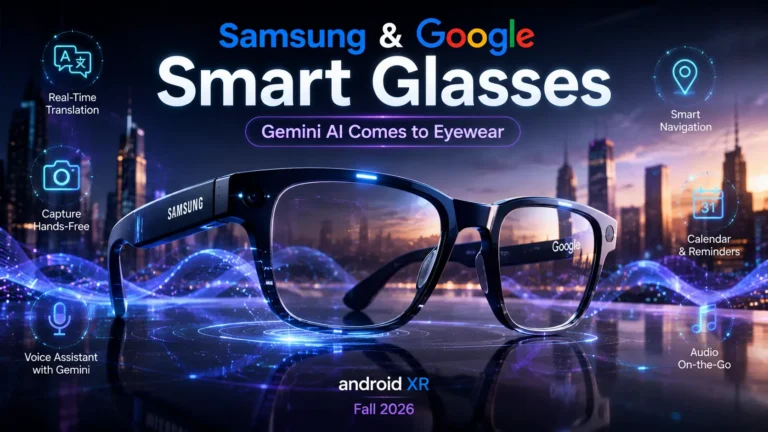
The smart glasses race just got a lot more interesting. Samsung and Google have officially unveiled Gemini-powered smart glasses at Google I/O 2026. Samsung and Google are challenging Meta’s Ray-Ban glasses with stylish AI-powered eyewear arriving in fall 2026. The new Gemini smart glasses feature voice controls, live translations, photo capture, and support for Android and iPhone users.
At Google I/O 2026, Samsung and Google officially pulled back the curtain on their jointly developed smart glasses — the first consumer product to emerge from their Android XR collaboration. The announcement confirmed a fall 2026 launch in select markets and revealed compatibility with both Android phones and iPhones, a cross-platform decision that immediately sets this product apart from much of the competition.
This has been in the works for a while. Google announced a partnership with Samsung to create a new line of smart glasses with help from traditional eyewear makers Warby Parker and Gentle Monster last year, and Google I/O 2026 finally gave a clearer picture of what those glasses will look like when they go on sale later this year.
What Can These Glasses Actually Do?
This first generation of glasses will be audio-only with no built-in displays, relying on onboard speakers, voice controls, and cameras to perform tasks and interact with Gemini and other apps. Think of them less like a screen you wear on your face and more like a hands-free AI assistant that happens to sit on your nose.
The feature set is genuinely useful for everyday life. Users can access navigation assistance by simply asking Gemini with their voices, receive personalised suggestions such as a nearby coffee shop on their walking route, or even place an order for pickup. Users can also receive summarised notifications for important texts and add events to their calendars.

The translation feature is arguably the most impressive. Additional features include real-time translations with audio that matches the speaker’s voice, as well as the ability to translate text on menus or signs in the user’s line of sight. For anyone who travels frequently or works in multilingual environments, that alone makes these glasses worth serious consideration.
Working seamlessly within the Galaxy ecosystem, the device helps users easily manage everyday tasks or effortlessly capture photos, all without taking their phone out.
Two Designs — One Classic, One Bold
One of the smarter decisions Google and Samsung made here was not designing the frames themselves. The two models feature very different designs, with Gentle Monster’s pair evoking “disruptive yet refined aesthetics” while Warby Parker’s frame showcases a more traditional silhouette.
Google is committing up to $150 million as part of the Warby Parker deal, which gives a clear indication of how seriously the company is taking this project. These aren’t throwaway accessories — they’re meant to sit alongside established eyewear labels and actually look good on people’s faces.
The two-designer approach is deliberate. Different people want different aesthetics, and forcing everyone into one frame style was one of the things that made the original Google Glass feel exclusionary. A bold fashion-forward option from Gentle Monster and a clean everyday option from Warby Parker covers a much wider range of buyers.
Why This Is Different from the Original Google Glass
Google’s history with smart glasses isn’t exactly glowing. Google’s original Glass product, launched in 2013, was pulled from the consumer market within two years after becoming a symbol of privacy overreach and social friction.
The approach this time is structurally different. Google confirmed the two devices will be available in stores this fall, becoming the first Android XR intelligent eyewear designs that will allow users to interact with Gemini AI without taking out their phones. The focus is on usefulness in daily life, not on showing off technology for its own sake.
It’s unlikely these devices will be as expensive as the original Google Glass, which retailed for around $1,500 when it was available. Pricing and detailed specs haven’t been announced yet, but the intent is clearly to make these accessible to a broad consumer audience rather than positioning them as a luxury tech item.
Also Read: ChatGPT Younger Self Photo Trend Is Turning Old Memories Into Viral AI Art
Taking On Meta Directly
The reveal arrives as Meta holds roughly 76 per cent of the global smart glasses market after selling more than seven million pairs of its Ray-Ban glasses in 2025 alone. That’s the mountain Samsung and Google need to climb, and they know it.
The Gemini integration gives them a potentially significant advantage. Meta’s AI features are solid, but Google’s AI infrastructure — search, maps, real-time translation, calendar, and the broader Android ecosystem — is deeply embedded in how people actually live their daily lives. If the glasses execute on that integration smoothly, they could offer a meaningfully better experience for Android users specifically.
The iOS compatibility announcement is also smart — it removes the “Android only” barrier that might have kept a large chunk of potential buyers away.
Pricing and exact availability details are still to come. But the fall 2026 window is confirmed, the features are real, and the competition in the smart glasses space just got significantly more interesting.