



Most IPL profiles start with a player’s domestic debut or their first big innings. With Raj Angad Bawa, you have to start one generation back.
His grandfather, Tarlochan Bawa, was part of the Indian hockey team that won the Olympic gold medal at the 1948 London Games. That team is part of Indian sporting folklore — the post-independence era when India dominated world hockey in a way that felt almost supernatural. To come from that lineage, to grow up with that history in your household, is to understand from a very young age that representing India at the highest level is something real and achievable and worth chasing.
Whether that pressure is a weight or a motivation probably varies depending on the day. But it’s part of who Raj Angad Bawa is, and it’s worth knowing before you start looking at his cricket numbers.
Who Is Raj Angad Bawa?
Bawa was born on November 12, 2002, in Nahan, Himachal Pradesh, but grew up in Chandigarh — which, as anyone who follows Indian cricket knows, has produced a disproportionate amount of talent relative to its size. Something about the city’s culture around sport in general and cricket specifically tends to produce players with a certain confidence and directness to their game.
He came through the age-group system representing Chandigarh, steadily building a reputation as an all-rounder with the rare ability to genuinely contribute with both bat and ball rather than being primarily one thing and slightly useful at the other.
His Ranji Trophy debut is worth mentioning specifically because of how it started: he took a wicket with his very first ball in first-class cricket. That’s not a common beginning, and it suggests something about the kind of player he is — someone who arrives at a new level and immediately competes rather than spending time getting comfortable.
The U-19 World Cup Performance That Changed Everything
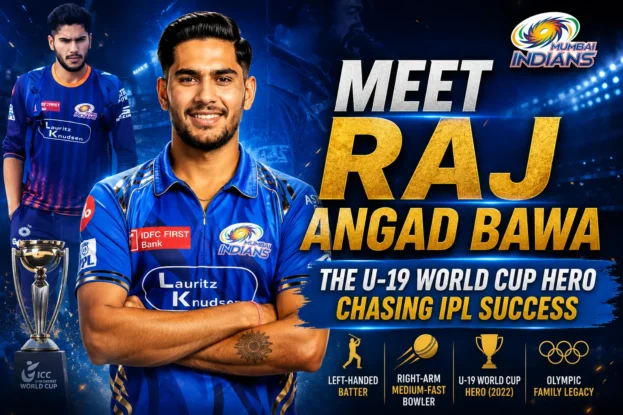
The 2022 ICC Under-19 Cricket World Cup is where most of India first properly noticed Raj Angad Bawa, and the tournament gave him two moments that people are still talking about.
The first was an unbeaten 162 against Uganda — the highest score ever made by an Indian player in the history of the Under-19 World Cup. That innings alone would have been enough to get him attention. But the second moment was in the final against England, and that’s the one that defined him.
In a knockout final, with India needing someone to step up with both bat and ball, Bawa took five wickets and scored important runs. He won the Player of the Match award in the game that gave India the trophy. That’s the kind of all-round performance that announces a player completely — not just “this kid can bat” or “this kid can bowl” but “this kid can determine the outcome of a game when everything is on the line.”
He was 19 years old.
The IPL Path Hasn’t Been Straightforward
Punjab Kings picked him up for ₹2 crore in the IPL 2022 auction — reasonable money for a young talent fresh off a World Cup performance — and gave him time in the setup. But opportunities were limited, and the kind of consistent run that developing all-rounders need to actually develop didn’t really come.
This is one of the genuine tensions in the IPL ecosystem. Young players need matches to grow, but IPL squads are built around winning now, which means experienced players tend to get the nod in pressure situations. Waiting for your chance while watching from the dugout is a test of character that doesn’t show up in any statistics.
Mumbai Indians picked him up for ₹30 lakh ahead of IPL 2025 — base price, low-risk — which on the surface looks like a step down from his Punjab Kings valuation. But the more relevant context is where. Mumbai Indians have a specific track record of developing young Indian all-rounders within a system that’s been built around patience and process rather than immediate results. For Bawa’s stage of development, that environment probably matters more than the auction price.
What Kind of Player Is He?
Left-handed batsman, right-arm medium-fast bowler, sharp fielder. On paper, exactly the profile that every T20 franchise wants in their squad — someone who can bat in the top six and bowl four overs without being a liability.
In practice, his batting is built around elegant driving and powerful pull shots. He’s not a batter who relies exclusively on one mode — he can play proper cricket shots in the middle overs and clear the boundary in the death. The left-handedness also creates problems for bowlers who’ve set field positions for right-handers, which is an underrated tactical advantage.
With the ball, he uses hard lengths, cutters, and variations rather than pace alone. He can move the ball slightly, which gives him options beyond just hitting the pitch hard. In T20 cricket, variety with the ball in the death overs is worth more than raw pace, and Bawa seems to understand that.
Why Mumbai Indians Are the Right Fit
Mumbai Indians are not a franchise that rushes young players. Their history — Hardik Pandya, Kieron Pollard before him, the whole culture around developing multi-format all-rounders — suggests a specific philosophy about how talent like Bawa’s needs to be nurtured.
He might not be in the playing XI every match. He might have games where he contributes with one skill but not the other. The franchise will almost certainly keep him out of situations where the pressure is so high that a bad experience might damage his confidence at a formative stage.
What they’re building toward is a player who, in two or three years, is a reliable IPL all-rounder — someone who can bat at five or six, bowl his four overs at any stage of the innings, and field well everywhere. That’s a valuable commodity, and it takes time to produce properly.
Also Read: Who Is Jitesh Sharma? RCB’s IPL 2025 Hero Facing a Tough IPL 2026 Season
The Bigger Picture for Indian Cricket
Indian cricket is perpetually searching for fast-bowling all-rounders who can also bat in the top six. It’s the hardest profile to find and develop, partly because the skills required pull in slightly different directions — batting technique and bowling technique have different physical demands, and doing both under T20 pressure is genuinely difficult.
Bawa’s profile fits exactly what India needs. He’s left-handed, which adds variety to both batting and bowling lineups. He’s athletic and a good fielder. He has already shown — in the biggest stage available to someone his age — that he can deliver when it matters.
Whether he becomes a regular Indian white-ball cricketer depends on factors still being determined: how consistently he develops at the domestic level, whether he gets enough IPL matches to refine his game at the franchise level, and whether his improvement curve keeps going the way it has been.
At 23, there is time. The U-19 World Cup showed that the talent is real. The Ranji debut showed the nerve is there. Now it’s about the grinding middle phase of a career — less spectacular than the debut moments, but where the actual players are made.
What to Watch For in IPL 2026
Every time Bawa gets a chance to play — whether it’s a batting cameo, a bowling spell, or just a piece of fielding — it’s worth paying attention to the specifics rather than just the result.
Is his batting more assured than last season? Has his bowling action become more repeatable under pressure? How does he handle the moments when things don’t go right — does he look rattled or does he reset quickly?
Those are the things that tell you whether a young all-rounder is actually developing or just waiting for his break. Based on everything that’s come before in Bawa’s career, the smart money is on the former.
His grandfather won Olympic gold. Raj Angad Bawa is working on something different but no less his own. The story is still being written, and the interesting chapters are probably still ahead.