


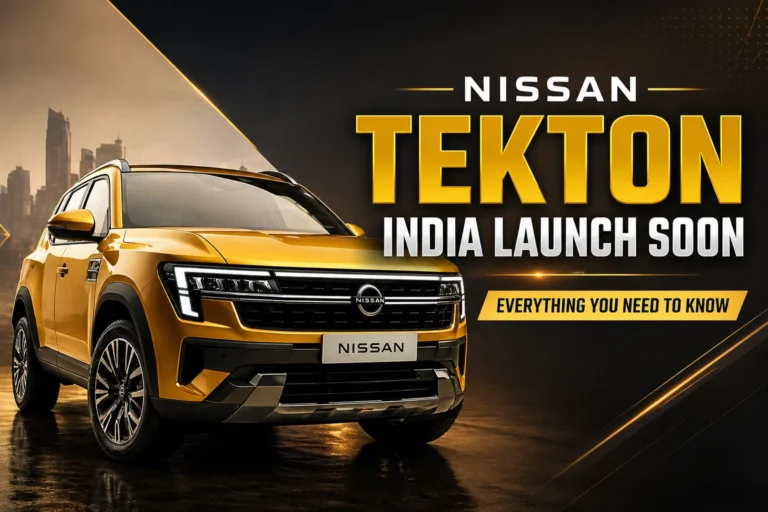
Nissan hasn’t exactly been the loudest name in India’s SUV conversation over the past few years. The brand has been present, but not really competing at the level the market demands. The Tekton is clearly an attempt to change that.
This new mid-size SUV is expected to launch in India around mid-2026, and it’s being built specifically with this market in mind — manufactured in Chennai, priced to go directly at the Hyundai Creta and Kia Seltos, and packed with the kind of features that today’s Indian SUV buyer actually asks for.
Here’s everything we know so far.
What Is the Nissan Tekton?
The Tekton is a compact to mid-size SUV sitting roughly in the 4.3 metre length bracket — proper mid-size territory, not a sub-compact trying to stretch itself. It’s built on the CMF-B platform, which Nissan shares with Renault (the same underpinnings as the Renault Duster), and that’s a solid foundation. The platform has a good track record for balancing ride quality, space, and safety.
The India-spec Tekton is also expected to be exported to other markets from the Chennai plant, which usually signals that the manufacturer is serious about the quality and volume commitments involved.
Expected Price — Where Does It Sit?
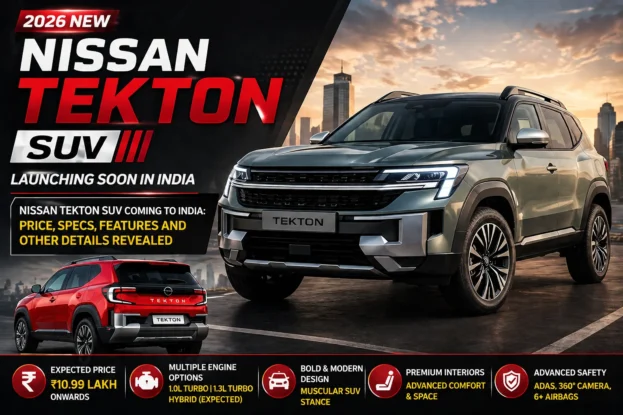
Based on current estimates, the Tekton is expected to be priced starting around ₹10 lakh for the base variant, going up to approximately ₹18–19 lakh for the fully-loaded top trim.
| Variant | Expected Price |
|---|---|
| Base | ₹10 – ₹11 lakh |
| Mid | ₹12 – ₹15 lakh |
| Top | ₹16 – ₹19 lakh |
That range puts it squarely in Creta and Seltos territory, which is exactly where Nissan needs to be to have a serious conversation with buyers. Whether the actual pricing lands within these estimates when the official announcement comes will depend on how aggressively Nissan wants to position it — but the intent to compete in this bracket is clear.
Engine Options — What’s Under the Bonnet?
Nissan is expected to offer two petrol engine choices at launch, with a hybrid option coming in later.
| Engine | What to Expect |
|---|---|
| 1.0L Turbo Petrol | Entry-level option, good fuel efficiency |
| 1.3L Turbo Petrol | Performance-focused, expected around 150–160 hp |
| Hybrid | To be introduced post-launch |
The 1.3L turbo is the one most buyers will gravitate toward if they want a proper mid-size SUV driving experience. Around 150–160 horsepower puts it in competitive territory against the turbocharged options in the Creta and Seltos lineups.
Both manual and automatic transmission options are expected across variants. The hybrid powertrain, when it arrives, will likely be positioned in the upper trims for buyers who prioritise fuel efficiency over outright performance — similar to what Toyota and Maruti have done with the Hyryder and Grand Vitara.
Design — Bold and Muscular Is the Direction
Nissan has drawn design inspiration from its larger global SUVs, including the Patrol, for the Tekton’s exterior. The result, based on what’s been shown, is a SUV that looks genuinely tough rather than just styling-exercise tough.
Key design elements expected on the production version include a large, prominent front grille with Nissan’s signature styling, C-shaped LED headlamps with DRLs, connected LED tail lamps running across the rear, chunky bumpers, and body cladding that gives it a rugged visual stance.
It’s not trying to look sporty or sleek — it’s going for presence and road stance, which is a deliberate choice that should appeal to buyers who want their SUV to actually look like an SUV.
Interior — Is It Premium Enough?
This is where Nissan will need to deliver, because the Creta and Seltos have set a high bar for cabin quality and feature count in this segment.
The expected feature list for the Tekton includes a large touchscreen infotainment system, a digital instrument cluster, wireless Android Auto and Apple CarPlay, a panoramic sunroof, and ventilated front seats. Add wireless charging, connected car technology, a premium sound system, push-button start, and cruise control to that list.
Soft-touch materials and ambient lighting are also expected in higher variants, which would give the cabin the premium feel that buyers in this price bracket increasingly expect.
If Nissan delivers on all of this — and actually delivers it well rather than just listing the features on a spec sheet — the Tekton should be competitive on the inside.
Safety Features
The Tekton is expected to come with a solid safety package, including multiple airbags, electronic stability control, a 360-degree camera system, and Level 2 ADAS (Advanced Driver Assistance Systems) in higher variants.
ADAS is now becoming a genuine purchase criterion for a growing number of Indian buyers, especially in the upper trim levels. The Creta and Seltos both offer it, and the Tekton will need to match them here to stay in the conversation.
Who Is It Up Against?
The mid-size SUV segment in India is genuinely one of the most competitive spaces in the global auto industry right now. The Tekton’s main rivals will be the Hyundai Creta, Kia Seltos, Maruti Suzuki Grand Vitara, Toyota Hyryder, and Skoda Kushaq.
That’s a tough lineup. Each of those models has been around long enough to build loyal ownership communities, strong after-sales networks, and well-understood reputations. The Tekton is going to need more than just competitive specs to pull buyers away from established choices.
What it has going for it is the combination of a fresh design, the promise of a comprehensive feature set, and a price positioning that’s been calculated specifically to undercut or match segment leaders. Whether that’s enough will depend heavily on execution — how the car actually drives, how the cabin feels in person, and how Nissan’s dealer and service network holds up.
Also Read: 2026 Maruti Suzuki Baleno Facelift: Expected Features, Safety Upgrades, and Engine Details
Why the Tekton Matters for Nissan in India
The Tekton isn’t just another model launch. It represents Nissan’s most serious attempt in years to reestablish itself as a genuine contender in India’s fastest-growing car segment.
The brand has been losing ground steadily as other manufacturers invested more aggressively in the Indian market. A mid-size SUV manufactured locally, priced competitively, and built with this market’s preferences in mind is the kind of move that could change that trajectory — if it’s executed well.
The Chennai manufacturing base gives it a cost and supply chain advantage. The CMF-B platform gives it proven engineering credentials. And the timing — arriving in a market that continues to grow its appetite for feature-rich SUVs — gives it a genuine opportunity.
When Can You Expect It?
A global debut is expected in early 2026, with the India launch following around mid-2026. More official details on specifications, pricing, and variant breakdowns will emerge closer to that date.
For anyone actively shopping in this segment, the Tekton is worth keeping on your radar. It won’t suit everyone, and the established competition is strong. But if Nissan gets the pricing, quality, and after-sales right — which is a real if — this could be a genuinely competitive addition to one of India’s most contested car segments.