


There are good IPL innings. There are great ones. And then, once in a very long while, there’s one that makes you stop and just stare at the scorecard.
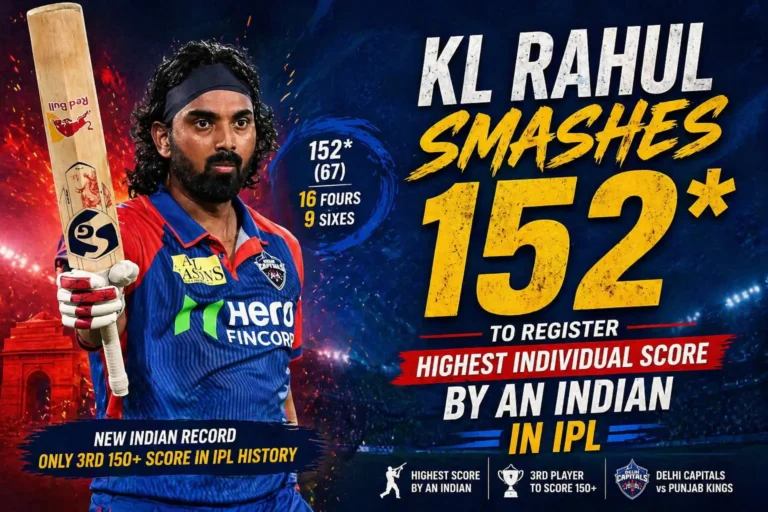
KL Rahul’s 152* off 67 balls for Delhi Capitals against Punjab Kings at the Arun Jaitley Stadium is that last kind. Not just a record — though it broke several — but the kind of innings where the numbers don’t fully capture what it felt like to watch in real time.
It is now the highest individual score ever made by an Indian batter in IPL history. And it arrived more than thirteen years after the last time anyone scored 150 or more in this tournament.
KL Rahul’s 152: The Numbers, Because They’re Extraordinary
Let’s just look at what Rahul actually did.
152 not out. 67 balls. 16 fours and 9 sixes. A strike rate that crossed 220.
That strike rate means he was scoring at more than double the rate of a run a ball — consistently, for over sixty deliveries, against a professional bowling attack in a high-stakes IPL match. Not for a cameo, not for a few overs at the end when the game was already won. From start to finish, with the weight of the innings on his shoulders, maintaining that level of output without ever losing control.
The Record He Broke
Before this innings, the record for the highest score by an Indian batter in IPL history sat with someone else. Rahul walked past it comprehensively.
What’s easy to overlook in the excitement of a record-breaking innings is the 13-year gap that preceded it. The last time anyone scored 150 or more in an IPL match was way back in the early years of the tournament. Since then, despite the evolution of batting techniques, bigger bats, shorter boundaries, and an entire generation of fearless T20 specialists — nobody had done it.
That tells you something about how difficult this particular threshold actually is. Modern bowling is smarter, fielding is sharper, data analysis means bowlers have detailed plans for every batter. Getting to 150 in this environment isn’t just about being talented. It requires an almost perfect extended period of batting.
Joining Elite 150+ Club: He’s Now in Company That Barely Exists
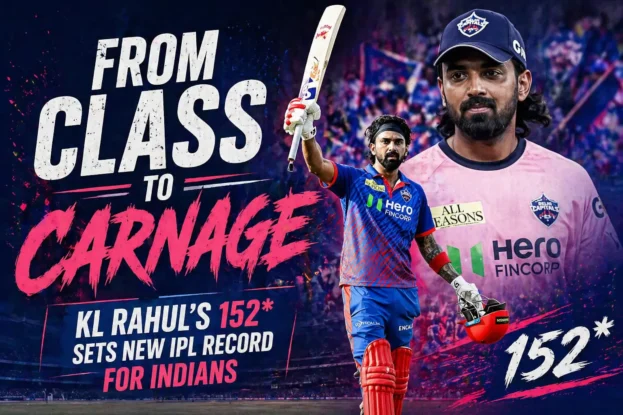
With 152*, KL Rahul became only the third player in IPL history to score 150 or more in a single innings. The other two are Chris Gayle — whose 175* against Pune Warriors in 2013 remains the all-time record — and Brendon McCullum, whose 158* in the very first IPL match in 2008 announced the tournament’s arrival to the world.
Think about that list. Gayle at his absolute peak, he is one of the most destructive batters T20 cricket has ever seen. McCullum in the inaugural IPL game, when nobody knew what the tournament was going to become. And now KL Rahul in IPL 2026!
It’s a short list for a reason. Getting there requires everything going right for an extended period—reading deliveries perfectly, timing the big shots cleanly, managing the inevitable pressure moments, and staying mentally locked in even when the scoreboard is already saying something ridiculous.
Another Record That Went Unnoticed in the Chaos
Buried underneath the headline numbers was another milestone that deserves its own moment. In this century, KL Rahul became the first player in IPL history to score hundreds for three different franchises.
That particular record says something important about who Rahul is as a player. Big hundreds can sometimes be situational — the right pitch, the right opposition, and the right conditions coming together. But doing it repeatedly across different teams, different support structures, and different roles within a batting lineup — that speaks to consistency and adaptability that goes beyond a single extraordinary night.
How KL Rahul Built His Innings
What separated this innings from a simple power-hitting exhibition was the way it was constructed.
Rahul didn’t come out swinging from ball one. He started with intent, but with timing and placement as the primary tools — finding gaps, rotating strike, building the foundation before the acceleration. As the innings developed and he found his rhythm, the tempo shifted. Deliveries that deserved to go to the boundary went to the boundary. The sixes came when they were on, not as desperation shots.
His handling of spin was particularly impressive — using his feet, hitting into gaps rather than just over the top, making bowlers feel like there was no correct ball to bowl at him. Against pace, he mixed genuine power hitting with clever manipulation of line and length.
The cumulative effect was an innings that felt both inevitable and shocking — like watching someone execute a plan perfectly while also doing things that no plan could have prepared you for.
What It Means for the Delhi Capitals
On a practical level, Rahul’s innings put Delhi Capitals into a position of complete and total control. A total built on a 150+ knock from your captain and opener gives your bowlers something they can genuinely defend, and it shifts the psychological momentum of a match in ways that are hard to recover from if you’re on the wrong side of it.
Beyond the individual match, innings like this carry weight through a tournament. They remind opponents of what’s possible, lift team confidence to a different level, and establish a sense that this team has a player who can single-handedly change any game.
Why This Matters for Indian Cricket Beyond the IPL
For a long time, the list of the biggest individual IPL scores was effectively an overseas players’ club. Gayle, McCullum, AB de Villiers, various others — the truly enormous scores tended to come from international batters with that particular T20 destructiveness that Indian players were somehow assumed not to possess at the same level.
Rahul’s 152* challenges that assumption directly and forcefully. It says that an Indian batter, operating at the peak of his powers, can dominate T20 bowling in the same way that the best overseas players can. That’s not a small statement in the context of Indian cricket’s evolving identity in the shortest format.
Also Read: Who is Danish Malewar? All You Need to Know About Mumbai Indians’ Young Vidarbha Batter
Where It Sits in the All-Time List
The overall IPL record is still Gayle’s 175*, which has now stood for over a decade and a half. But 152* puts Rahul’s innings among the closest approaches to that mark that anyone has managed.
More than the positioning in a list, what stands out is the nature of the innings itself. It wasn’t slog and luck — it was batting that combined classical technique with modern power hitting in proportions that very few players in the world can manage at this level.
A Performance That Redefines T20 Batting
When KL Rahul walked off that ground unbeaten on 152, the scoreboard behind him was telling a story that seemed almost impossible when you trace back how cricket arrived at this evening.
A player who has spent his career being brilliant without always getting the credit he deserved. A player who has dealt with injuries, form slumps, captaincy pressures, and constant scrutiny. Standing there at the end of an innings that put his name in the history books alongside the biggest ever played in this tournament.
Cricket does this sometimes. Gives someone a night that belongs entirely to them. May 2026 gave that night to KL Rahul.