


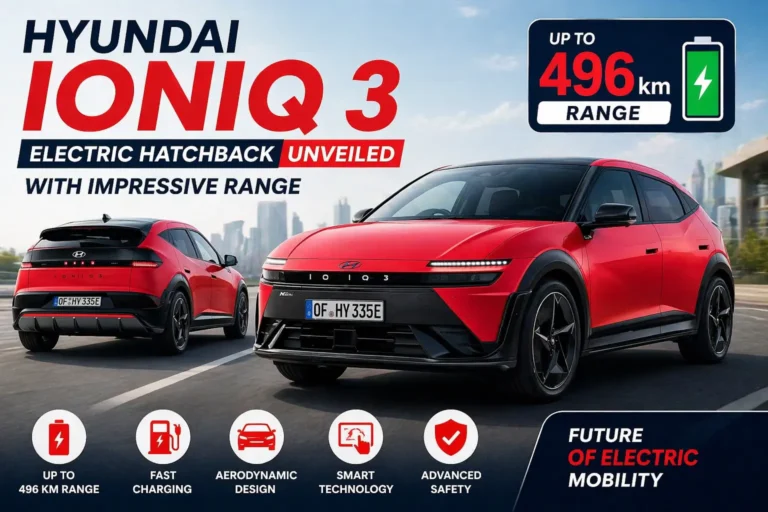
Hyundai has pulled the wraps off the Ioniq 3, and it’s shaping up to be one of the more interesting entries in the compact EV space. Sitting below the Ioniq 5 in the lineup, this one is clearly aimed at buyers who want something smaller, more city-friendly, and easier to live with day to day.
The headline number is a claimed range of up to 496 km on a single charge, which, if real-world driving bears that out even roughly, puts it in genuinely useful territory for most people’s needs. This isn’t a city runabout with barely enough range to get you out of town. It’s designed to handle both urban commuting and longer drives without constant charging anxiety.
Battery, Range and Performance
Hyundai has built the Ioniq 3 on a dedicated EV platform — not a converted petrol car with a battery shoved in — which makes a real difference in how the space is used and how the car behaves.
| Range | Up to 496 km |
| Powertrain | Fully electric |
| Platform | Dedicated EV architecture |
| Charging | Fast charging supported |
Fast charging support means you’re not waiting around for hours on a road trip. Top up enough to keep going, and you’re back on your way.
The performance tuning here is worth noting, too. Hyundai hasn’t tried to make the Ioniq 3 into a hot hatch — it’s tuned for smooth, quiet, relaxed driving. That’s the right call for a car that most people will use for commuting and errands rather than track days. Silent acceleration in city traffic is one of those small pleasures that EV drivers tend to appreciate more than they expected.
Design — Clean, Aero, and Practical
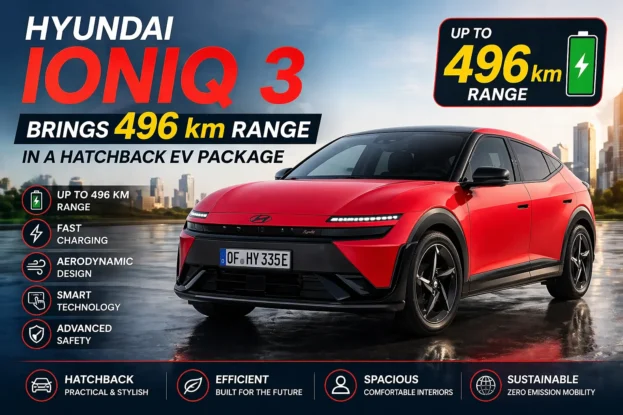
The Ioniq 3 has that distinctly Hyundai EV look — aerodynamic without being weird about it. The body is smooth and drag-reducing, the front end is minimal and clean, and the overall silhouette is a proper compact hatchback that won’t feel oversized in a tight parking spot.
LED lighting, modern alloy wheels, and a shape that clearly prioritizes airflow over drama. It won’t turn heads the way a more aggressive design might, but it’ll age well and look right at home in most environments.
The compact dimensions are a genuine selling point for anyone navigating busy cities. Big enough to be practical, small enough not to be a headache.
Inside — Simple, Spacious, and Sorted
One of the recurring surprises with dedicated EV platforms is how much interior space they free up, and the Ioniq 3 seems to follow that pattern. Hyundai claims good headroom and legroom despite the car’s compact footprint — which is the kind of thing that sounds like marketing until you actually sit in the back seat and find yourself not complaining.
The dashboard is clean and uncluttered, with digital displays doing the heavy lifting and physical buttons kept to a minimum. Some people love this, some people miss the tactile feedback of actual knobs and switches. Fair warning either way.
The overall cabin feel is designed around daily practicality — easy to understand, easy to use, and not overwhelming with features you’ll never touch.
Also Read: 2026 Maruti Suzuki Baleno Facelift: Expected Features, Safety Upgrades, and Engine Details
Tech and Features
The Ioniq 3 comes well-equipped on the technology front. Here’s what you can expect:
- Digital instrument cluster
- Touchscreen infotainment system
- Wireless smartphone connectivity
- Connected car features
- Advanced driver assistance systems
Nothing here is groundbreaking in 2026, but it’s all done well and put together in a way that doesn’t require a manual to figure out. Hyundai has gotten noticeably better at making tech feel intuitive rather than complicated, and the Ioniq 3 reflects that.
Efficiency and How It’s Achieved
The 496 km range doesn’t happen by accident. Hyundai has put real engineering effort into the aerodynamics — optimizing airflow around the car to reduce drag and therefore reduce how hard the battery has to work. Lightweight construction plays into this too, keeping the overall weight down and making the most of every kilowatt-hour.
For buyers who spend a lot of time on motorways, this kind of efficiency work matters more than headline specs. A car that’s genuinely slippery through the air is one that’ll hold its range estimate more consistently at higher speeds.
Safety
Safety systems on the Ioniq 3 are expected to include:
- Multiple airbags
- Electronic stability control
- Lane assist
- Emergency braking
- Full suite of driver assistance features
Nothing surprising here — this is roughly what you’d expect from a modern Hyundai — but it’s reassuring that the compact, more affordable positioning hasn’t meant cutting corners on safety equipment.
Also Read: Best Hybrid Scooters in India — Prices, Mileage and Features You Should Know About
Price and Where It Fits
Official pricing hasn’t been confirmed yet, but the Ioniq 3 is clearly being positioned as the accessible entry point into Hyundai’s EV range. It’ll compete against other compact electric hatchbacks, and the combination of real-world range, solid tech, and a dedicated EV platform gives it a reasonable claim to being one of the better options in that category.
For anyone who’s been waiting for an EV that doesn’t compromise too much to hit a lower price point — this one is worth watching.
The Bigger Picture
What’s interesting about the Ioniq 3 is what it represents beyond its own specs. Hyundai is essentially saying: you don’t need to spend big to get a proper electric car. Good range, smart features, comfortable cabin, safe and efficient — all in a package that doesn’t ask you to stretch your budget to breaking point.
For a lot of people, this will be their first EV. And first impressions in that world matter enormously. If the Ioniq 3 delivers on what’s been shown, it could be the car that convinces a significant number of hesitant buyers that going electric isn’t actually a compromise — it’s just a different, and in many ways better, way of driving.