


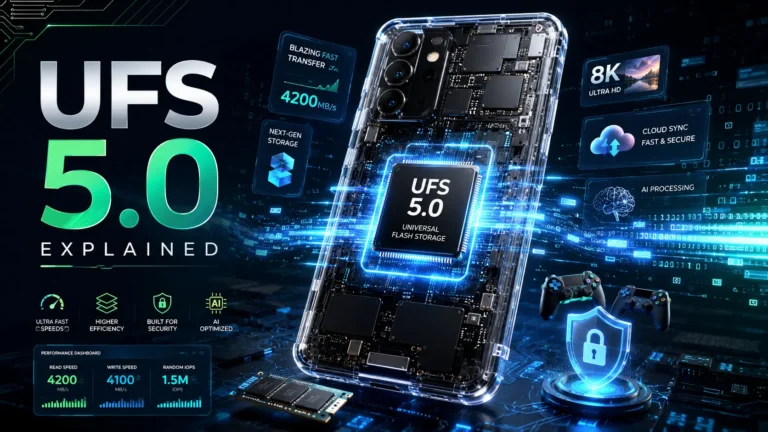
When people talk about what makes a smartphone feel fast, they usually mention the processor. Sometimes the RAM. Occasionally the display refresh rate. Storage rarely comes up in that conversation — which is strange, because it is often the thing silently holding everything else back.
JEDEC, the organisation that sets global standards for semiconductor memory, finalised the UFS 5.0 standard earlier this year. It is the most significant storage upgrade the Android smartphone world has seen in years, and when it arrives in your pocket — probably in 2027 — you are going to feel the difference even if you never learn what UFS stands for.
Here is everything you need to know, explained without the jargon.
What Exactly Is UFS?
UFS stands for Universal Flash Storage. It is the storage system used in most modern Android flagship smartphones — the component that stores all your apps, photos, videos, and data, and retrieves them whenever your phone needs them.
Every time you open an app, take a photo, download a game, or process a video, your phone is reading from and writing to UFS storage. The speed at which it can do that has a direct impact on how fast the experience feels — how quickly an app opens, how long you wait for a game to load, how smoothly your camera handles a burst of photos.
Most flagship Android phones in 2026 use UFS 4.0 or UFS 4.1 storage. UFS 5.0 is the next major step forward, and the gap between them is considerable.
What Does UFS 5.0 Actually Do?
The headline number is transfer speed. UFS 5.0 supports standard transfer speeds of up to 10.8GB/s — roughly double the bandwidth available on many current smartphones.
It achieves this through two new underlying technologies: MIPI M-PHY v6.0 and UniPro 3.0. You do not need to remember those names. What they mean in practice is that your phone can access, transfer, and process data significantly faster than before — which has ripple effects across almost everything you do with the device.
But raw speed is only one part of what UFS 5.0 brings. There are two other improvements worth understanding.
Link Equalisation maintains signal integrity during high-speed data transfers. As storage gets faster, keeping the communication between the storage chip and the processor clean and error-free becomes increasingly difficult. Link Equalisation addresses that, reducing data transmission errors and improving overall reliability.
Inline Hashing is a built-in mechanism that verifies data during transfers. It works quietly in the background and adds protection against data corruption and certain security risks. You will never notice it working. That is the point.
Why Storage Speed Matters More in 2026 Than It Did Before
For most of the smartphone era, faster storage mainly meant apps opened a second or two quicker and games loaded faster. Useful, but not exactly revolutionary.
That has changed. Modern smartphones are now running increasingly complex workloads directly on the device rather than sending tasks to cloud servers. Generative AI image editing, real-time language translation, on-device large language models, AI assistants that understand your screen context — all of these features require massive amounts of data to be accessed and processed almost instantly.
A faster storage subsystem is what allows these AI models to load quickly, respond in real time, and not make you wait while the phone thinks. The smarter your phone’s AI features become, the more dependent they are on how fast the underlying storage can keep up.
The same logic applies to photography. Modern flagship cameras capture enormous amounts of data — RAW images, HDR computational stacks, high-bitrate 4K and 8K video. Every time you press the shutter, the phone is moving a significant volume of data very quickly. Faster storage means less delay between shots, smoother burst photography, and cleaner handling of high-resolution video workflows.
As phone cameras continue to get more capable, storage speed increasingly determines whether those capabilities feel seamless or slightly frustrating in daily use.
What About Power Consumption?
Faster storage usually costs more battery. More speed generally means more energy required to push data at higher rates.
UFS 5.0 has been designed to counteract this. The standard is built to complete tasks more quickly and then return to low-power idle states faster. The logic is that a shorter burst of higher-speed activity uses less total energy than a longer stretch of slower activity achieving the same result. In practical terms, UFS 5.0 should not drain your battery faster than UFS 4.0 — and in some scenarios may actually improve efficiency.
Also Read: 6 Android Apps That Will Transform Your Smartphone Experience
What Will You Actually Notice?
Most people will never think about UFS 5.0 as a feature. They will just notice that their phone feels different.
Apps might open before you have finished pressing the icon. Games that currently have noticeable load screens may start feeling more immediate. AI-powered features — the kind that currently make you wait a beat while the phone processes something — should respond more quickly. Camera bursts will feel smoother. Large file transfers, whether to a computer or between apps, will happen faster.
The cumulative effect of all these small improvements is what the industry calls how “fast” a device feels in daily use. UFS 5.0 will not change what your phone can do. It will change how quickly it feels like it is doing it.
When Will UFS 5.0 Arrive?
Not immediately. JEDEC has finalised the standard, and memory manufacturers have already started providing evaluation samples to device makers. But commercial mass production of UFS 5.0 storage modules is not expected to begin until later in 2026 at the earliest.
The first smartphones equipped with UFS 5.0 are likely to appear in early 2027, and almost certainly in premium flagship devices first. Mid-range and budget phones will follow in subsequent years, as the technology becomes cheaper to produce at scale.
If you are planning to buy a flagship Android phone in late 2026, you will likely still get UFS 4.0 or 4.1. If you are the type who upgrades every two years, your next phone after that may well be your first UFS 5.0 device — and you will probably notice the difference even if nobody tells you what changed.