


Gold has long been regarded as a symbol of wealth, stability, and financial security. From ancient civilizations to modern financial markets, the yellow metal continues to attract investors during periods of uncertainty. Today, when investors check the gold rate today, they are not just monitoring commodity prices – they are assessing inflation trends, currency movements, and global risk sentiment.
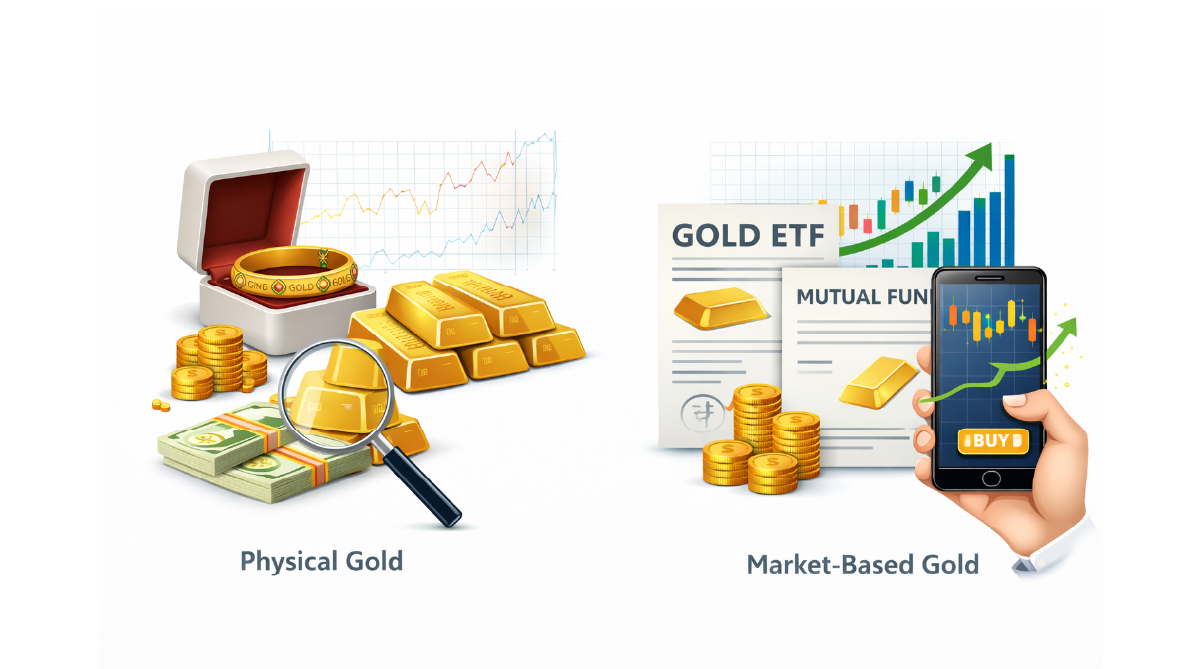
With evolving financial markets, investors now have multiple ways to invest in gold. Traditionally, physical gold dominated portfolios. However, market-based instruments like Gold ETF products have become increasingly popular. Understanding the difference between these two investment routes is essential for making informed decisions.
The Reason why Investors monitor Gold Prices
Gold is thought to be a safe-haven asset. The gold rate today is closely followed by the investors due to a number of reasons:

- Hedge against inflation
- Insurance against geopolitical risk.
- Equity diversification.
- Currency depreciation hedge.
- Portfolio risk management
Gold prices normally increase when there is some uncertainty in the economy or when the stock market is volatile. On the other hand, gold can perform poorly in the times of high economic growth as compared to equities.
Learning the Physical Gold Investment
Physical gold includes:
- Jewelry
- Gold coins
- Gold bars
In most areas, this form of traditional ownership is still culturally and financially prominent.
Advantages of Physical Gold
- Tangible Asset: The metal is physically owned by the investors and this brings psychological relief.
- No Market Intermediary: There is no ownership in terms of brokerage and financial systems.
- Universal Acceptance: One can sell gold anywhere in the world.
Physical Gold Pros and Cons
- Storage and Security Costs: Storage facilities, in most cases, need lockers or vault services.
- Making Charges (for jewelry): Costs of craftsmanship are part of jewelry and it cannot be recovered when reselling.
- Liquidity Spread: The purchasing and selling price is different, and this decreases the short-term profitability.
- Purity Concerns: There is the need to make sure that investors are genuine and certified.
Sometimes physical gold is more appropriate when it is used to preserve wealth over a long period of time instead of being traded on a regular basis.
Gold Investment, Market-Based: GOLD ETF
A GOLD ETF (Exchange Traded Fund) is a monetary tool that follows the cost of gold and it is traded on a stock exchange. The unit normally represents a specified amount of actual gold owned by the fund.
Advantages of GOLD ETF
- Ease of Trading: ETFs can be sold and purchased within the market hours just like stocks.
- No Storage Hassles: Physical security is not a worry of the investors.
- High Liquidity: Faster transactions are guaranteed through market-based trading.
- Transparency: The price of ETF is directly dependent on the Gold rate today.
- Lower Cost Structure: None of the charges, but probably minimal expense proportions.
Disadvantages of GOLD ETF
- Demat and Trading Account are required.
- Brokerage is required by the investors.
- Market Volatility: The prices of ETFs vary across the trading days.
- Expense Ratio: Management fees have a minor impact on reducing returns annually.
- The investors prefer to invest in gold through the market where they want convenience and liquidity.
Comparing Physical Gold vs GOLD ETF
| Feature | Physical Gold | GOLD ETF |
| Ownership | Tangible | Electronic |
| Storage | Required | Not required |
| Liquidity | Moderate | High |
| Transaction Cost | Higher | Lower |
| Ease of Trading | Limited hours | Market hours |
| Transparency | Depends on seller | Exchange-traded |
This comparison helps investors evaluate which option aligns with their goals.
Prices of Gold: Factors at Work
To follow the trend of the GOLD RATE TODAY, it is necessary to know the cause of the price movement.
1. Inflation Trends
Gold is regarded as a conventional inflation hedge. The demand of gold tends to go up when the inflation is high.
2. Interest Rates
An increase in interest rates can make gold less appealing since gold does not interest one.
3. Currency Movements
The prices of gold tend to be opposite of the great currencies. A depreciated currency can drive the domestic prices of gold upwards.
4. Geopolitical Tensions
Safe-haven buying is often brought about by wars, global conflicts and political instability.
5. Central Bank Policies
The world demand is affected by the central bank gold reserves and monetary policies.
Investment Horizon Matters
The decision of physical gold versus GOLD ETF will be subject to a significant amount of investment objectives.
Long term wealth preservation.
The tangible gold can be appealing to the conservative investors who value the physical assets.
Portfolio Diversification
GOLD ETF provides an easy means of investing a minor portion of the portfolio in gold without logistical problems.
Active Trading
ETFs may be more flexible to those investors that monitor short-term price fluctuations.
Portfolio Allocation Strategy.
It is commonly suggested by financial professionals to invest 515 percent of a diversified portfolio towards gold. This allocation:
- Minimizes the volatility of the portfolio.
- Offsets equity risk
- Offers stability in correction of the market.
Allocation however should be in respect of risk tolerance and financial objectives.
Tax Considerations
There can be difference in taxation in physical gold and GOLD ETF investment. The overall returns can be affected by the capital gains regulations and holding periods. Before investing, the investors ought to consider the regulations that apply.
Online Revolution in Gold Investment
Gold investing has been made easy through technology. Investors are now able to keep track of GOLD RATE TODAY using mobile applications and trading systems. ETFs are providing real-time tracking, which improves the speed of decision-making and transparency.
Market-based gold products have witnessed a great increase in adoption due to the convenience of digital platforms.
Risk Considerations
Despite the fact that gold is regarded to be safe, it is not risk-free.
- The gold prices may stagnate long.
- Excessive exposure can restrain the development of the portfolio.
- Instruments based on the market are volatile to trade.
- The importance of equal distribution and long-term view is paramount.
When to Choose Physical Gold
- Religious or ritualistic requirements.
- Long-term holding intention
- Biases in favor of physical assets.
- Not based on the need to trade frequently.
When to Choose GOLD ETF
- Desire for liquidity
- Portfolio diversification ease.
- Lower transaction costs
- Effective monitoring of Gold rate today.
Final Thoughts
Tracking the gold rate today helps investors assess economic stability, inflation trends, and global uncertainty. While physical gold provides traditional security and tangible ownership, a gold ETF offers convenience, liquidity, and cost efficiency in modern financial markets.
Both investment routes serve different purposes. The right choice depends on financial goals, risk appetite, and time horizon. A balanced approach combining traditional stability with modern market access can help investors harness the benefits of gold while maintaining flexibility and efficiency.
Gold remains timeless, but the way we invest in it continues to evolve.