


The India Story Review: ★★★☆☆ (3/5)
The India Story is a well-intentioned but frustratingly compromised Hindi courtroom drama that raises one of India’s most pressing public health concerns — pesticide contamination in everyday food — and then refuses to follow that concern to its most uncomfortable conclusions, settling instead for melodrama, soft targets, and a resolution so toothless it practically undermines everything that came before it. Shreyas Talpade’s performance and the film’s genuine emotional sincerity keep it watchable, but the missed opportunities sting more than most bad films.
Rating: ★★★☆☆ (3/5)
Director: Chettan D.K.
Release: July 24, 2026
Language: Hindi
Cast: Shreyas Talpade, Kajal Aggarwal, Trisha Sarda, Murli Sharma, Manish Wadhwa
Runtime: 130 mins
We have all seen the news stories. Adulterated milk. Vegetables sprayed with chemicals to extend shelf life. Pesticide residues in food that accumulate quietly over years until a body breaks down in ways that take doctors months to understand.
The India Story looks directly at this reality — at the growing body of evidence linking chemical farming practices to rising cancer rates — and builds a courtroom drama around a father’s fight to hold someone, anyone, responsible for his daughter’s death.
That is the kind of film India needs someone to make. The tragedy of The India Story is how close it comes to being that film, and how consistently it stops itself from going the full distance.
The story follows Yogesh Patil, played by Shreyas Talpade, a former army officer whose young daughter Pari dies of blood cancer caused by toxins in the food she was eating every day. The police refuse to take his complaint seriously. Lawyers decline the case one by one.
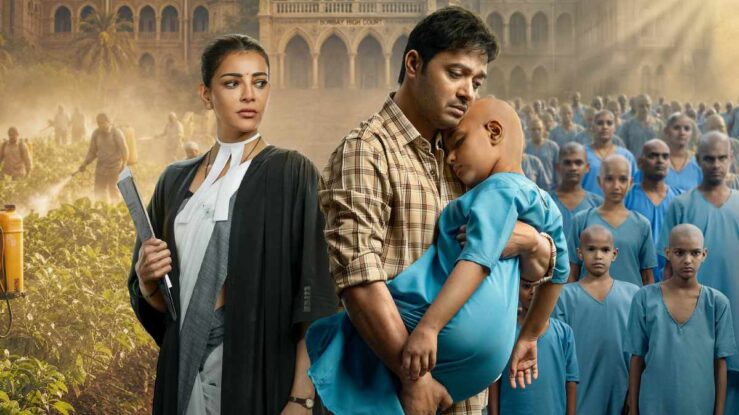
Eventually, a first-time advocate named Archana, played by Kajal Aggarwal, agrees to fight for him at the Bombay High Court, arguing that farmers, pesticide companies, and the government bear collective responsibility for Pari’s death.
Shreyas Talpade carries the film’s emotional weight with genuine conviction. His performance as a father who refuses to accept that his daughter simply died — who insists instead that she was failed by a system designed to profit from that failure — is quiet, restrained, and deeply felt.
The scenes depicting Pari’s illness and treatment are handled with tenderness rather than exploitation, and the father-daughter relationship has enough authentic warmth to make the grief land properly.
Kajal Aggarwal is decent in the courtroom sequences — her delivery of the film’s bigger speeches is confident — though her expressions are inconsistent in the quieter moments.
Murli Sharma provides solid support as a police officer gradually awakening to the scale of what is being revealed. Child actor Trisha Sarda as Pari is genuinely impressive, particularly in the physically demanding scenes of her illness.
Also Read: Tera Yaar Hoon Main Review
The film’s fundamental problem is its unwillingness to be truly uncomfortable. It blames farmers for pesticide use without meaningfully engaging with why farmers use chemicals in the first place — the debt, the lack of affordable alternatives, the market structures that reward cosmetically perfect produce.
It names corporations but keeps them abstract and faceless. It portrays the government in a flattering light at precisely the moment the story demands accountability.
The courtroom drama itself is underwhelming — the opposition lawyer makes strong arguments but produces no witnesses, and the eventual resolution asks the government to merely advise companies to use fewer harmful chemicals, which is not justice so much as a strongly worded suggestion.
The second half becomes progressively melodramatic, leaning into tearjerker territory long after the audience’s sympathies have already been firmly established. The India Story is the rare film that genuinely deserved to be angrier than it was willing to be.
The India Story is now playing in cinemas.