



India’s startup ecosystem went through a genuine reckoning between 2022 and 2024. The era of funding companies on growth metrics alone — user numbers, GMV, market share grabs — ran into the wall of rising interest rates, tighter capital markets, and investors who suddenly remembered that businesses need to make money eventually.
What’s emerged on the other side is a more interesting and arguably healthier ecosystem. Large rounds are returning, but the companies attracting them are building things with more permanence — infrastructure, technology ownership, defensible positions in sectors that will matter for decades. The companies on this list aren’t just well-funded. They’re well-funded for the right reasons.
India’s Funding Scenario in 2026
The capital is back, but it’s concentrated differently. Rather than spreading hundreds of smaller bets across a wide range of consumer apps, investors in 2026 are making larger commitments to category leaders with clear paths to dominance in their respective sectors.
Three shifts define the current environment. First, AI and deep-tech are receiving more serious attention than they ever did during the consumer app boom. Second, infrastructure-heavy companies — businesses that own or tightly control logistics, manufacturing, or technology — are becoming mainstream VC targets rather than exceptions. Third, profitability is back in the conversation in a way it wasn’t between 2019 and 2022.
Companies heading toward an IPO are actively reducing losses rather than expanding them. Investors are asking harder questions about revenue quality and retention. The days of rewarding pure growth regardless of unit economics feel genuinely over.
6 Most Funded Indian Startups Attracting Huge Funding in 2026
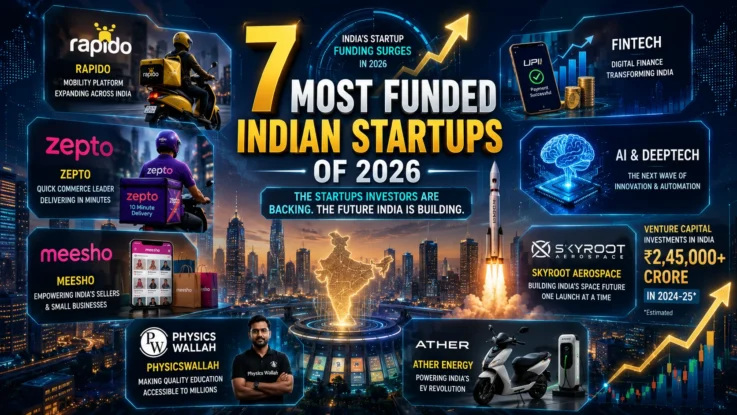
1. Rapido
Rapido’s evolution from bike-taxi startup to full mobility platform is the thing that explains why investors moved its valuation from $2.3 billion toward $3 billion. This isn’t a company doing one thing at moderate scale anymore.
Auto-rickshaw aggregation, cab services, local delivery, and broader mobility infrastructure — Rapido has built across the urban transportation stack in ways that make it significantly harder to replicate than a single-service app. And it’s done this with a leaner operating model than either Uber or Ola, which matters in markets where margin discipline separates survivors from casualties.
The real opportunity sits in Tier 2 and 3 cities, where local transportation needs are genuinely underserved and where Rapido’s regional adaptability gives it advantages that global ride-hailing platforms struggle to match. Investors backing Rapido aren’t just betting on a mobility company — they’re betting on India’s urban growth story playing out in cities that most people outside India couldn’t name.
2. Skyroot Aerospace
The fact that Skyroot is on this list at all tells you something about how much India’s startup ecosystem has changed. Private space infrastructure receiving serious institutional capital was almost unimaginable five years ago. Today it reflects a genuine structural shift in where strategic value is being created.
Also Read: Best Stocks to Buy This Month
Skyroot launched India’s first private rocket in 2022 — that milestone established credibility in a sector where credibility is everything. The company is now building toward an orbital launch with the Vikram-1 rocket and expanding its production and launch facilities.
The investor thesis here is long-term and strategic rather than near-term revenue focused. Satellite deployment, defense infrastructure, global launch capabilities, communication technologies — these are multi-decade opportunities, and India’s evolving space policy has opened the door for private players to participate in ways that weren’t possible before. Skyroot is the best-positioned Indian company to capture a significant share of what emerges.
For India’s startup ecosystem specifically, Skyroot’s rise matters because it signals a genuine shift away from the fintech-food delivery-ecommerce funding concentration that defined the previous decade. Deep tech and aerospace are now legitimate categories for serious institutional capital.
3. Meesho
Meesho succeeded by being completely uninterested in the customer segment that most Indian ecommerce platforms fought over. While Flipkart and Amazon battled for urban, premium consumers, Meesho built for Tier 2 and Tier 3 India — value-conscious buyers, small sellers, social commerce participants for whom the existing platforms were either too expensive or not accessible enough.
That focus turned out to be a much larger market than the conventional wisdom suggested, and Meesho’s seller-focused ecosystem and affordability-first approach have created a platform that serves hundreds of millions of Indians who were underserved by the alternatives.
Investors who once dismissed the model as too discount-dependent now increasingly see Meesho as long-term infrastructure for India’s digital commerce expansion. The value-first approach isn’t a temporary strategy — it’s the right approach for the majority of India’s internet users, and that majority keeps growing.
4. PhysicsWallah
Most heavily funded edtech companies from the 2020-2022 boom have had a difficult few years. PhysicsWallah hasn’t, and the reason is simple: it was never trying to be what they were trying to be.
The model is deliberately accessible — low cost, focused on exam preparation, built for mass markets rather than premium urban students. The expansion into hybrid learning has added physical infrastructure without abandoning the accessibility that made the brand work in the first place.
What makes PhysicsWallah particularly interesting in 2026’s funding environment is the capital discipline. While competitors burned cash building premium products for segments that turned out to be smaller than projected, PhysicsWallah stayed focused on a model it understood and expanded carefully. Investors in the current environment reward exactly that kind of discipline, and PhysicsWallah continues to attract attention as a result.
6. Zepto
Quick commerce seemed like a bet that would never make economic sense when the category first emerged. Ten-minute grocery delivery requires dense dark store networks, precise inventory management, and logistics infrastructure that costs serious money to build and maintain. The skeptics had a point.
What changed is that the unit economics actually improved at scale in dense urban markets, and Zepto was one of the companies that proved it. Over 1,000 dark stores, proprietary logistics infrastructure, hyper-local inventory management — the company has built something that’s genuinely difficult to replicate from scratch.
The billion-plus dollars raised in recent years reflects investor confidence that Zepto can translate operational scale into sustainable profitability. The focus now is on reducing EBITDA losses ahead of what looks like a serious IPO conversation. That transition — from growth-focused to IPO-ready — is exactly what sophisticated investors want to see, and Zepto is executing it.
6. Ather Energy
India’s electric vehicle transition is genuinely underway — government policy, infrastructure investment, and changing consumer behavior are all pointing in the same direction — and Ather is positioned as one of the most important companies in how that transition plays out in two-wheelers.
The distinction between Ather and EV aggregator models is important. Ather manufactures its vehicles and is expanding into charging infrastructure and broader EV ecosystem development. That vertical integration creates both higher capital requirements and more defensible long-term positioning. Investors making long-term bets on India’s electric mobility story are increasingly comfortable with the capital intensity because the potential scale justifies it.
The Biggest Funding Trend in 2026: AI and Infrastructure
The pattern across all six companies reflects something bigger than any individual startup story. Capital is moving toward businesses that build infrastructure rather than applications, own technology rather than license it, and create ecosystems rather than marketplaces.
Quick commerce logistics, mobility platforms, EV manufacturing, spacetech, enterprise AI — the common thread is that these are hard to build, hard to replicate, and strategically valuable in ways that a consumer app with strong growth metrics simply isn’t.
The sectors attracting the most funding in 2026: AI infrastructure, enterprise automation, quick commerce logistics, mobility platforms, EVs, spacetech, and defense tech. Consumer app investment hasn’t disappeared, but it’s no longer where the conviction capital goes.
What Investors Are Looking For in 2026
The framework has genuinely changed from the previous cycle and it’s worth being specific about how.
Quality of revenue matters more than volume. High GMV without good unit economics, retention, and monetization efficiency doesn’t impress the way it once did. Investors want to see businesses that earn money from their customers rather than subsidizing them.
Infrastructure ownership is actively rewarded. Companies that control their supply chains, logistics, manufacturing, or core technology attract stronger valuations than those dependent on third-party infrastructure for their core value proposition.
IPO readiness has replaced private valuation maximization as the relevant metric for late-stage companies. The goal is to be a credible public market story, which requires different disciplines than simply raising the next private round at a higher number.
AI integration is increasingly a basic expectation rather than a differentiator. Non-AI startups that demonstrate meaningful AI adoption across logistics, automation, or personalization are attracting better terms than those that haven’t engaged with the technology at all.
Also Read: Top 7 Startup Sectors Investors Are Funding Aggressively in India Right Now
Frequently Asked Questions
Which Indian startups attracted the most investor interest in 2026?
Zepto, Rapido, Skyroot Aerospace, Meesho, PhysicsWallah, and Ather Energy — each building in sectors with strong long-term fundamentals rather than near-term consumer trends.
Why has AI investment in India grown so significantly?
Investors have moved from treating AI as a speculative theme to treating it as fundamental infrastructure. The applications across logistics, automation, personalization, and enterprise services are concrete enough that long-term capital now flows toward them consistently.
Which sectors received the most funding in 2026?
Quick commerce, AI infrastructure, EV ecosystem, mobility platforms, spacetech, enterprise SaaS, and deep tech led the way.
Why has profitability returned to investor conversations?
The global startup correction of 2022-2024 reminded investors what should always have been obvious — that companies burning cash without a clear profitability path are not inherently valuable. Startups with better operational efficiency and revenue quality are now rewarded accordingly.
Is India still one of the world’s fastest-growing startup markets?
Yes — and increasingly so in sectors with genuine global relevance. AI, deep tech, and infrastructure-focused startups are positioning India as a contributor to global technology development rather than just a consumer market.