


This is the kind of news that doesn’t stay regional for long. Two Indian-flagged vessels were targeted by Iranian gunboats while passing through the Strait of Hormuz, and the incident has set off a chain of reactions that’s already affecting shipping routes, trade timelines, and diplomatic conversations.
The good news — and it genuinely is good news — is that all crew members on both ships came out of this unharmed. The vessels managed to move away from the threat without suffering major damage. But the situation in the Strait is far from calm, and what’s happening there deserves a clear, honest look.
Eight Ships Turned Around. That Tells You Everything.
While the two targeted vessels made it out safely, the broader response from the shipping world speaks volumes. At least eight India-bound ships that were already on their way decided to reverse course rather than attempt the crossing.
That’s not a small thing. Turning a cargo ship around mid-journey costs time, fuel, and money. Shipping companies don’t make that call lightly. The fact that eight vessels chose to do exactly that tells you how seriously operators are taking the threat right now.
At the same time, at least one Indian ship did manage to cross the strait successfully during this period — which shows that passage isn’t impossible, but it’s being treated with a level of caution that simply wasn’t necessary a few weeks ago.
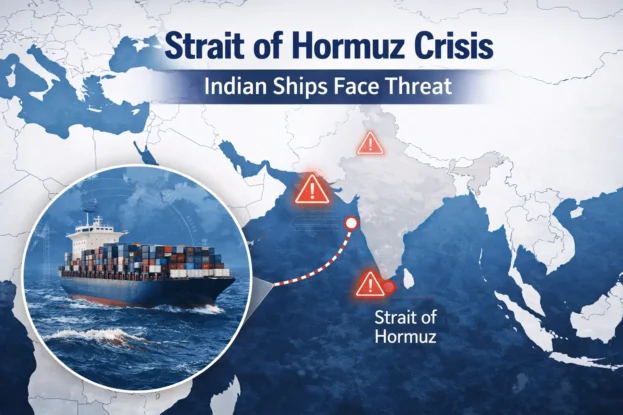
What’s Actually Causing This?
The Strait of Hormuz has never been a particularly relaxed stretch of water geopolitically, but the current flare-up is being linked to something specific — internal friction within Iran, particularly involving the Islamic Revolutionary Guard Corps and how much control they exercise over maritime operations in the region.
When there are competing power centres within a government, and one of them controls gunboats in a critical shipping lane, things can get unpredictable quickly. Statements coming out of Iran have reflected these divisions, with different officials appearing to send different signals about what’s happening and why.
That kind of internal incoherence is often more dangerous than a clear, stated policy — because it’s harder to predict and harder to negotiate around.
Why Does the Strait of Hormuz Matter So Much?
If you’re not familiar with just how important this waterway is, here’s the short version: a massive share of the world’s daily oil supply moves through this narrow stretch of water connecting the Persian Gulf to the open ocean. It’s one of those chokepoints where geography and global economics collide in a way that makes disruptions immediately felt far beyond the region itself.
For India specifically, this isn’t abstract. A significant portion of India’s energy imports travel this route. When ships start turning back or rerouting, the effects show up in shipping costs, cargo delays, and eventually in prices for fuel and goods. It doesn’t take long for a maritime crisis in the Gulf to become an economic inconvenience for people nowhere near the water.
What’s the Immediate Impact on Shipping?
It’s already being felt. Cargo movement is slowing down, and insurance costs for vessels transiting the area are climbing. That’s a standard response to elevated risk — insurers price danger, and right now the Strait of Hormuz is looking dangerous.
Shipping companies are looking at alternative routes, but the honest reality is that there aren’t great alternatives. The routes that bypass the strait are significantly longer and more expensive. Choosing them solves the safety problem but creates a different set of cost problems — which, again, tend to filter down eventually.
What Is India Doing About It?
Indian authorities are tracking the situation closely and are in active contact with shipping companies, international maritime partners, and diplomatic channels. The priority right now is the safety of Indian crew members and vessels still operating in the region.
The government isn’t being loud about its response publicly, but the monitoring is clearly happening. Quick response mechanisms are being put in place to handle things if the situation escalates further.
Also Read: Microsoft Shuts Down Outlook Lite: What It Means for Android Users Worldwide
Quick Summary of Where Things Stand
| What Happened | Details |
|---|---|
| Ships attacked | 2 Indian-flagged vessels |
| Crew status | All safe |
| Ships turned back | 8 India-bound vessels |
| Successful crossings | At least 1 Indian ship |
| Location | Strait of Hormuz |
This Isn’t Over Yet
The honest assessment right now is that this situation is unresolved and unpredictable. The underlying causes — internal Iranian power dynamics, regional geopolitical tensions — aren’t going to be sorted out quickly. And as long as they aren’t, the Strait of Hormuz remains a risk for vessels transiting it.
Indian authorities are doing what they can through diplomatic and operational channels. But for shipping companies, crews, and anyone whose supply chains run through the Persian Gulf, the message right now is simple: stay alert, stay updated, and don’t assume yesterday’s safe route is still safe today.