


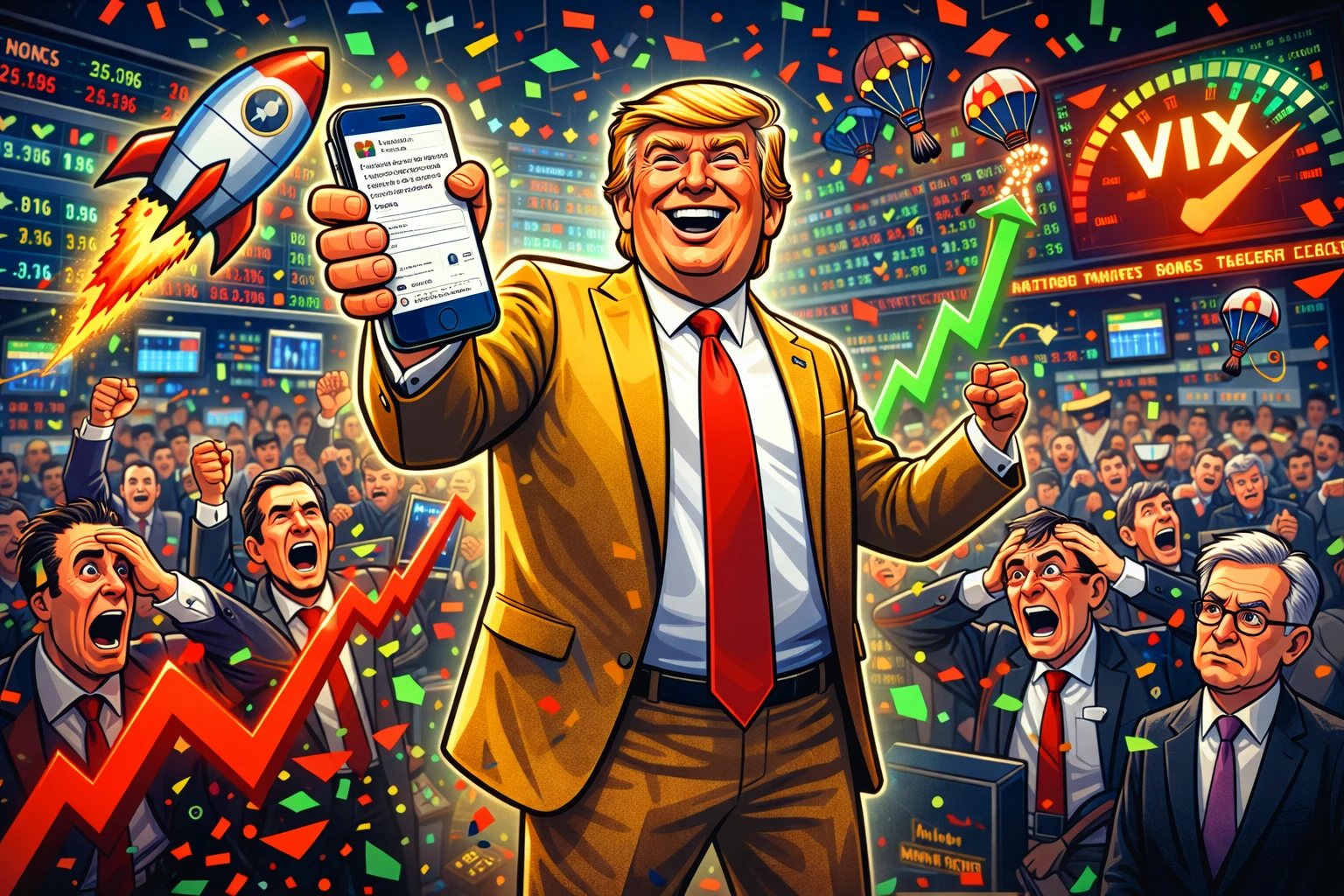
Donald Trump’s influence on the share market is like watching a reality show that’s been given a finance degree. Sometimes stocks leap higher than a TV drama cliffhanger, and other times they fall faster than a punchline gone wrong. Investors and analysts alike tweet, trade, and try to predict his next move, even when he’s just having breakfast.
Since Trump’s reelection in 2024 and his inauguration in January 2025, the stock market has had one of those “hold onto your hats” seasons. The S&P 500 rallied strongly overall, partly riding on hopes of tax cuts and deregulation, yet the markets are still dancing to the beat of volatility.
The “Trump Bump” That Made Wall Street Cheer
When Donald Trump secured the presidency in November 2024, stocks didn’t just smile — they threw a party. The S&P 500 jumped about 2.5% on the day of his victory, marking one of the best post-election rally moments in over a century. Investors were optimistic about lower taxes, fewer regulations, and what they imagined would be a turbocharged economy.

Certain sectors, especially energy and finance, were the life of that party. Stocks that aligned with Trump’s policy priorities — things like oil, industrials, and banks — saw especially high gains. This phenomenon is linked to what experts call “political proximity” — basically, companies that Trump would RSVP “yes” to seeing tend to benefit, at least initially.
Tariff Tweets: When Markets Go “Uh Oh…”
Then came the tariffs — and with them, the market’s collective eye-roll. Like a dramatic plot twist in a series nobody asked for, Trump’s frequent tariff threats on major trading partners sent markets into a tizzy. On dates like January 20, 2026, the S&P 500 suffered its worst single-day drop since late 2025 after a barrage of tariff threats jolted investors and sent tech stocks sliding.
It’s not just an American thing: global markets react too. Tariff uncertainty has forced firms to rethink production, pushed gold prices higher as a “safe haven,” and caused volatility all over commodities markets.
Donald Trump and the Share Market: A Love-Hate Story Wall Street Can’t Ignore
Imagine if your financial advisor also had a Twitter account, a personal vendetta against the Federal Reserve, and a habit of announcing trillion-dollar policy decisions between rounds of golf. Welcome to the Donald Trump-Stock Market relationship — the most riveting, nerve-wracking, occasionally profitable drama that Wall Street has ever had to price in.
Since Trump first descended that golden escalator in 2015, the stock market has essentially become a live audience reacting to his every move. Markets cheer, groan, rally, and crash in real time — and as any trader will tell you, it never gets boring.
Chapter 1: The ‘Trump Bump’ — How It All Began (2016)
When Trump won the 2016 election, global markets initially panicked overnight — Dow futures plummeted 800 points. Then, as if someone had pressed a cosmic ‘undo’ button, markets reversed and the Dow surged ~256 points the very next day.
Investors quickly did the math: tax cuts + deregulation + infrastructure spending = profits. And thus was born the legendary ‘Trump Bump’ — a term that sounds like either a great investment strategy or a very bad dance move.
The Numbers That Started It All
| Event | Market Reaction |
| Election Night 2016 (overnight) | Dow futures: -800 pts (PANIC) |
| Nov 9, 2016 (market open) | Dow: +256 pts (lol never mind) |
| Dow Jones 2016 year-end | +13.4% — best year since 2013 |
| S&P 500 under Trump Term 1 | +67% (if you ignored the drama) |
| Election Night Nov 6, 2024 | S&P 500: +2.5% (best post-election day in 100 years) |
Chapter 2: Tweet-o-nomics — When 280 Characters Moved Trillions
At some point during Trump’s presidency, financial analysts had to add a new variable to their models: @realDonaldTrump. The man could move markets faster than a Fed announcement — and with considerably less grammatical precision.
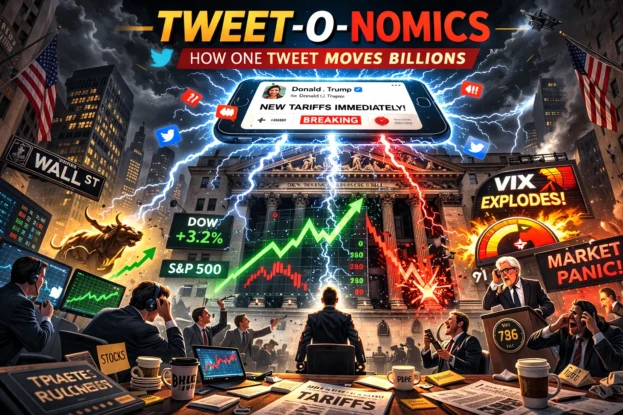
Hall of Fame Trump Market-Moving Moments
- July 2018: One tweet threatening $200B more in China tariffs wiped ~$1.6 trillion from global markets in a single session. That is more money than the GDP of most countries — moved by a man on his phone.
- August 2019: ‘Hereby order’ tweet demanding U.S. companies leave China sent the Dow down 623 points in a day. Investors quietly Googled whether presidents could actually ‘hereby order’ private companies.
- December 2018: A single trade war tweet erased $1 trillion in market cap. The Dow dropped 799 points. Someone on Reddit called it the ‘Tweetsunami.’
- January 2020: The Soleimani airstrike announcement spiked oil prices 4% overnight, tanked defense stocks slightly (counterintuitively), and had traders frantically reading geopolitics textbooks at 3 AM.
- 2026: One post capping credit card interest rates caused financial sector stocks to drop 5% within hours. VISA and Mastercard shareholders had a very bad Tuesday.
Fun fact: Academics at the Federal Reserve actually quantified that Trump tweets caused a 10x spike in market volatility on days he posted about trade policy. There is a paper about it. Wall Street has never felt more academically validated for its anxiety.
Chapter 3: The Tariff Tango — Markets Learn to Dance With Chaos
If Trump’s tweets were the opening act, tariffs were the main event. Beginning in 2018 and returning with a vengeance in 2025-2026, Trump’s tariff agenda turned international trade into a suspense thriller where no one knew what the next chapter would bring.
The Tariff Playbook (A Predictably Unpredictable Pattern)
| # | What Trump Did | What Markets Did |
| 1 | Announced sweeping China tariffs (25% on $200B goods) | Markets plunged. Panic. Red everywhere. |
| 2 | Hinted at a ‘deal’ with China via tweet | Markets surged. Green candles. Champagne. |
| 3 | Confirmed MORE tariffs | Markets crashed again. Analysts cried. |
| 4 | Said negotiations are going ‘very well’ | Markets bounced back. Analysts changed careers. |
| 5 | Suggested some possible exemptions | North American markets went into full meltdown mode |
| 6 | Suggested some exemptions possible | Partial recovery. VIX still elevated. Antacids sold out. |
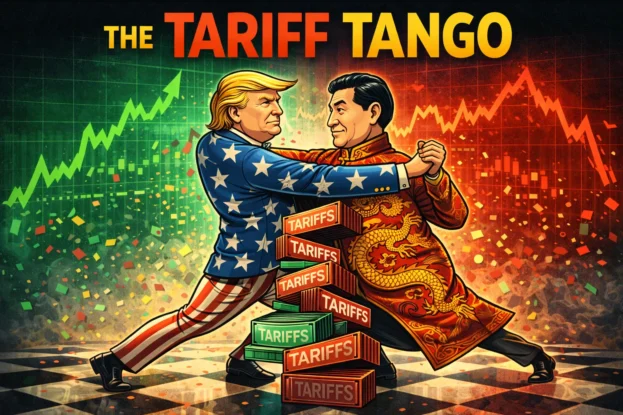
Repeat this cycle indefinitely. Economists called it ‘strategic uncertainty.’ Traders called it ‘exhausting.’ Therapists called it ‘good for business.’
Chapter 4: The 2024 Comeback — ‘Trump Bump 2.0: Electric Boogaloo’
In November 2024, Trump won the presidential election again. Markets reacted with the subtlety of a freight train: the S&P 500 jumped 2.5% on November 6, 2024 — the best post-election day in over 100 years. Apparently, Wall Street had missed the drama.
- Small-cap stocks partied hard — the Russell 2000 surged on expectations of domestic-focused policies and tariff protections.
- Energy stocks went vertical. ‘Drill, baby, drill’ was basically a stock ticker at this point.
- Crypto went nuclear — Bitcoin hit all-time highs as Trump positioned himself as the ‘crypto-friendly’ candidate. Even digital made-up money got a Trump Bump.
- Green energy stocks had a moment of silence. Then a selloff.
By February 2026: The Scoreboard
| Metric | Result |
| NVIDIA (China chip restrictions) | +~20% |
| Oil stocks (Venezuela action) | Skyrocketed (‘Drill’ became policy) |
| Credit card sector (rate cap threat) | -5% in hours. One post. One afternoon. |
| Nvidia (China chip restrictions) | Dipped. AI is not tweet-proof either. |
| Pro-Trump sector abnormal return | +7-10% post-election (per CEPR) |
| VIX on election night | Dropped 4 points (relief rally) |
Also Read: Donald Trump’s 4000+ Legal Cases Before Presidency: Explained Simply
Chapter 5: The Fed Feud — When Trump Met Powell
No discussion of Trump and markets is complete without the legendary Trump vs. Federal Reserve saga. In a relationship that makes most romantic comedies look stable, Trump repeatedly and publicly attacked his own appointed Fed Chairman, Jerome Powell, for keeping interest rates too high.
- 2018-2019: Trump called the Fed ‘loco,’ ‘crazy,’ and his ‘biggest threat’ — not geopolitical rivals, not trade wars. His own central bank.
- He reportedly asked advisors whether he could legally fire Powell. Spoiler: it’s complicated. Markets wobbled every time this rumor surfaced.
- 2026: Rumors of a ‘Powell probe’ spooked Wall Street briefly — but markets ultimately shrugged it off, having developed impressive Trump-drama immunity by this point.
The irony? Despite all the feuding, the U.S. economy posted solid GDP growth during Trump’s first term, unemployment hit 50-year lows (pre-COVID), and the market hit record highs. Powell kept his job. Markets eventually calmed down. Nobody fully won. Classic Washington.
Chapter 6: Winners and Losers — The Trump Portfolio
If you could invest in ‘Trump agenda alignment’ as an asset class, here’s roughly how the portfolio performed:
The Champions (Sectors That Loved the Drama)
- Energy: ‘Drill, baby, drill’ wasn’t just a slogan — it was a sector upgrade. Oil and gas stocks thrived on deregulation and favorable leasing policies.
- Defense: Military spending promises = defense contractor dreams. Lockheed Martin and Raytheon were basically doing a victory lap.
- Financials (mostly): Deregulation of Dodd-Frank rules meant banks could take more risk. They celebrated. Until the credit card rate cap tweet. Then they didn’t.
- Domestic manufacturers: Tariff protections meant foreign competition got pricier. Steel and aluminum producers had a moment. A loud, tariff-protected moment.
The Casualties (Sectors That Did NOT Get the Memo)
- Green energy: Every mention of exiting the Paris Agreement was essentially a short signal. Solar stocks became a leading indicator of Trump’s mood.
- Import-dependent retail: Tariffs on Chinese goods meant higher input costs. Target, Walmart, and every company with ‘Made in China’ supply chains had complicated earnings calls.
- Semiconductors/Tech (China exposure): Nvidia, Qualcomm — any chipmaker with China exposure got caught in the crossfire of export restrictions. AI may be the future, but tariffs are very much the present.
- Soybean farmers: Perhaps the most ironic casualties — largely Trump’s own voter base in the Midwest, hurt badly by Chinese retaliatory tariffs on agricultural exports.
Chapter 7: Wall Street’s Survival Guide — How Investors Cope
After a decade of Trump-era market dynamics, professional investors have developed a unique Trump-adapted investment philosophy. Here’s the unofficial playbook:
- Rule #1 — Don’t fight the White House: Analysts now openly advise clients to align with Trump-favored sectors. Ideological purity is expensive.
- Rule #2 — Set news alerts for Mar-a-Lago: Many traders monitor Trump’s Truth Social and X posts the way they once monitored Fed meeting minutes. Both move markets. One is considerably more entertaining.
- Rule #3 — Keep cash on tariff announcement days: When trade war escalation news drops, liquidity is your best friend. Dry powder saved many a portfolio.
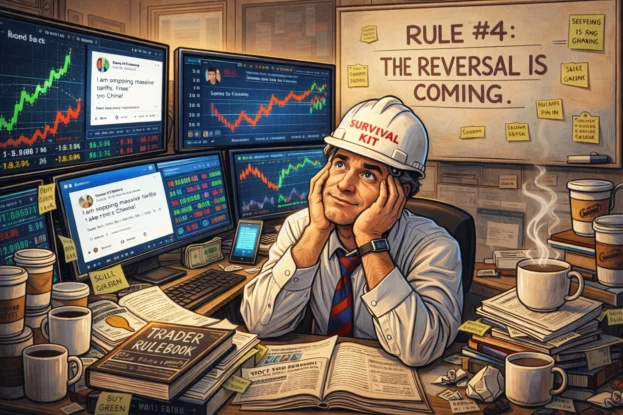
- Rule #4 — The reversal is coming: Trump escalates, markets panic, Trump walks it back, markets recover. Patient investors learned to wait for the inevitable ‘dial-back tweet.’
- Rule #5 — Proximity pays: Companies that cultivate relationships with Trump’s administration consistently demonstrated better short-term stock performance. Cynical? Absolutely. Profitable? Also yes.
Chapter 8: What Does 2026 Hold? (Spoiler: Nobody Knows)
As of early 2026, Wall Street’s consensus view is a cocktail of cautious optimism and mild existential dread — which, coincidentally, is exactly what it was in 2017, 2018, 2019, 2020, and 2025.
The Bull Case (Things That Could Go Right)
- Tax cuts 2.0 materialize — corporate America parties like it’s 2017 again.
- Deregulation accelerates across energy, finance, and tech — earnings improve.
- Trade deals get done (eventually) — tariff fears fade, risk appetite returns.
- The Fed cuts rates — borrowing costs fall, growth assets rip higher.
The Bear Case (Things That Could Go Wrong)
- Tariff escalations trigger retaliatory spirals — global trade slows, inflation rises.
- Fed independence concerns spook bond markets — dollar weakens, yields spike.
- A Truth Social post hits at 11 PM on a Sunday. Markets open on Monday. It’s not good.
- Geopolitical wildcards (Venezuela, Taiwan, Iran) introduce risk premiums that markets haven’t fully priced.
The honest answer is that nobody on Wall Street knows what comes next — and that’s perfectly on-brand for a market narrative shaped by one of history’s most unpredictable political figures. Analysts use the word ‘uncertainty’ approximately 47 times per earnings call. It has never been more appropriate.
The Most Entertaining Non-Central-Banker in History
Whatever your political views, the data is clear: Donald Trump and the stock market share one of the most consequential and chaotic relationships in modern financial history.
Markets gained enormously under his watch — and also suffered spectacular one-day crashes driven by a single sentence. Investors who understood the ‘Trump pattern’ — escalate, panic, walk back, recover — made money. Those who reacted emotionally to every headline learned expensive lessons.
In the grand Wall Street tradition of finding the angle in everything, the Trump era gave us a new asset class: political volatility arbitrage. Buy on the panic, sell on the resolution. Repeat until exhausted.
Buckle up. The show must go on. And it probably will.
Also Read: Who Was Ayatollah Ali Khamenei? Supreme Leader of Iran Killed in US-Israel Attack
Tweeting and Market Screaming
Donald Trump’s favorite communication tool — yes, Twitter and its successor platforms — has governments, CEOs, and investors bookmarking updates like they’re weekly weather reports. Believe it or not, studies have shown that Trump’s tweets with economic or trade content can impact markets and even currency valuations — a curious blend of social media and financial analytics.
Investors love a good plot twist, but they hate surprises when money is involved. That’s why certain Trump tweets have been linked to sudden swings in volatility indices. One index even earned its own name in homage to Trump’s tweeting era — the “Volfefe” index — tracking how much market volatility is tied to Trump’s social media musings.
This Show Is Far From Over
In the end, the relationship between Donald Trump and the share market reads like the world’s most unpredictable sitcom. Gains, losses, twists, and surprises — all wrapped together with tweets, tariffs, and enthusiasm. Facts show that certain sectors have enjoyed the “Trump Bump”, while others have been buffeted by tariff uncertainty and wild volatility.
If you’re an investor, a spectator, or someone who just enjoys bizarre market drama, buckle up: this season still has many chapters left, and the stock market isn’t yet ready to close its curtain.