


Four Hands, Two Sonatas Review: ★★★★☆ (4/5)
Four Hands, Two Sonatas opens with a compelling mix of beautiful music, genuine competition and complicated young relationships. Song Kang and Lee Jun-young make the central rivalry worth investing in, though the story needs a few episodes to fully find its emotional footing.
Rating: ★★★★☆ (4/5)
Language: Korean
Genre: Musical Romance
Runtime: Approximately 1 hour 10 minutes per episode
Director: Jung Jin-young
Cast: Song Kang, Lee Jun-young, Jang Gyu-ri
Four Hands, Two Sonatas immediately sets itself apart from the standard K-drama lineup. This isn’t a workplace romance or a fantasy romp — it’s a show set inside the pressurised, obsessive world of elite music education, where talent is everywhere and still somehow never quite enough.
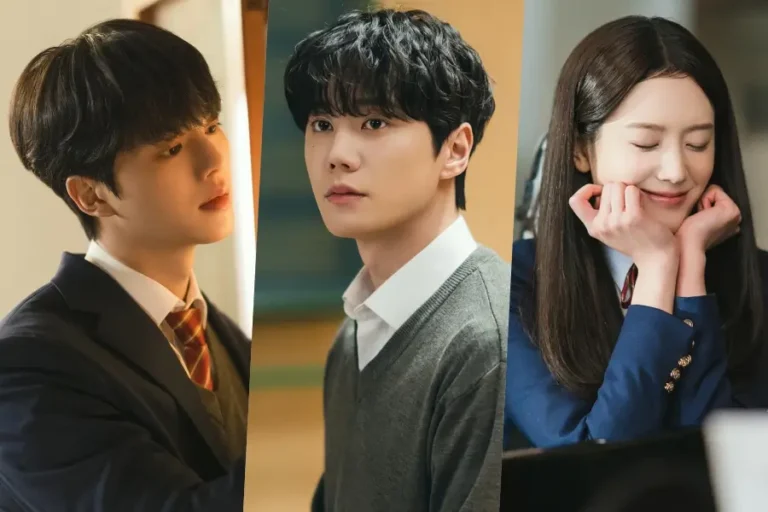
Song Kang plays Kang Bi-o, and Lee Jun-young plays Choi Jeong-yo — two pianists on what appears to be a collision course. Jang Gyu-ri rounds out the central trio as Hong Jae-in, a gifted viola student who becomes woven into both their lives in ways that complicate everything. Together, the three carry a story built around music, ambition, friendship and the particular tension that comes when all three are pointed at the same person.
Bi-o is a perfectionist with his entire future mapped out. Major competitions, a glittering career, expectations that have been stacking up since childhood — he carries all of it with the controlled composure of someone who has learned to hide how heavy it is.
Then Jeong-yo arrives. Also gifted, but complicated — someone whose relationship with music has been fractured by personal circumstances, and who has deliberately stepped away from it. The detail that makes their connection more than a simple rivalry is that Bi-o’s playing was once what drew Jeong-yo back to music. There’s a history between them before they’ve even properly met.
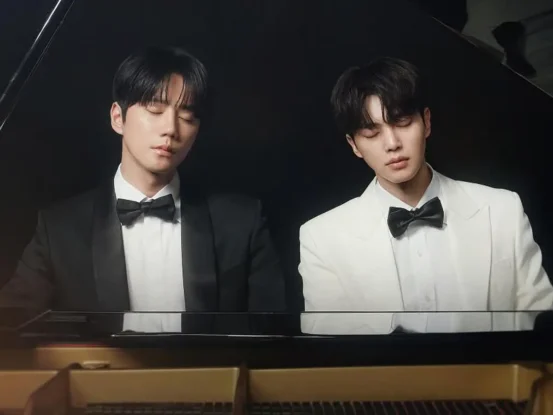
That layered setup is the show’s best quality in its early episodes. The rivalry feels real, but so does the potential for something else — respect, connection, maybe even friendship, if competition doesn’t consume all of it first.
Four Hands, Two Sonatas earns real credit for how it handles its musical world. Piano performances aren’t decorative — they’re character work. The way each character plays reflects who they are, what they’re hiding and what they’re fighting for.
Bi-o plays with control and precision, the musical equivalent of his carefully maintained exterior. Jeong-yo’s relationship with his own talent is messier, more ambivalent, and it shows in how he approaches the instrument when he allows himself to approach it at all.
The Korea Arts High School setting compounds this effectively. In a world where every student is genuinely talented, talent stops being a differentiator. What matters is what you do with it under pressure — and there is pressure everywhere.
Song Kang’s return to television after mandatory military service is a natural talking point, and Four Hands, Two Sonatas gives him a character that suits where he is as a performer — someone who needs to project confidence while quietly carrying a significant personal weight underneath it.
Lee Jun-young as Jeong-yo is the greater surprise. The character could easily have been written as the antagonist in a straightforward competition story, but he’s given his own emotional journey and his own reasons for being the way he is. The scenes between the two actors have genuine tension — the kind that comes from actors who are actually listening to each other rather than simply waiting for their cue.
Jang Gyu-ri’s Hong Jae-in is a real asset to the series. A viola student with unusually sensitive hearing, deeply moved by Bi-o’s playing — she becomes the emotional connective tissue between the two rivals without feeling like a device.
Her presence gives the story somewhere to breathe beyond the competition. The romantic thread she introduces with Bi-o is handled carefully in the early episodes, kept in the background while the character relationships are established. That restraint is probably the right choice — there’s already a lot happening, and the show clearly intends to let the romantic angle develop naturally rather than front-load it.
The most legitimate criticism of the early episodes is that the show is carrying a lot of material and doesn’t always manage the weight with perfect grace. Musical ambition, family pressure, rival dynamics, friendship complications and romantic tension — fitting all of that into an opening that still needs to introduce three central characters creates a slightly crowded feeling.
The pacing is slower than some viewers will expect, and the first couple of episodes ask for a certain patience before the emotional stakes become genuinely felt rather than intellectually understood.
The 12-episode run should give the writers enough room to let these elements breathe properly. The early episodes feel like setup — necessary, well-constructed setup, but setup nonetheless. The real payoff is likely still ahead.
Similar Article: Graveyard Season 3 Review
Four Hands, Two Sonatas has a distinct identity that most K-dramas don’t — a musical world that feels genuinely lived in, a central rivalry with real emotional complexity and two lead actors who sell that rivalry convincingly.
The early pacing is the one thing holding it back from landing immediately, but the ingredients are right, and the 12-episode format gives the story room to develop. With two episodes releasing each week, viewers should find that the emotional rhythm improves as the characters’ relationships deepen and the competition intensifies.
For anyone who enjoys K-dramas that take their central world seriously — where the music is as much a character as the people playing it — Four Hands, Two Sonatas is a worthwhile addition to the watchlist.