



Buying a watch should be exciting. But walk into any watch store or browse online for five minutes, and the sheer number of options can make your head spin. Chronograph, automatic, quartz, dive watch, field watch, dress watch — what does any of it actually mean, and which one is right for you?
The good news is that once you understand the three basic ways watches are categorised — by their movement, by their functionality, and by their style — everything starts to make a lot more sense. Here’s a plain-English guide to every type of watch worth knowing about.
Explore Different Types of Watches
Types of Watches by Movement
The movement is the engine inside the watch. It’s what makes the hands move and keeps time. Everything else about a watch — the design, the features, the price — builds on top of this foundation. There are four main types.
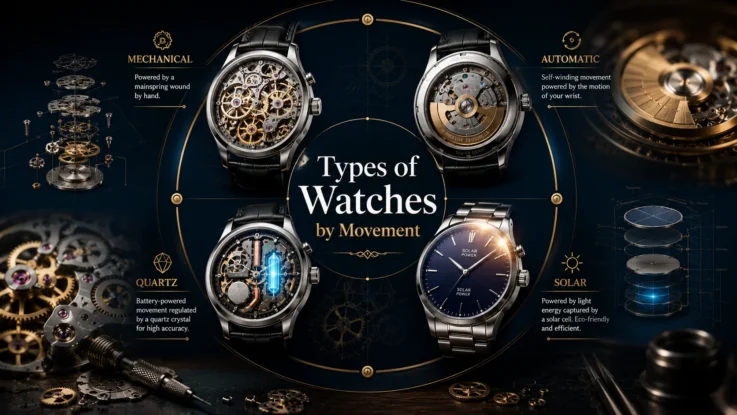
Mechanical Watches
Mechanical watches are the oldest type, and for many collectors, the most fascinating. There’s no battery involved — instead, the watch is powered by a tightly wound spring called a mainspring, which you wind by hand periodically to keep it running.
Inside a mechanical watch is an intricate series of tiny gears, springs, and levers working together in perfect coordination. That complexity is a big part of the appeal. When you look through the case-back of a high-quality mechanical watch and see all those components moving together, it’s genuinely impressive.
They’re accurate to about plus or minus 20 seconds a day, which isn’t as tight as a quartz watch but is perfectly fine for everyday use. The craftsmanship involved justifies the higher price tags that mechanical watches typically carry.
Automatic Watches
Automatic watches are technically a type of mechanical watch, with one very clever difference — they wind themselves. A small rotor inside the watch spins with the natural movement of your wrist throughout the day, converting that energy into power for the mainspring. As long as you wear the watch regularly, it never needs winding.
No battery, very little maintenance, and the same beautiful mechanical movement inside. Automatic watches are available across a wide range of price points, making them accessible to first-time buyers and serious collectors alike. Accuracy sits at around plus or minus 20 seconds a day.
Quartz Watches
Quartz is the most common watch movement in the world, and for good reason. These watches run on a battery that sends an electric current through a tiny quartz crystal, which vibrates at a precise frequency to keep time. They’re incredibly accurate — about plus or minus 15 seconds per month — and require very little care beyond a battery replacement every two to three years.
Quartz movements are also affordable to produce, which is why you’ll find them across every price range from budget fashion watches to high-end Swiss timepieces. If you want a reliable, low-maintenance everyday watch, quartz is the logical choice.
Solar Watches
Solar watches take the quartz concept a step further by replacing disposable batteries with a solar cell that converts light into energy. There are two types — primary solar watches that stop if there’s no light source, and secondary solar watches that include a rechargeable battery so the watch keeps running even in the dark.
The accuracy is similar to quartz — about plus or minus 15 seconds per month — and the obvious advantage is that you never need to buy or replace batteries. For environmentally conscious buyers or anyone who simply wants one less thing to worry about, solar watches are a genuinely compelling option.
Types of Watches by Functionality
Once you understand movements, the next question is what you want your watch to actually do. Here’s how the main functional categories break down.
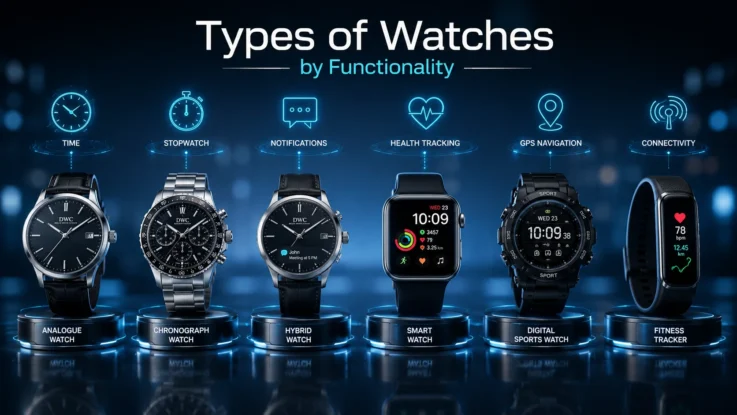
Analogue Watches
The classic. Analogue watches display time through hands moving across a dial, just as watches have done for centuries. Three hands — hour, minute, second — on a clean face. Some also show the date or day of the week.
Analogue watches are available for every budget and suit every occasion. They’re the natural choice for anyone who wants a traditional, elegant timepiece that works as well at a formal dinner as it does at the office.
Digital Watches
Digital watches show time as numbers on an electronic display rather than through moving hands. They typically pack in a wide range of features — GPS, step counters, timers, alarms, and more — making them practical tools rather than traditional accessories.
They’re great for sports, outdoor activities, and workwear, and like analogue watches, they come in price ranges that cover everything from basic budget models to high-spec adventure watches.
Chronograph Watches
A chronograph is essentially a watch with a built-in stopwatch function. You’ll recognise one by the subdials on the face — small secondary dials that track elapsed seconds, minutes, and sometimes hours. Many chronographs also feature a tachymeter scale around the outer rim, which lets you calculate speed over a known distance.
Chronographs look sophisticated and purposeful, which is why they’ve become popular as everyday dress watches even among people who never use the stopwatch function. They’re available across a wide range of styles and budgets.
Hybrid Watches
Hybrid watches sit between traditional analogue and full smartwatch. They look like conventional watches — proper hands, classic dial — but incorporate digital features underneath, like step counting, notification alerts, and sleep tracking.
They’re ideal for people who want the benefits of a fitness tracker without sacrificing the look of a real watch. A hybrid gives you both without asking you to choose.
Smart Watches
Smartwatches are wearable computers that happen to tell the time. They connect to your smartphone via Bluetooth or Wi-Fi, display notifications, make and receive calls, track fitness metrics, monitor heart rate, use GPS, and in some cases, work completely independently of a phone. If technology integration is your priority, a smartwatch is the most capable option on this list.
Fitness Watches
Fitness watches are purpose-built for health and activity tracking. Step counting, heart rate monitoring, calorie tracking, sleep analysis, GPS route recording — the focus is entirely on helping you understand and improve your physical wellbeing. Most are water-resistant to at least 30 to 50 metres, so you can wear them in the shower or pool without worry.
Types of Watches by Style
Beyond movement and functionality, style plays a huge role in which watch suits you best. Here’s a breakdown of the main style categories.

Dress Watches
Dress watches are made for formal occasions. Slim, elegant, and refined — they’re designed to slip under a shirt cuff and complement formal or business attire without drawing too much attention. Simple dials, precious metals, and minimal complications are the hallmarks of a great dress watch.
Luxury Watches
Luxury watches are about craftsmanship and artistry as much as timekeeping. Hand-finished movements, premium materials, meticulous attention to detail, and designs that have been refined over decades or centuries — a true luxury watch is a piece of history you wear on your wrist.
Dive Watches
Built for underwater use, dive watches are water-resistant to at least 100 metres and typically feature rotating bezels that let divers track elapsed time while submerged. They’re rugged, reliable, and have become one of the most popular casual watch styles precisely because of their durability and clean, purposeful design.
Field Watches
Originally designed for soldiers in World War II, field watches prioritise legibility, durability, and simplicity. Clear dials, easy-to-read numerals, lightweight cases, and water resistance make them versatile companions for both outdoor adventures and everyday wear.
Aviator Watches
Designed for pilots, aviator watches are built for legibility and practicality in demanding conditions. Large dials, bold numerals, and often a rotating bezel or multiple time zone displays make them functional tools. They also happen to look excellent off the cockpit.
Racing Watches
Racing watches are the chronograph’s sporting sibling — built around speed measurement, with large dials, prominent tachymeter scales, and bold, confident designs inspired by motorsport. They’re dramatic on the wrist and built to be noticed.
Similar Reads: Top 10 Titan Watches | 10 Best Indian Watch Brands | 10 Best Timex Watches
Military Watches
Tactical, durable, and functional above all else — military watches are built for the field. Compass functions, shock resistance, waterproofing, and robust straps make them capable tools for anyone who spends time in demanding environments.
Fashion Watches
Fashion watches prioritise aesthetics over mechanical complexity. They’re designed to look great, coordinate with an outfit, and make a style statement. Most use quartz movements and simple complications. Some fashion watch collections are built around a broader lifestyle brand — coordinating with bags, belts, and accessories as part of a complete look.
Sport Watches
Sport watches are purpose-built for physical activity. Water resistance, shock resistance, GPS, heart rate monitoring, and activity tracking are all common features depending on the sport. From running to cycling to swimming, there’s a sport watch built specifically for what you do.
Wood Watches
An increasingly popular niche, wood watches use natural wood in the case, the strap, or both. They’re lightweight, eco-friendly, and genuinely distinctive — no two pieces of wood are identical, which means every wood watch is slightly unique.
Pocket Watches
The ancestor of the modern wristwatch, pocket watches carry all the charm of a different era. Kept in a waistcoat or jacket pocket rather than worn on the wrist, they’re now primarily worn as statement accessories or kept as collectibles — but they’re still made and sold for those who appreciate the tradition.
Nurses Watches
Designed specifically for medical professionals, nurses watches are typically worn on a lapel rather than the wrist, keeping them clean and hygienic. They’re water-resistant for frequent handwashing, easy to read at a glance, and built to handle the demands of a clinical environment.
Similar Read: Top 10 DWC Watches to Consider for Every Wrist
Which Type Is Right for You?
The honest answer is that the best watch is the one that fits your life. If you want elegance and tradition, a mechanical or automatic dress watch is hard to beat. If you want practicality and low maintenance, quartz is the smart choice. If health tracking matters most, go fitness or smart. If you want something that turns heads and starts conversations, a chronograph or dive watch in a bold colourway does the job.
The beauty of watches is that there are no wrong answers — just different priorities. And now that you understand what all the categories actually mean, finding the right one for you should feel a lot less overwhelming.