


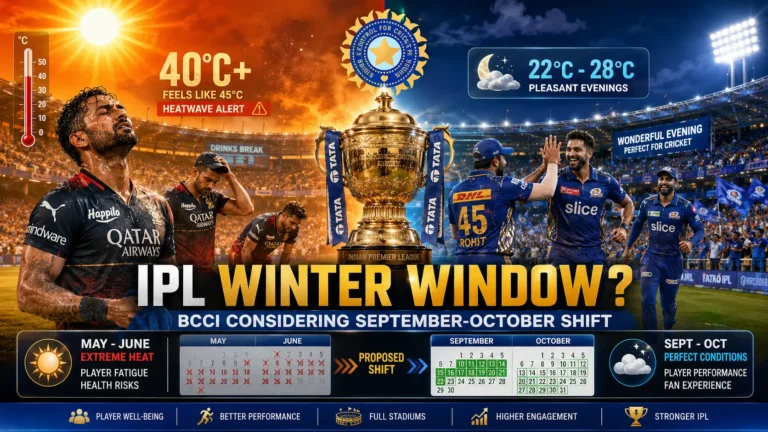
For 18 years, the IPL has been a summer fixture — starting in March, running through April, and wrapping up at the end of May. Fans have accepted the sweltering heat, the sticky evenings, and the rain interruptions as part of the package. Moreover, the extreme heat conditions in India will not only damage fans but can also harm players. But it looks like that might finally be about to change.
The BCCI is seriously considering shifting the IPL to a winter window — most likely September to October — and the conversation has moved well beyond casual speculation. IPL Chairman Arun Dhumal’s recent comments have sparked a new debate about the timing of the most valuable cricket league in the world, with the BCCI considering shifting the window from April-May to September-October.
The trigger is straightforward — the weather has simply become too difficult to ignore. With players battling 40°C heat and rain interruptions becoming routine, India’s cricket board is seriously exploring a September-October slot for the world’s biggest T20 league. Here’s what a winter IPL could mean for players, fans, and the tournament’s future.
The Heat Problem Is Getting Worse
Watching IPL matches in the sweltering heat of April and May is often exhausting for cricket fans, while frequent thunderstorms and rain interruptions often spoil the spectacle. At the IPL 2026 final in Ahmedabad, the afternoon temperature touched nearly 40°C, and even when the match began in the evening, it hovered around 35°C with humidity levels at approximately 55 per cent.
Players were seen wiping sweat off their faces throughout the evening — and this wasn’t an exception. There have been complaints from players and coaches — particularly overseas cricketers — about the physical toll of playing in extreme heat, and these concerns are among the key reasons why the BCCI has begun exploring the possibility of turning the IPL into a winter tournament.
Many cricketers have suffered from cramps, injuries and exhaustion, with some even forced to leave the field during matches. For a league that depends on its overseas stars showing up fit and at their best, that’s a real problem — not just for player welfare, but for the quality of cricket on display.
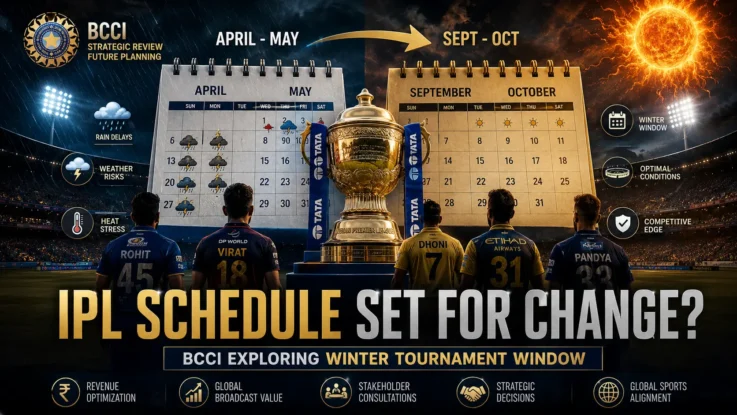
Why September-October Makes Sense
A September-October window solves several problems at once. The worst of the Indian summer is over, monsoon season is winding down, and temperatures across most venues are far more manageable. Evening matches in October feel like a completely different experience compared to a humid April night in Chennai or Kolkata.
Another major reason for the BCCI to consider moving this window is that international cricketers are busy with their national duties until late March, which creates scheduling pressure at the start of the current April-May slot. A September start would give players more breathing room between international commitments and the IPL.
There’s also the expansion question. The BCCI is actively considering expanding the IPL season to 94 matches from 2028, but the current April-May window simply doesn’t have enough space to accommodate that many games without stretching into genuinely brutal weather. A longer window in cooler months would make expansion far more practical.
The Shorter-Term Option — Start Earlier
Not everyone at the BCCI is ready to make a dramatic leap to September. There’s also a more conservative proposal on the table. The BCCI is exploring the possibility of moving the IPL calendar forward by around 15 days — since the 2026 season started on March 28, the board is looking at a potential start date closer to March 15 in future editions, with the aim of concluding the tournament by around May 15 rather than stretching it to the end of May.
The thought behind this proposal is straightforward — finishing the season earlier could help avoid both the harshest summer heat and the pre-monsoon weather that often affects several venues across the country. It’s a smaller change, but one that could make a noticeable difference in player conditions and fan experience without requiring a complete overhaul of the international cricket calendar.
The Complications Involved
Moving the IPL window isn’t as simple as printing new dates on tickets. The international cricket calendar is a tightly packed puzzle, and the September-October period is already claimed by bilateral series, ICC events, and other franchise leagues around the world. Any significant change would require extensive negotiations with other boards and ICC approval.
BCCI Secretary Devajit Saikia stressed that any increase in matches or window changes would need to fit within the international cricket calendar and align with commitments under the Future Tours Programme. The participation of overseas players, bilateral series, and multinational events governed by the ICC would all need to be considered.
For now, the BCCI’s attention remains firmly on creating a smoother and more weather-friendly tournament rather than making it bigger, with no immediate discussion on a 94-match IPL — a situation that may be revisited after 2027 depending on how the cricket calendar evolves.
Whether a full winter shift happens or just an earlier March start, one thing is clear — after 18 editions of cooking players and fans alive, the BCCI has finally acknowledged that something needs to change. The only question now is how big that change will be.
Also Read: Kohli Delivers Again as Royal Challengers Bengaluru Clinches Consecutive IPL Championships
Also Read: IPL 2026 Prize Money Breakdown: RCB Wins ₹20 Crore, GT Takes ₹13 Crore as Runners-Up
Also Read: BCCI Bans Smart Sunglasses Inside IPL Match Zones — Here’s Why It’s a Big Deal