


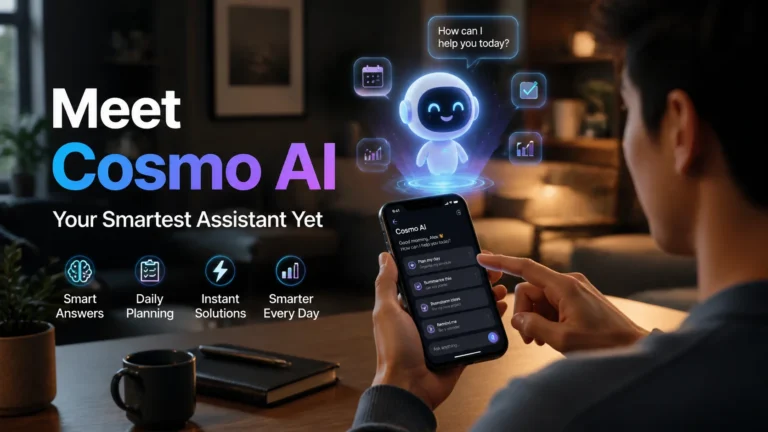
Something interesting slipped through Google’s gates recently. An app called Cosmo briefly appeared online before being quietly pulled down, and the glimpse it offered has been generating serious conversation in tech circles ever since.
The core idea behind Cosmo — as far as the leak reveals — isn’t about responding to questions faster or understanding voice commands more accurately. It’s about anticipating what you need before you ask. That’s a different ambition from most AI assistants, and if it works the way early reports suggest, it could genuinely change how people think about phone assistants.
What Is Google Cosmo AI Assistant
Cosmo appears to be Google’s next attempt at building an AI assistant that operates more like a smart companion than a search tool with a voice interface. Rather than waiting for you to ask something, it’s designed to monitor context, understand patterns, and proactively surface what you need when you need it.
The technical term for this is proactive intelligence — the assistant builds a picture of your habits and uses that picture to stay one step ahead. Early reports suggest this is the central design principle of Cosmo rather than just a feature added on top of traditional assistant functionality.
The app was live for a brief window before being removed, which suggests it either appeared ahead of schedule or was pulled back for further development. Either way, it gave people enough of a look to start asking serious questions about what Google is building.
A Leak That Sparked Curiosity
Accidental app leaks in the tech world aren’t unusual — they happen when internal builds make it further along the release pipeline than intended. What’s interesting about the Cosmo leak specifically is how quickly it disappeared once it was spotted.
That speed of removal suggests the team either wasn’t ready to show it yet or had specific reasons for keeping it under wraps a little longer. The timing — ahead of Google I/O season — has added fuel to speculation that this is something being prepared for a formal announcement soon.
For now, most of what we know about Cosmo comes from that brief window before the listing vanished.
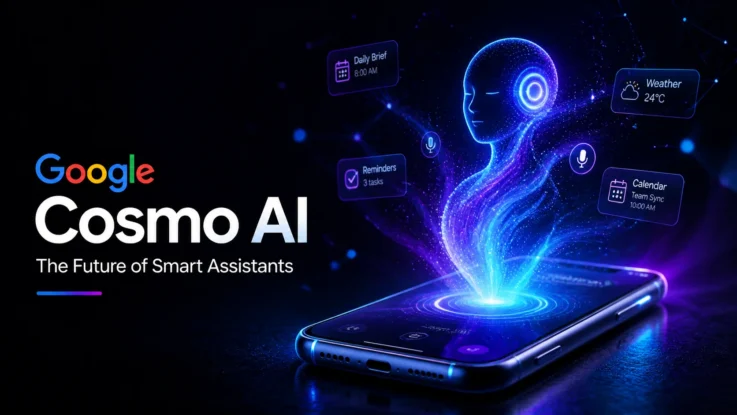
What Makes Cosmo Different
The existing Google Assistant works on a simple model — you ask, it answers. Even with improvements over the years, the fundamental interaction pattern is the same: the human initiates, the AI responds.
Cosmo appears to be designed around flipping that dynamic. Instead of you asking about traffic before a meeting, Cosmo notices you have a meeting and checks traffic without being asked. Instead of you manually composing a reply to a message, it drafts a contextually appropriate response based on your conversation history and communication style.
The difference sounds subtle but it isn’t. An assistant that waits to be asked is a tool. An assistant that anticipates is something closer to an actual helper.
A Shift Toward Proactive AI
Google has been moving in this direction for a few years — features in Google Now, Discover feed updates, and various Pixel-specific capabilities have all pointed toward the same goal. Cosmo looks like the most explicit expression of that direction yet.
The broader AI trend supports this shift. The most useful AI systems are increasingly the ones that work quietly in the background, surfacing relevant information at the right moment rather than requiring constant active engagement. Cosmo seems to be Google’s bet that users are ready for that kind of relationship with their assistant.
Integration with Google Ecosystem
This is where Cosmo could have a genuine advantage over standalone AI apps. Google’s ecosystem — Gmail, Calendar, Maps, Search, YouTube, Drive, and everything else — represents an enormous amount of contextual data about how people live their digital lives.
An AI assistant with access to your calendar knows about your meetings. One with access to Maps knows your commute patterns. One with access to Gmail understands your communication habits. Combine all of that with proactive intelligence and you start to see what Cosmo could actually do.
The depth of integration possible within Google’s own ecosystem is something that third-party AI apps simply can’t match, and that’s probably one of Cosmo’s core strategic advantages.
Privacy and Control Questions
An assistant that proactively monitors context and anticipates behaviour needs access to a lot of personal data to do that effectively. That’s not a criticism — it’s just the reality of how proactive AI works — but it does raise legitimate questions.
What data does Cosmo access? How long is it stored? What happens if you want to limit what it knows about you? How transparent is Google about how the system makes its decisions?
These aren’t hypothetical concerns. They’re the questions that will determine whether people actually trust Cosmo enough to use it the way it’s designed to be used. Google will need clear, straightforward privacy controls rather than settings buried in menus that most people never find.
What We Know About the Features
Based on the leak and surrounding reports, Cosmo appears to be focused on contextual awareness — understanding not just what you’re currently doing, but how that fits into your broader patterns and routines. This would allow it to make suggestions that feel relevant rather than random.
Smart suggestions, automated actions, deeper personalisation, and cross-app intelligence all seem to be part of the picture. The specific implementation details remain unknown, but the direction is fairly clear — make everyday digital tasks feel less like tasks and more like things that just happen smoothly.
Possible Launch Timeline
No official release date has been announced. The leak timing, positioned ahead of Google I/O, strongly suggests this is being prepared for a formal reveal at that event or shortly after. Google typically uses I/O to showcase AI developments, and Cosmo would fit that pattern well.
Whether what gets announced matches what the leak suggested, or whether the product has evolved significantly in development, we’ll have to wait and see.
Also Read: Top 7 AI Image Generation Tools | Best Alternatives to ChatGPT in 2026
Why Cosmo Could Be a Game Changer
The assistant space has been relatively static for a few years. Voice commands got more reliable, language understanding improved, but the fundamental model stayed the same. Cosmo represents a genuine philosophical shift in how an assistant is supposed to work.
If the execution is good — if the anticipation feels accurate rather than intrusive, if the privacy controls are genuinely transparent, if the integration across apps is as smooth as the concept suggests — this could be the thing that makes people actually rely on their phone assistant rather than just occasionally using it.
A Glimpse Into the Future of AI Assistants
Cosmo isn’t just another app update. It’s an indication of where Google thinks AI assistants are heading — toward systems that understand context deeply enough to be useful without being asked, that run quietly in the background of your digital life and make it flow more smoothly.
Whether Cosmo fully delivers on that vision when it launches, or whether it’s the first step in a longer development arc, the direction it represents feels inevitable. The interesting question isn’t whether AI assistants will become proactive — it’s how quickly and how well the transition happens.