


If you have been shopping for a new car lately, you have probably noticed that the word “hybrid” is everywhere. Every second car advertisement mentions it. Showroom staff bring it up unprompted. And yet, for most buyers, the honest answer to “how does a hybrid car actually work?” is somewhere between vague and genuinely baffling.
Is it electric? Sort of. Does it need charging? Usually not. Does it save fuel? Yes — but how? This guide answers all of that in plain language, step by step, without asking you to understand engineering diagrams or technical manuals. By the end of it, you will have a clear mental picture of what is happening under the hood every time a hybrid car moves.
Table of Contents
What Is a Hybrid Car, in the Simplest Possible Terms?
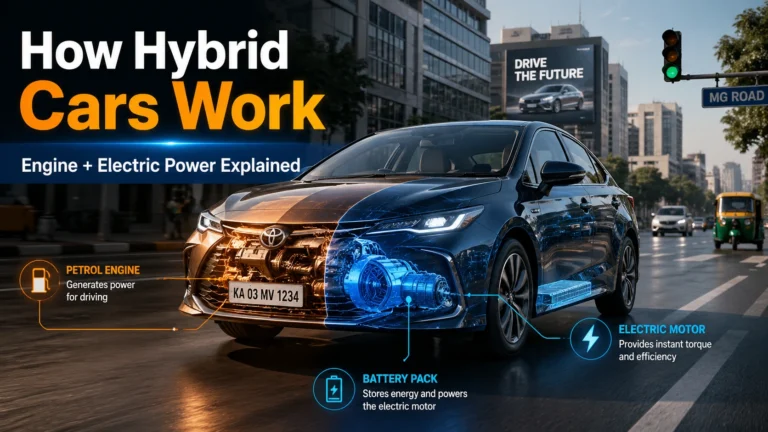
A hybrid car has two engines instead of one. There is a regular petrol engine — the same kind you would find in any ordinary car — and there is an electric motor powered by a battery pack. These two systems work together, and a computer in the car decides automatically which one to use at any given moment, or whether to use both at the same time.
You do not need to do anything differently as a driver. You get in, start the car, and drive as you normally would. The car handles all the switching. What you notice is that the engine is quieter than you would expect, the fuel economy is better than a normal petrol car, and the whole experience feels smoother — especially in stop-and-go city traffic.
Think of it this way: if a petrol engine is a long-distance runner and an electric motor is a sprinter, a hybrid uses the sprinter for the short, punchy bits and the distance runner for the sustained effort, swapping between them automatically to get the best out of both.
The Four Key Parts Under a Hybrid Car’s Hood
You do not need to know how each component is built, but knowing what the four main parts do makes everything else much easier to understand.
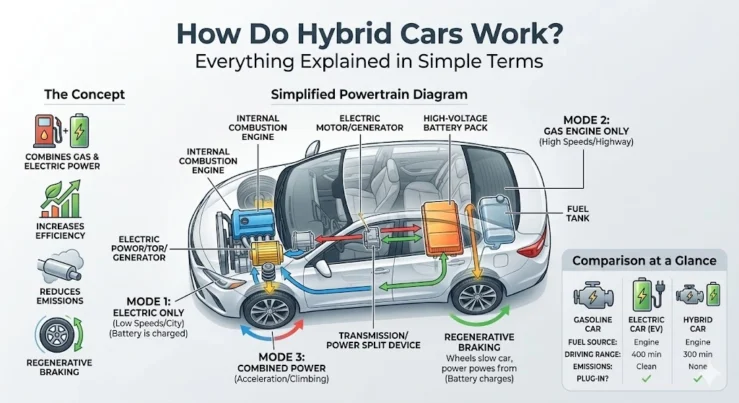
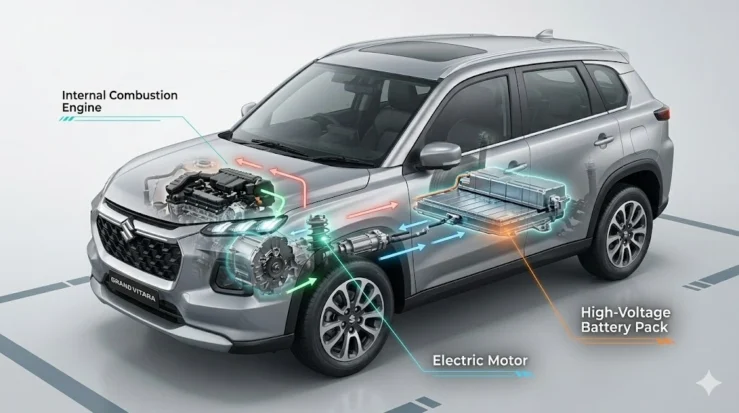
- The petrol engine: This is the conventional combustion engine that burns fuel to create power — identical in principle to the engine in any regular car. In a hybrid, it tends to be slightly smaller and more efficient because it does not have to do all the heavy lifting alone.
- The electric motor: This motor runs entirely on electricity from the battery pack. It is what powers the car at low speeds and gives it that instant, smooth acceleration when you pull away from a traffic light. It also acts as a generator when the car is braking.
- The hybrid battery pack: Not the small 12-volt battery that starts a regular car — this is a much larger, high-voltage battery pack (usually lithium-ion or nickel-metal hydride) that stores energy specifically for the electric motor. In most hybrids, this battery charges itself while you drive; you do not need to plug anything in.
- The power electronics unit: This is essentially the brain of the hybrid system — a computer that monitors everything happening in real time and decides when to use the petrol engine, when to use the electric motor, when to use both together, and when to redirect energy back into the battery. You never interact with it directly, but it is making decisions many times per second.
How a Hybrid Car Actually Behaves on the Road — Step by Step
The easiest way to understand a hybrid is to follow it through a typical day of driving.
Starting the Car and Moving at Low Speed
When you start a hybrid and move slowly — pulling out of a parking spot, crawling through a crowded market street, or sitting in bumper-to-bumper traffic — the car almost always runs on the electric motor alone. The petrol engine stays completely off.
This is one of the main reasons hybrids feel so different from conventional cars in city traffic. It is nearly silent at low speeds. There are no exhaust fumes during this phase. And because the petrol engine is not running, no fuel is being consumed at all. That adds up to significant savings on any commute that involves a lot of slow, stop-and-go movement.
Picking Up Speed on an Open Road
Once you are moving at a moderate pace on a highway or a free-flowing road — typically above 25 to 30 km/h — the petrol engine kicks in. At sustained, steady speeds, a combustion engine is actually quite efficient, so the car takes advantage of that. As the engine runs, it also generates electricity and sends it to the battery pack, quietly topping it up for the next time the electric motor is needed.
Hard Acceleration — Overtaking or Climbing a Slope
When you put your foot down for a quick overtake or hit a steep incline, both the petrol engine and the electric motor run together. The electric motor provides instant torque — the kind of immediate, effortless push you feel the moment you press the accelerator — while the petrol engine provides sustained power for the longer pull. Together, they give the car strong performance without the engine having to strain or burn excess fuel.
Braking and Slowing Down — Where the Magic Happens
This is the part of hybrid technology that most people find genuinely clever once they understand it. In a regular car, when you brake, all the kinetic energy — the energy of the car moving forward — is converted into heat by the brake pads and simply wasted. It disappears into the air.
In a hybrid, when you brake or lift off the accelerator, the electric motor reverses its role and becomes a generator. Instead of driving the wheels, it is now being driven by the wheels. This converts the car’s motion back into electricity, which gets stored in the battery pack for later use. The process is called regenerative braking, and it is one of the biggest reasons hybrids are so much more fuel-efficient in city driving than on highways — because the more you brake, the more energy you recover.
Not All Hybrids Are the Same — The Three Main Types Explained
When you see the word “hybrid” on a car, it could mean one of three quite different things. Here is a quick guide to telling them apart.
| Type | What It Means | Can Drive on Electric Only? | Needs Charging? |
| Mild Hybrid | Small motor assists the petrol engine — mainly for smoother start-stop and minor fuel savings | No | No |
| Full Hybrid (HEV) | Can run on electric only for short distances, petrol only, or both together | Yes, for short distances | No — charges itself while driving |
| Plug-in Hybrid (PHEV) | Bigger battery; can drive many kilometres on electricity before petrol engine kicks in | Yes, for longer distances | Yes — from a socket or charging point |
For most urban buyers in India, the full hybrid is the most practical option. It gives real fuel savings in city traffic without requiring you to find a charging point or change your habits. A plug-in hybrid makes more sense if you have a charging point at home and want to cover shorter daily commutes entirely on electricity.
Why Is a Hybrid More Fuel-Efficient Than a Regular Petrol Car?
Pull all of the above together and the efficiency gains become obvious. The petrol engine turns off when it is not needed — at traffic lights, in slow traffic, while coasting. The electric motor handles the situations where petrol engines are least efficient. The regenerative braking system recovers energy that would otherwise be thrown away as heat. And the whole system is managed by a computer that is constantly optimising for efficiency.
The result is that a hybrid typically delivers 20 to 40 percent better fuel economy than an equivalent petrol car, with the improvement most noticeable in city and suburban driving conditions. On a long highway run at constant speed, the gap narrows — because a regular petrol engine is actually fairly efficient at steady speeds, and regenerative braking has fewer opportunities to help.
Also Read: How to Choose Among the Best EV Scooters in India for Daily Travel
What Is It Actually Like to Drive a Hybrid?
Quieter than you expect — especially at low speeds. Smoother, with less engine vibration when pulling away. The transition between electric mode and petrol mode is almost imperceptible in well-engineered hybrids; you do not feel a jolt or hear a clunk as the engine comes on.
You still fill up with petrol exactly as you always have. Servicing is similar to a conventional car, though regenerative braking means your brake pads tend to wear far more slowly than in a regular vehicle because you are doing less mechanical braking overall. The hybrid battery is designed to last the life of the car, and most manufacturers offer long warranties on it — typically eight years or more.
The only thing that catches some new hybrid owners off guard is the total silence at low speeds. It is so quiet that some countries now require hybrids to emit a low artificial sound at speeds below 20 km/h so that pedestrians can hear them coming.
So, Should You Buy a Hybrid?
If you spend a significant portion of your driving time in city traffic — which describes most Indian commuters — a full hybrid will almost certainly save you money on fuel over time, while also reducing your vehicle’s emissions. The technology is mature, reliable, and widely available across price points in 2026.
A hybrid is not an electric car. It is not magic. It is simply a very clever way of using two different power sources, each in the conditions where it performs best, managed by a system that never stops optimising. Once you understand that, the whole thing stops sounding like engineering and starts sounding exactly like what it is: common sense on four wheels.
Note: Specifications, fuel-efficiency figures, and battery warranties vary by manufacturer and model. Always check the manufacturer’s official documentation before making a purchase decision.