


Most people get their PAN card, put it in their wallet, and don’t think about it again until they actually need it — which is usually at the worst possible moment, like when you’re in the middle of a bank transaction or filing your income tax return, and something doesn’t match up.
A PAN card isn’t just a piece of plastic. It’s tied to your tax records, your bank accounts, your investments, and almost every significant financial activity you do in India. A small error or a piece of outdated information can create delays, rejections, or complications that take weeks to sort out.
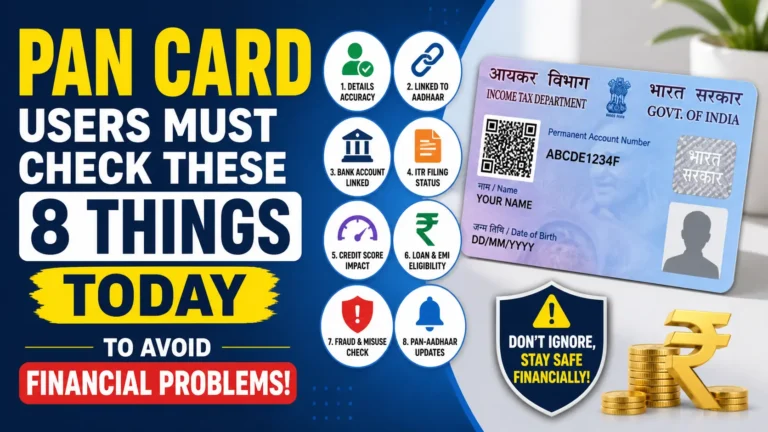
Here are eight things every PAN card holder should check right now — before a problem catches you off guard.
1. Verify That Your PAN Details Are Correct
This sounds obvious, but a surprising number of people have never actually sat down and compared what’s printed on their PAN card with their other official documents.
Check your full name exactly as it appears — including middle names and initials. Check your date of birth. Check your father’s name if it appears on the card. Any mismatch between your PAN card and your Aadhaar, passport, or birth certificate can create problems during tax filing, banking processes, or any verification that cross-references multiple documents.
If you find an error, the correction process through NSDL or UTI is straightforward, but it does take time — so better to sort it out now rather than when you’re under pressure.
2. Keep Your PAN and Aadhaar Details Aligned
PAN and Aadhaar are increasingly used together for a wide range of financial and government services. The details across both documents need to be consistent — your name, date of birth, and address should match or be as close as possible.
If your name is spelled differently on one versus the other, or if your date of birth has a discrepancy, this can cause authentication failures when you’re trying to use services that pull both documents simultaneously. Getting these aligned now saves significant frustration later.
3. Protect Your PAN Number — Treat It Like Sensitive Information
Your PAN number is directly connected to your financial history and tax records. That means it’s valuable information that fraudsters actively look for.
Also Read: Best Stocks to Buy This Month
Be selective about where and with whom you share it. Only provide it when it’s genuinely required — such as tax filings, banking KYC processes, large financial transactions, or government applications. Avoid uploading a photo of your PAN card to unfamiliar websites, apps, or forms that you haven’t independently verified as legitimate.
When a business or individual asks for your PAN, it’s completely reasonable to ask why they need it before handing it over.
4. Check Whether You Have More Than One PAN
Every individual is legally permitted to hold only one PAN card. Having two PAN numbers — even if the second one was issued accidentally or due to an old application you forgot about — is a violation that can attract a penalty of ₹10,000 under Section 272B of the Income Tax Act.
This can happen more often than people realise. If you applied for a PAN a long time ago and the card never arrived, then applied again, there’s a possibility two numbers were issued in your name. Check your records and if you discover a duplicate, surrender the extra one to the Income Tax Department immediately.
5. Use Your PAN Actively for Tracking Financial Records
Your PAN functions as a thread that connects all your financial activities — tax payments, investments, large purchases, insurance policies, property transactions. The more accurately your PAN details are recorded across these platforms, the easier it becomes to manage and track your overall financial picture.
When you switch banks, open a new investment account, or start a new financial relationship, always ensure your PAN is correctly linked and on record. Consistent use of a single, accurate PAN across all platforms makes your financial life significantly easier to manage.
6. Download Your e-PAN and Keep a Digital Copy
Physical cards get lost, damaged, or left at home at the worst possible times.
The good news is that an e-PAN — a digital version of your PAN card — is fully valid for most official purposes. You can download it from the NSDL or UTI portals, and it’s extremely helpful to have stored securely on your phone or in a trusted cloud storage service.
It’s also useful to have the e-PAN saved in your email — somewhere you can pull it up quickly if you’re asked for it during a bank visit or while filling a form online.
7. Stay Alert to PAN-Related Fraud
PAN fraud is a real and growing problem. Fraudsters use stolen PAN details to open fake bank accounts, apply for loans, file fraudulent tax returns, or conduct other unauthorized financial activities in someone else’s name.
Be wary of calls, messages, or emails claiming to be from the Income Tax Department, NSDL, or your bank asking you to share or verify your PAN details through a link. Legitimate institutions don’t ask for sensitive document details through these channels.
If you suspect your PAN has been misused, contact the Income Tax Department and your bank immediately. The faster you act, the better your chances of limiting the damage.
8. Keep Your Registered Contact Details Updated
Your registered mobile number and email address connected to your PAN and income tax account are important communication channels. Transaction alerts, tax notices, refund intimations, and authentication OTPs all depend on these being active and current.
If you’ve changed your phone number or email address, update these details on the Income Tax portal and with your bank as soon as possible. An inactive number means missed alerts and potential delays in time-sensitive financial communications.
Related Article: 10 Risks and 10 Benefits of Linking Your Bank Cards to Your Phone
A PAN card is much more than an identity document. It’s the backbone of your financial identity in India — the number that connects your taxes, your banking, your investments, and your financial history into one traceable record.
Going through this checklist takes maybe twenty minutes. Fixing a problem that could have been caught early can take months. Take the twenty minutes today.