



Karuppu Review: ⭐⭐⭐☆☆ (3/5)
Karuppu delivers solid mass moments powered by Suriya’s commanding dual-role performance and an energetic background score. While the courtroom drama and mythological fantasy portions work individually, the uneven transition between the two keeps the film from becoming a fully satisfying big-screen experience.
Rating: 3/5
Release: May 14, 2026
Language: Tamil
Cast: Suriya, Trisha Krishnan
Director: RJ Balaji
Music: Sai Abyankkar
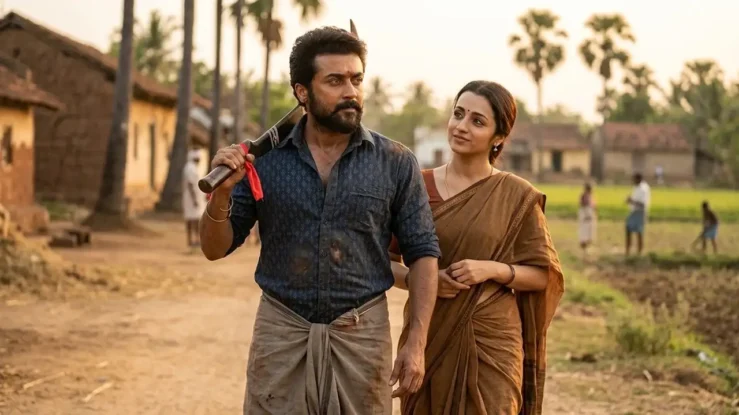
When Suriya shows up on a big screen, Tamil cinema audiences show up with him. That has been true for over two decades, and Karuppu — which hit theatres on May 14, 2026 — was always going to be an event. The build-up was intense. Trailers promised a dual role, a mythology-meets-courtroom storyline, and the long-awaited reunion of Suriya and Trisha Krishnan. The question walking out of the first shows was the same one it always is: did the film match what the trailers promised?
The early answer is: partly. Karuppu is a film of two very distinct halves, and Suriya himself described it that way in the lead-up to release. The first half is an emotional courtroom drama — tighter, more grounded, and built around a legal conflict that gives the story its moral backbone. The second half shifts into full mass masala territory — action sequences, deity mythology rooted in the story of Karuppasamy, humour, and the kind of whistle-worthy moments that Tamil cinema audiences travel specifically to experience in a packed theatre. Whether those two halves feel like they belong in the same film is the question early viewers seem divided on.
What is not in question is Suriya. The man is in excellent form. The dual role — lawyer on one side, an avatar connected to the deity Karuppasamy on the other — gives him room to work across registers, and he uses every bit of it. The courtroom scenes are measured and controlled, the mass scenes are explosive and physical, and in the quieter moments between, he makes you feel the weight the character is carrying. There are sequences in the second half, from the footage and early reactions, that will almost certainly become highlights of his career. When he is on screen and the BGM kicks in, the film is exactly what it promised to be.
Trisha Krishnan brings warmth and steadiness to her role, and the chemistry between her and Suriya — which fans have been waiting to see rekindled since their earlier films together — registers as the emotional core of the first half. Early reviews are somewhat divided on whether she gets enough to do as the film moves into its second gear, with some noting that her character takes a backseat once the mass elements take over. It is a fair observation. The courtroom drama gave her space; the fantasy action sequences give her considerably less.
RJ Balaji, known primarily as a comedian and television personality, has made a bold creative leap with Karuppu. Directing Suriya in a large-scale mythological action film is not a small undertaking, and the ambition is visible throughout. The visual set pieces are larger than anything Balaji has attempted before, and Sai Abyankkar’s background score is being widely praised for elevating both the emotional beats and the action sequences. The music genuinely seems to be one of the film’s strongest elements — the BGM in particular is drawing consistent appreciation from people who have seen it.
Where the film invites the most criticism, based on first reactions, is in the transition between its two halves. The tonal shift from grounded courtroom drama to full-blown mythological mass entertainer is significant, and not everyone in the audience is finding it seamless. Some viewers have praised it as a film that genuinely offers something for everyone — emotion, action, humour, mythology, and spectacle. Others feel the two halves compete rather than complement each other, as if two different films were edited together and asked to share a running time.
If you enjoy Tamil mass entertainers and you are a Suriya fan, Karuppu is very likely worth your time. He delivers. The spectacle is real. The second half has the kind of energy that reminds you why people still choose the theatre over the streaming platform. Go for him, stay for the BGM, and decide for yourself whether the two halves of the story hold together as well as the two halves of his performance do.