


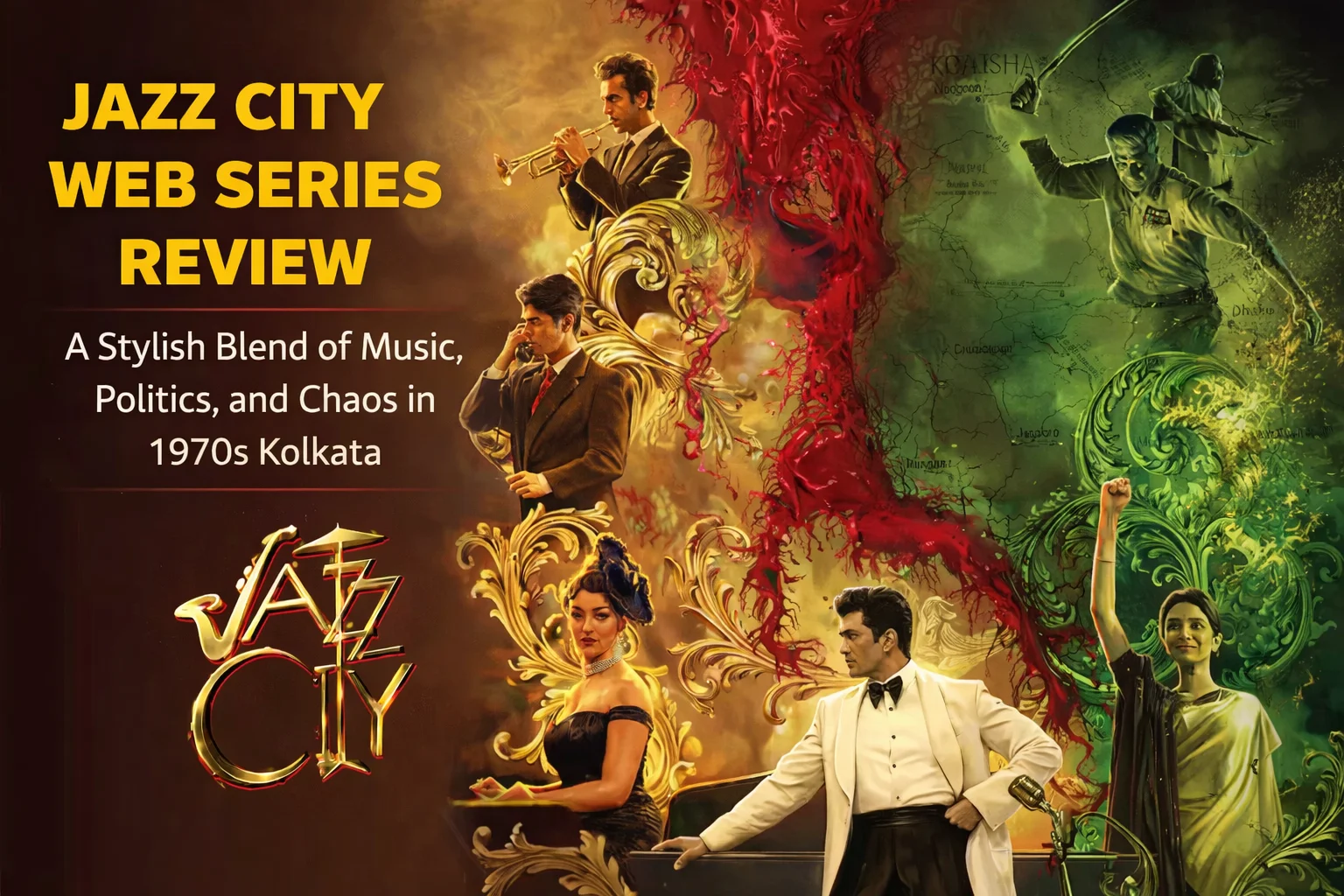
Jazz City premiered on SonyLIV on March 19, 2026, as the platform’s first Bengali original series. Set in 1970s Kolkata during the Bangladesh Liberation War, the show brings together history, music, and suspense.
The series revolves around a jazz club on Park Street that becomes a hidden hub for spies, revolutionaries, and refugees. It creates a layered narrative where every conversation and performance carries deeper meaning.
From the very beginning, the show establishes a rich and immersive world. It invites viewers into a time where art and politics collide.

Jazz City Web Series Review: A Story Rooted in Conflict and Survival
At the center of Jazz City is Jimmy Roy, a complex character caught between survival and purpose. His journey reflects the chaos of a city dealing with political unrest and social change.
Alongside him is Sheela, whose story brings in elements of espionage and emotional conflict. Their arcs intertwine with multiple characters, each carrying their own secrets and motivations.
The series does not follow a single linear path. Instead, it explores multiple narratives that together paint a larger picture of the era.
This approach adds depth but also creates moments where the story feels stretched. The balance between personal drama and political storytelling is not always consistent.
Atmosphere and Visual Design Steal the Show
One of the strongest aspects of Jazz City is its atmosphere. The production design beautifully recreates 1970s Kolkata with detailed sets, costumes, and props.
The smoky jazz clubs, dim lighting, and vintage elements transport viewers into a different time. Every frame feels carefully crafted to match the tone of the story.
The use of color palettes, including sepia and muted tones, enhances the historical feel. It creates a sense of nostalgia mixed with tension.
Visually, the series stands out as one of the most polished Bengali web shows. It succeeds in making the setting feel like a character itself.
Music Becomes a Narrative Tool
Music plays a central role in Jazz City. The soundtrack blends English jazz with Bengali musical traditions, creating a unique audio experience.
Songs are not just background elements but part of the storytelling. They reflect emotions, tensions, and even political undertones.
The jazz performances inside the club act as moments of expression. They often mirror the chaos unfolding outside.
This musical layer adds depth to the series. It makes the narrative more engaging and emotionally rich.
Performances Bring Authenticity
The cast delivers performances that feel grounded and real. Arifin Shuvoo brings intensity to Jimmy Roy, capturing both vulnerability and strength.
Sauraseni Maitra adds emotional depth to her role. Her character reflects the complexities of trust, fear, and survival.
The supporting cast also contributes significantly to the story. Many actors bring a natural style that enhances the realism of the series.
The chemistry between characters helps in maintaining viewer engagement. Even in slower moments, the performances keep the narrative alive.
Also Read: Invincible Season 4 Review: The Darkest and Most Explosive Chapter Yet
Direction Shows Ambition and Risk
Director Soumik Sen takes a bold approach with Jazz City. He attempts to merge genres that are rarely combined in Indian web series.
The mix of musical storytelling with political drama is ambitious. It gives the show a distinct identity.
However, this ambition also becomes a challenge. At times, the series feels overloaded with ideas and themes.
The direction shines in emotional and atmospheric scenes. But in narrative transitions, it occasionally loses focus.
Pacing and Narrative Challenges
While Jazz City starts strong, its pacing becomes uneven as the story progresses. Some episodes feel slow due to extended character setups.
The multiple storylines compete for attention. This makes it difficult for the narrative to maintain a steady rhythm.
Certain sequences feel longer than necessary. A tighter edit could have improved the overall flow.
Despite these issues, the series manages to hold interest through its visual and thematic strength. It remains engaging even when the story slows down.
A Bold Take on History and Society
The series explores themes like war, displacement, and identity. It highlights how political events impact ordinary lives.
Through its characters, Jazz City presents different perspectives on conflict. It shows both the chaos and resilience of people during difficult times.
The jazz club acts as a metaphor for freedom and expression. It becomes a space where voices are heard despite the surrounding tension.
This thematic depth adds value to the series. It makes it more than just a thriller.
Strengths That Make Jazz City Worth Watching
Jazz City stands out for its atmosphere and originality. The blend of music and storytelling creates a unique viewing experience.
The performances and production design are major highlights. They bring authenticity and emotional depth to the series.
The historical setting adds a layer of richness. It makes the story more engaging and meaningful.
The show also deserves credit for taking creative risks. It attempts something different in the OTT space.
Where the Series Falls Short
The biggest issue with Jazz City is its overcrowded narrative. Too many subplots make it difficult to focus on a central story.
The pacing could have been more consistent. Some episodes feel stretched while others move too quickly.
Character development is uneven for certain roles. A few arcs feel incomplete or underexplored.
The balance between music and storytelling sometimes leans too heavily on style over substance.
A Series That Leaves You Thinking
Jazz City is not a typical web series that offers quick entertainment. It asks viewers to invest time and attention.
Its layered storytelling and musical elements make it a unique experience. It stays with you even after the episodes end.
As the final moments unfold, the series quietly raises questions about truth, identity, and survival. It leaves behind an atmosphere rather than a clear resolution, much like a lingering jazz note that refuses to fade away.