


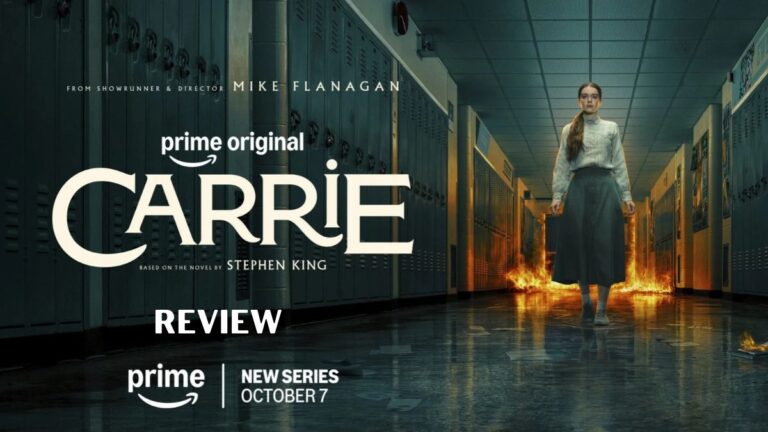
Carrie Review: ★★★★☆ (4/5)
Carrie reimagines Stephen King’s classic story for the social media era, delivering genuinely wonderful performances and quiet, emotionally resonant character work, even when the expanded eight-episode format occasionally overstuffs itself with extra plot.
Rating: ★★★★☆ (4/5)
Platform: Prime Video
Genre: Horror Drama
Episodes: 8
Creator: Mike Flanagan
Cast: Summer H. Howell, Samantha Sloyan, Matthew Lillard
Stephen King’s debut novel Carrie, published back in 1974, went on to sell millions of copies and inspired Brian De Palma’s iconic 1976 film adaptation, a breakthrough for Sissy Spacek and a genuine horror classic.
Now, Mike Flanagan, the mind behind The Haunting of Hill House, takes on the story again, this time as an eight-part Prime Video series, updating King’s tale with often startling accuracy for the present day.
The story still follows Carrie White, played by the phenomenal newcomer Summer H. Howell, a sheltered teenager living with her mother Margaret, played by Samantha Sloyan, and father Ralph, played by Tahmoh Penikett, a conspiracy-minded construction worker.
The family exists almost like a cult of three, with Carrie rarely allowed any contact with the outside world. After her father dies early in the series, a visit from social services sends Carrie to high school for the first time, where her oddness and homemade clothes immediately make her a target for the school’s cruelest students.
What makes this version genuinely compelling is how smartly it updates the story’s central horror for today’s world. The mean girls are still unspeakably mean, but now they have smartphones, social media, and anonymous accounts specifically built to torment Carrie online as well as in person.
When Carrie gets her first period in the girls’ locker room, having never been taught anything about it, the resulting humiliation kids pelting her with tampons feels both painfully familiar and freshly brutal in this modern context.
Alison Thornton plays Chris Hargensen, the ringleader of Carrie’s tormentors, though Flanagan smartly adds real dimension to her character rather than keeping her a flat villain.
Chris is revealed to be a sad mean girl herself, dealing with sudden financial ruin and an absent mother, played by Heather Graham, which pushes her toward hooking up with local troublemaker Billy Nolan, played by Arthur Conti. Siena Agudong plays Sue Snell, Chris’s more sympathetic best friend, whose guilt over the events to come frames much of the series through reflective narration.
The show also leans into Carrie’s growing telekinetic powers, showing her gradually learning to control abilities she previously only unleashed by accident. There are clear echoes of Stranger Things’ Eleven in how these powers are portrayed, which makes sense given how much King’s original story influenced that entire genre in the first place.
Where Carrie truly shines is in its quieter, more intimate character work, particularly the relationship between Carrie and her mother. Unlike previous adaptations that painted Margaret as purely a deranged religious fanatic, this version gives her a genuinely loving, if deeply frightened, dynamic with Carrie, one that gets a surprisingly rich arc of its own in the back half of the series.
Howell and Sloyan are both excellent in these scenes, grounding the show’s larger supernatural elements in something genuinely emotional and human.
The eight-hour runtime does come with some trade-offs. Stephen King’s original novel really only provided enough material for a tight feature film, so the series stretches things out with a few unnecessary subplots and some genuinely odd narrative detours in later episodes, seemingly laying groundwork for a planned three-season arc that will eventually go well beyond the source material.
The show also leans heavily into modern social commentary, touching on cyberbullying, school shootings, conspiracy thinking, and book banning, which occasionally feels a bit heavy-handed, even if it rarely feels entirely unearned.
Despite those hiccups, Carrie succeeds at exactly what it sets out to do, making you feel genuinely sad for most of its runtime and anxious for the rest. With a phenomenal lead performance from Summer H. Howell and genuinely thoughtful character work surrounding her, this modern Carrie earns its place as a worthy, often moving reinterpretation of King’s classic story.
If gentler, more whimsical television is more your mood after all that dread, our review of Small Prophets is a lovely change of pace, and for everything you need to know about streaming this new Carrie series, our release guide has all the details.