


The idea of the United States leaving NATO has once again come into focus after Donald Trump openly said he is considering such a move. His remarks have triggered serious discussions across political and security circles worldwide.
NATO has been a key military alliance since 1949, and the US plays a central role in its functioning. Any decision to withdraw would not just affect America but also reshape global security dynamics.
What Is NATO and Why Does It Matter?
NATO, or the North Atlantic Treaty Organization, is a military alliance of over 30 countries focused on collective defense. Its core principle is simple—an attack on one member is treated as an attack on all.

This alliance has played a major role in global stability, especially in Europe. The US provides significant military strength, funding, and leadership within NATO.
Can a US President Legally Withdraw from NATO?
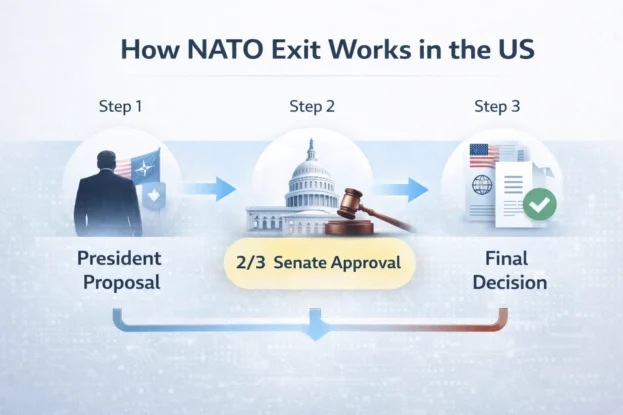
The legal question is not as simple as it seems. While the NATO treaty itself allows any member country to leave with a one-year notice, US domestic law complicates the process.
A law passed in 2023 clearly states that a president cannot withdraw from NATO without approval from two-thirds of the Senate or a separate act of Congress.
This means that even if a president wants to exit, they cannot do it alone without legislative support.
Why the Law Is Still Debated
The US Constitution is silent on how treaties should be terminated. While it requires Senate approval to join treaties, it does not clearly define the process for leaving them.
Because of this, some experts believe a president could still attempt to bypass Congress. Past examples, like treaty withdrawals by previous presidents, add to the legal uncertainty.
This creates a possible constitutional clash between the executive branch and lawmakers.
Trump’s Reasons for Considering NATO Exit
Donald Trump has long criticized NATO, calling it unfair to the US. He has argued that many European countries do not spend enough on defense and rely too heavily on American protection.
Recently, his frustration increased after NATO allies refused to support certain US military actions.
This has fueled his belief that the alliance is no longer serving US interests in the way it should.
Can the US Exit NATO Without Congress?
Here’s a simple breakdown of the situation:
| Factor | Status |
|---|---|
| NATO Treaty Rule | Allows exit with 1-year notice |
| US Constitution | Silent on treaty withdrawal |
| 2023 US Law | Requires Senate approval |
| Legal Reality | Likely court battle if attempted |
Even though the treaty allows withdrawal, US law puts strong checks in place. This means any attempt to leave NATO could end up in the Supreme Court.
Possible Workarounds Without Formal Exit
Even without officially leaving NATO, a US president could still reduce involvement. Experts say the US could weaken its participation by cutting funding, reducing troop presence, or limiting cooperation.
This is sometimes referred to as a “quiet exit” strategy.
Such actions could have nearly the same impact as leaving, without triggering a legal showdown.
What Happens If the US Leaves NATO
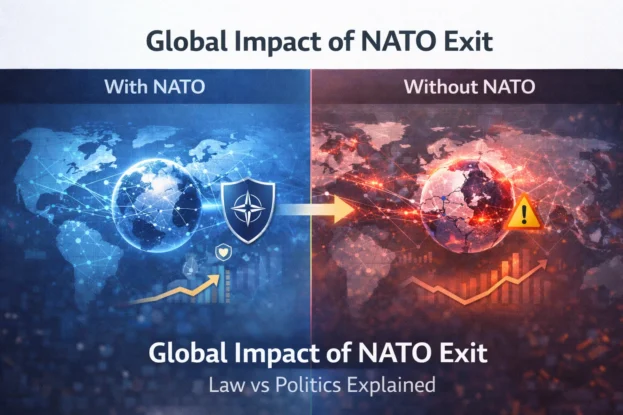
A US exit from NATO would be a major shift in global politics. It would weaken the alliance’s military strength and create uncertainty in Europe’s security system.
Countries that rely on US defense support may need to increase their own military spending. It could also encourage rival nations to expand their influence.
Experts warn that this could mark one of the biggest changes in global security since World War II.
How Allies Are Reacting
European leaders have already shown concern over the possibility of a US withdrawal. Many believe it could damage trust and weaken long-standing partnerships.
Some countries are now discussing building more independent defense systems. This indicates growing uncertainty about the future of NATO.
Also Read: India to Ban Chinese CCTV Cameras from April 1: What It Means for Buyers and the Security Industry
Key Takeaways on NATO Withdrawal
| Question | Answer |
|---|---|
| Can Trump exit NATO alone? | No, Senate approval is required |
| Is the law fully settled? | No, legal ambiguity remains |
| Can the US reduce involvement? | Yes, without formal exit |
| Would it impact global security? | Yes, significantly |
What This Means Going Forward
The debate over NATO is no longer just political—it is legal, strategic, and global. Even if a full withdrawal does not happen, the discussion itself is already changing how allies view US commitments.
The coming months could be crucial as legal interpretations, political decisions, and international reactions continue to evolve.