


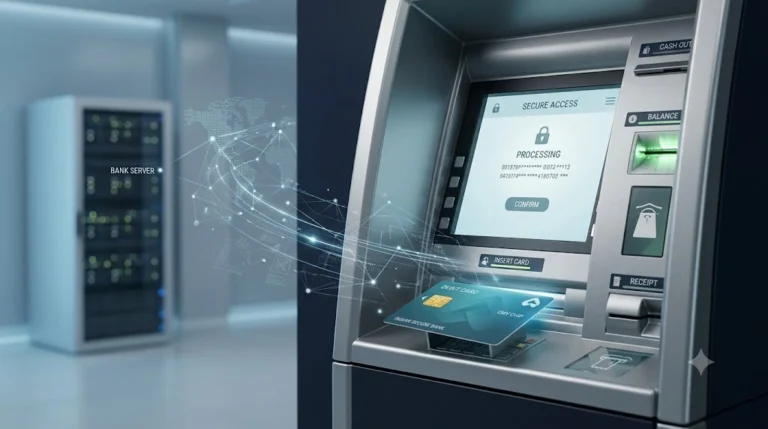
Using an ATM feels almost effortless. You insert your debit card, enter your PIN, choose the transaction, and collect your cash. The entire process usually takes only a few minutes.
But there is quite a lot happening behind the scenes. Your card is not simply carrying your bank account information around like a tiny storage device. Instead, it works as a secure way to identify and authenticate you while the actual account information is handled by your bank’s systems.
What Information Is Actually Stored on a Debit Card?
A debit card contains information that allows an ATM or payment machine to recognise the card and start a transaction.
Some details are printed directly on the card. These can include the card number, cardholder’s name and expiry date. Depending on the bank and card type, you may also see other information.
Most modern debit cards also have an EMV chip on the front. Many cards still have a magnetic stripe on the back, although chip-based payments have become much more common because they offer stronger security.
The important thing to remember is that your current bank balance is not normally stored on the physical card.
What Does the 16-Digit Card Number Mean?
Most debit cards in India have a 16-digit card number, although the exact number of digits can vary depending on the card and payment system.
In the card-payment world, this number is generally referred to as the Primary Account Number (PAN). It helps identify the payment network, card issuer, and card account within the payment system.
This PAN should not be confused with India’s Permanent Account Number, which is also commonly called PAN for income-tax purposes. They are completely different things.
Also Read: Best Stocks to Buy This Month
Your debit card number is also different from your bank account number. The two may be connected through your bank’s systems, but they are not the same number.
What Is the Magnetic Stripe Used For?
If you look at the back of a traditional debit card, you may notice a dark stripe. This is called the magnetic stripe.
The stripe contains card-related information in a form that compatible machines can read when the card is swiped. Older ATMs and payment terminals relied heavily on this technology.
However, magnetic stripes have an important security weakness. The information is relatively static, which means criminals can potentially copy it using card-skimming techniques.
This is one reason modern payment systems increasingly rely on chip technology.
How Does the EMV Chip Work?
The small metallic chip on your debit card is much more than a decorative feature.
EMV stands for Europay, Mastercard, and Visa, the companies associated with the original development of the standard. Modern EMV specifications are used across payment systems around the world.
During a chip-based transaction, the chip can perform cryptographic processing and generate security information for the specific transaction.
This makes it much harder for criminals to simply copy card information and reuse it for another transaction. Unlike a basic magnetic stripe, the chip can participate in creating transaction-specific security data.
That does not make chip cards completely immune to fraud, but it provides an important layer of protection.
What Happens When You Insert Your Card Into an ATM?
The process looks simple from the outside, but several things can happen within seconds.
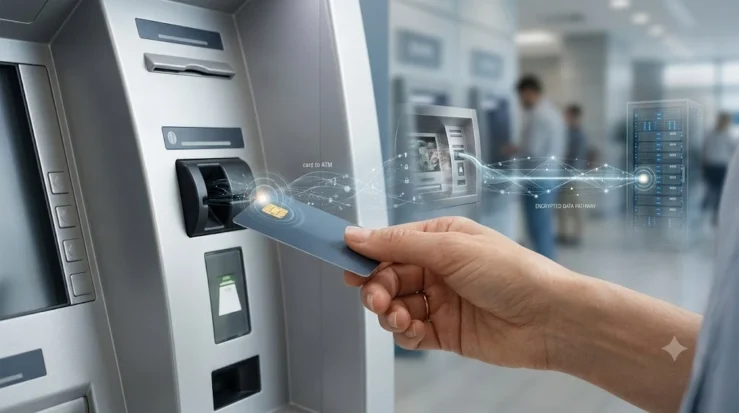
First, the ATM reads the required information from your card’s chip or another supported card interface. The transaction details are then sent through the appropriate payment and banking networks.
The relevant banking systems can check whether the card is valid, whether it has expired or been blocked, and whether the requested transaction can be processed.
You are then asked to enter your PIN. The PIN acts as an important authentication step before the transaction can be approved.
Once the necessary checks are completed, the bank can either approve or decline the transaction.
Where Is Your Bank Balance Stored?
This is probably the biggest question people have about ATM cards.
Your live bank balance is not stored on the debit card.
The actual account information is maintained in the bank’s computer systems. When you request a cash withdrawal or balance inquiry, the ATM communicates with those systems to obtain the information needed to process your request.
For example, imagine your account has ₹50,000 available, and you withdraw ₹10,000.
Your debit card does not independently calculate that your new balance should be ₹40,000. Instead, the authorised transaction is processed through the bank’s systems, where the account record is updated.
The ATM is essentially acting as a secure interface between you and the banking network.
What Happens After You Enter Your PIN?
Your PIN is one of the most important security elements in an ATM transaction.
When you enter your PIN on the ATM keypad, it is handled through secure transaction-processing systems. The PIN is not simply sent around as normal readable text for anyone to see.
The banking and payment infrastructure verifies the authentication information. If the PIN is correct and other transaction checks are successful, the bank can authorise the requested transaction.
For a cash withdrawal, the ATM then releases the approved amount and the transaction is recorded in the relevant banking systems.
Is Your PIN Stored on the Card?
Your PIN should not be thought of as ordinary information sitting on your card next to your name or card number.
PIN verification involves secure systems designed to protect this sensitive information during the transaction process.
This is also why you should never write your PIN on the back of your debit card or keep a written copy of it inside your wallet with the card.
If your card and PIN are stolen together, you could make it easier for someone to attempt unauthorised transactions before you have a chance to block the card.
Why Are Chip Cards Safer Than Magnetic-Stripe Cards?
The main advantage of EMV technology is that it does not depend only on static card information.
With older magnetic-stripe transactions, copied card data could potentially be reused. Chip-based transactions use cryptographic methods that make this kind of simple copying and reuse much harder.
However, an EMV chip is not a magic shield against every type of fraud.
Scammers can still target people through phishing messages, fake banking websites, fraudulent phone calls, social engineering, and stolen login credentials. In many cases, the weakest point is not the card itself but the person using it.
That is why good banking habits remain just as important as the technology built into the card.
Related Article: Things to Know Before Getting a Credit Card
What Security Layers Protect an ATM Transaction?
A typical ATM transaction can involve several security measures working together.
These may include the EMV chip, PIN authentication, encrypted communication, bank authorisation and transaction monitoring. Banks may also have systems that look for unusual or suspicious transaction patterns.
For example, an unusual withdrawal pattern or transaction that does not match normal activity could potentially trigger additional security checks, depending on the bank’s fraud-monitoring systems.
No single security feature does everything. Instead, several layers work together to make unauthorised access more difficult.
Never Share These Debit Card Details
Even with modern security technology, you still need to be careful about what information you share.
Never tell another person your ATM PIN or OTP. You should also be cautious about sharing card information with unknown people, websites or callers.
Be especially careful if someone claims to be a bank employee and asks for your PIN or OTP to “verify” your account, unblock your card or activate a service.
A genuine bank representative should not need you to reveal your ATM PIN.
Related Article: 7 Places Where You Should Never Use Your Credit Card
What Should You Do If Your Debit Card Is Lost?
If your card is lost or stolen, don’t wait to see whether it turns up later.
Use your bank’s official mobile banking app or internet banking service to temporarily disable or permanently block the card if that option is available. You can also contact the bank through its official customer-care channel.
It is also a good idea to check your recent transactions. If you find anything you do not recognise, report it to your bank immediately through an official channel.
Acting quickly can reduce the risk of further unauthorised transactions.
Your Debit Card Is a Secure Key to Your Bank Account
The easiest way to understand an ATM card is to think of it as a secure access and payment credential, rather than a miniature copy of your bank account.
The card contains information needed to identify and process transactions. Your actual account balance and transaction records are maintained by your bank’s systems.
When you insert the card, enter your PIN and request cash, the ATM communicates with the relevant banking and payment systems. Those systems help verify the card, authenticate the transaction, check whether it can be approved, and update your account after the transaction.
So the next time an ATM gives you cash in just a few seconds, remember that the plastic card in your hand is only one part of a much larger system working behind the scenes.