


India has been pushing hard to reduce its dependence on imported crude oil, and ethanol blending has been one of the biggest tools in that plan. But on the ground, the progress tells a different story — and the companies responsible for actually selling these fuels are pumping the brakes.
Here’s a plain-English breakdown of what’s happening, why it matters, and what it means for you as a vehicle owner.
First, What Are These Fuels?
Regular petrol at most pumps in India now contains up to 20% ethanol — that’s E20. It’s available in standard vehicles and has been gradually rolled out across the country.
E85 is a much higher blend — 85% ethanol and only 15% petrol. E100 is pure ethanol. Both of these can only be used in vehicles with special flex-fuel engines that are specifically designed to handle high ethanol content. Standard cars and bikes simply cannot run on them.
That distinction is at the heart of the entire problem.
The E100 Experiment That Went Nowhere
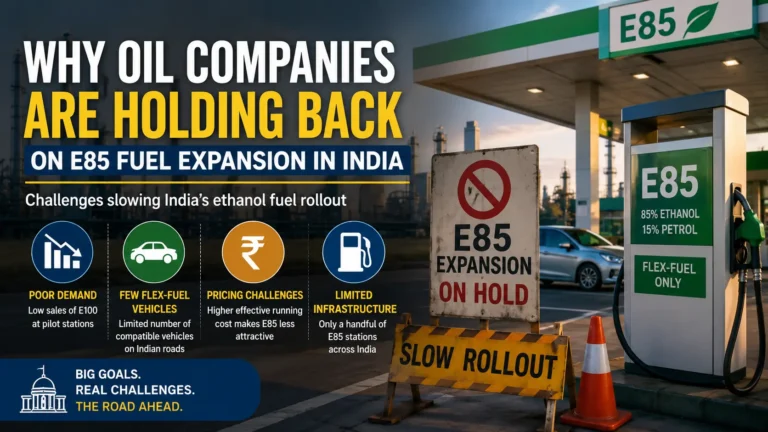
India’s oil marketing companies — Indian Oil (IOC), Bharat Petroleum (BPCL), and Hindustan Petroleum (HPCL) — launched E100 on a pilot basis at nearly 400 fuel stations across the country.
The result was almost no sales.
A senior Indian Oil Corporation official described the situation bluntly. The company saw virtually no demand at the pilot stations and has since reduced the active E100 network to just five or six outlets. The government has been encouraging expansion, but the official said they prefer to wait and see how things develop before committing to a larger rollout.
The reason is straightforward. You cannot sell a fuel if there are no vehicles that can use it.
The Flex-Fuel Vehicle Problem
E85 and E100 require flex-fuel vehicles — cars and bikes with engines built to handle ethanol-heavy fuel. Automobile manufacturers have started introducing these vehicles in India, but the numbers are still very small compared to the overall vehicle population on Indian roads.
Until a meaningful number of flex-fuel vehicles are actually on the road and being driven daily, building out hundreds or thousands of E85 stations is a financial risk that oil companies are not willing to take. Empty pumps cost money to run.
The Pricing Challenge Makes It Worse
Even for the few people who do have flex-fuel vehicles, the economics don’t always add up.
In Delhi, E85 is priced at ₹82.12 per litre compared to ₹102.12 for petrol — a difference of about ₹20. That sounds attractive, but there’s a catch. Ethanol has a lower energy content than petrol, which means your vehicle uses more of it to cover the same distance. When you factor that in, the effective running cost of E85 can actually be 15 to 25% higher than regular petrol.
Research by the Council on Energy, Environment and Water found that for ethanol to be genuinely cheaper to run than petrol, it would need to be priced at roughly ₹52 to ₹63 per litre — significantly below the cost of producing it commercially from any viable source.
Until that gap closes, most vehicle owners won’t have a strong financial reason to switch.
What the Government Says
Petroleum Minister Hardeep Singh Puri has pushed back on criticism of the ethanol blending programme. He rejected reports suggesting that E20 fuel is causing problems for vehicles, calling those claims a misrepresentation and noting that automobile manufacturers have consistently said there are no issues with the current 20% blend.
On E85, the minister acknowledged that the rollout is still in its early stages. The government’s plan involves setting up around 500 flex-fuel stations by December 2026, expanding to nearly 5,000 outlets across major cities by the end of 2027. As of now, only around 48 stations nationwide dispense E85.
The government is also reportedly reconsidering the pace of introducing E25 — a 25% ethanol blend — given that millions of vehicles on Indian roads were designed for lower ethanol content and may not handle higher blends well without engine modifications.
Also Read: 10 Countries with the Lowest National Debt | 10 Countries with the Highest National Debt
What This Means for Everyday Vehicle Owners
For most people driving standard petrol vehicles, very little changes in the immediate future. E20 is what you’re already using, and that’s likely to continue for the foreseeable future.
If you’re considering buying a new vehicle and long-term fuel flexibility matters to you, flex-fuel options are worth looking at — but the infrastructure to support them is still catching up.
India’s ethanol ambitions are real and the direction is clear. Getting there, however, is turning out to be a slower and more complicated process than the original roadmap suggested.