


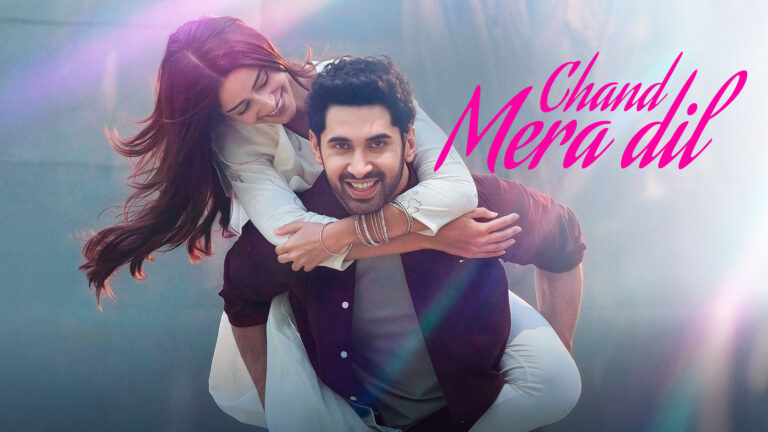
Chand Mera Dil Review: ★★☆☆☆ (2/5)
Chand Mera Dil has its heart in the right place and occasionally touches upon the harsh realities of young love and early adulthood with sincerity. However, the film gets too lost in its glossy presentation, dramatic slow-motion moments, and over-stylized emotions to truly leave a lasting impact.
Ananya Panday and Lakshya deliver committed performances, but the uneven screenplay and emotionally manipulative storytelling stop the film from becoming the mature romance it desperately wants to be.
Rating: ★★☆☆☆ (2/5)
Director: Vivek Soni
Cast: Ananya Panday, Lakshya
Language: Hindi
Release: May 22, 2026
Let us start with what Chand Mera Dil genuinely wants to be. It wants to be the film that shows young Indians what happens after the romance — the unplanned pregnancy, the too-early marriage, the bills, the burnout, the slow realisation that love alone does not pay rent or change diapers. That is a story worth telling. Bollywood rarely goes there. And for about twenty minutes, right around the midpoint, Chand Mera Dil actually goes there. Then it loses its nerve, cues a soulful song, and retreats back into the comfort of Instagram-ready close-ups and arms-wide-open railway station proposals.
The story follows Chandni and Aarav, both twenty-one, both engineering students in Hyderabad, both apparently too busy falling in love to attend class or use contraception. When Chandni decides to keep the baby despite neither of them having graduated or earned a single rupee, the film shifts gear. Responsibilities pile up. Sacrifices are made. The gap between the romantic dream and the domestic reality widens into something genuinely painful. The film knows what this feels like. It just does not always trust the audience to sit with that feeling without a musical distraction arriving every fifteen minutes.
Ananya Panday and Lakshya are both trying. That much is visible. Lakshya, in particular, has scenes that require real emotional exposure, and he throws himself into them with full commitment. The problem is that the screenplay keeps pulling the rug from under both of them. Chandni is written as independent and strong-willed in theory, and then written into a corner after a corner in practice. Her choices become increasingly hard to defend, not because real people do not make bad choices — they absolutely do — but because the film does not seem aware that it is making her unsympathetic. It thinks it is writing a complicated woman. What is actually written is a character that the story itself is quietly blaming for everything that goes wrong.
Aarav, meanwhile, gets the film’s full emotional sympathy. His crying scenes are shot beautifully. His pain is underscored with the right music. When a father compares their relationship to the warranty period of an LED bulb, the audience laughs because he had a point — and the film had accidentally handed the most reasonable line to the character meant to be the obstacle.
Then there is the filmmaking itself, which cannot stop drawing attention to itself. Every frame is soaked in golden hour warmth. Every confrontation happens in dramatic lighting. Windows rattle during emotional scenes. Silhouettes appear when words might have been more honest. The camera moves faster than the feelings, and the editing seems terrified of a quiet moment. Somewhere underneath all of it, there is a real film trying to breathe.
Hyderabad is genuinely lovely on screen — wide roads, green spaces, the casual mention of biryani — and it deserves more films set there. The title song, sung by Saiyaara-fame Faheem Abdullah, is genuinely beautiful and earns its place.
But beautiful songs and beautiful cities cannot carry a film that keeps flinching from its own story. Chand Mera Dil had something real to say about young love collapsing under the weight of real life. It just kept choosing the aesthetic over the honest moment, every single time.
Chand Mera Dil is now playing in cinemas.