


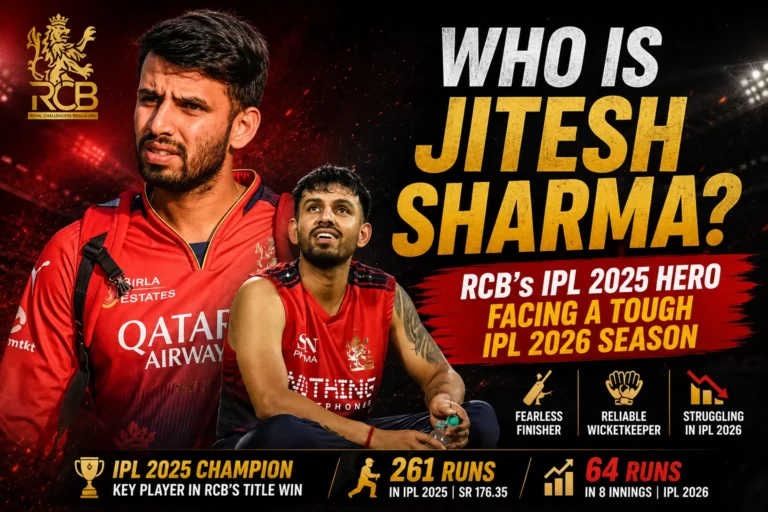
This time last year, Jitesh Sharma was the name RCB fans were putting in their appreciation posts. The wicketkeeper-batter from Nagpur who came in at number six or seven and somehow made every total look chaseable. The guy who attacked from ball one without appearing to have a single nervous bone in his body.
In IPL 2025, he scored 261 runs across 15 innings at a strike rate above 176. He hit an unbeaten 85 off 33 balls against Lucknow Super Giants in a game RCB had no business winning. He played a quickfire cameo in the final against Punjab Kings that shifted the momentum just enough. When RCB lifted their maiden IPL trophy, Jitesh Sharma was a genuine reason why.
In IPL 2026, he has scored 64 runs across eight innings. His average has dropped below 10. His strike rate has fallen off a cliff. In a match against Delhi Capitals, he managed 14 off 20 balls while RCB desperately needed someone to push the scoring rate — and he couldn’t do it.
Same player. Twelve months apart. Completely different story.
Who Is Jitesh Sharma? Where Does He Come From?
Jitesh was born on October 22, 1993, in Nagpur — which makes him 32 now, an age when cricket players are generally expected to be at or near their peak, not rebuilding confidence from scratch.
He came through the Vidarbha domestic system as an aggressive middle-order batter. The style was always there early — he preferred attacking bowlers to nudging singles, preferred hitting sixes to rotating strike, preferred pressure situations to comfortable ones. Domestic T20 cricket suited him precisely because it rewarded that instinct.
His early IPL years at Mumbai Indians didn’t give him enough runway. The real breakthrough came at Punjab Kings, where he finally had consistent chances to bat in the middle order and proved decisively that he could do it at the highest level. His reputation as a dangerous finisher was built there, over several seasons of delivering in situations where most players would have frozen.
Why RCB Paid ₹11 Crore for Him
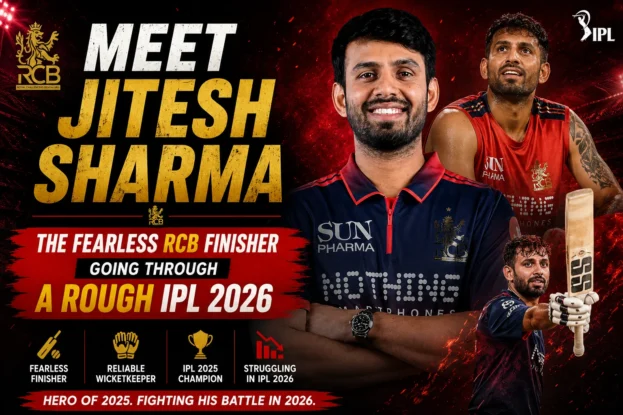
The IPL 2025 mega auction saw Royal Challengers Bengaluru pay ₹11 crore for Jitesh Sharma, and at the time it raised a few eyebrows. That’s a lot of money for a 31-year-old wicketkeeper who had been impressive but not dominant in his previous IPL stints.
RCB were buying a very specific thing: a finisher with no fear. Someone who could come in at 140 for 4 in the 16th over and turn it into 190 rather than 165. Someone who didn’t need to settle in, didn’t need three or four balls to assess conditions, didn’t need the match to be in a comfortable position before he started scoring.
The investment was validated almost immediately. Jitesh was exactly what RCB needed and paid for — and he delivered the season that justified every rupee of that price tag.
The Season That Made His Name
It’s worth going into the IPL 2025 season in some detail because the contrast with 2026 is so stark that you need to understand just how good he actually was.
The Lucknow Super Giants innings is the one everyone remembers. 85 not out off 33 balls. RCB needed a miracle and Jitesh provided one, with the kind of batting that doesn’t look like it should be possible — not because of the technical quality but because of the absolute refusal to acknowledge that the situation was dire. He batted like the match wasn’t in crisis, and somehow that affected the match’s reality.
Throughout the season, he was the player RCB turned to when they needed acceleration and couldn’t afford mistakes. He didn’t always make big scores — that’s not what a finisher’s job is — but he consistently made the right kind of impact at the right kind of moment. The strike rate of over 176 didn’t come from slogging carelessly. It came from reading the situation quickly and executing under pressure.
When RCB won the final, Jitesh was rightly celebrated as one of the architects of something the franchise had been trying to achieve for 18 years.
What Has Gone Wrong in 2026
The honest answer is: several things, probably in combination.
The most visible technical issue is his struggle against hard-length pace bowling. After his 2025 season, opposition teams did what they always do — they studied him carefully and found the angles that make him uncomfortable. Hard-length deliveries at pace, directed at specific areas that trouble his footwork and timing, have become the template for bowling at Jitesh in 2026.
He’s been dismissed repeatedly trying to force shots against fast bowlers when the ball isn’t in a place that invites those shots. The foot movement that looked assured in 2025 has looked hesitant this year. The timing that made him look effortless has looked effortful.
There’s also a confidence dimension to this. When a finisher loses form, the natural instinct is to try harder — to force the aggressive game that used to come naturally, because that’s the role and that’s what the team needs. That forcing tends to make things worse rather than better. The Delhi Capitals innings — 14 off 20, unable to rotate strike or find boundaries — suggested a player who had lost his rhythm completely and couldn’t find it under match conditions.
Teams plan for him now in a way they didn’t fully plan for him in 2025. That’s the price of a breakthrough season. The adjustment period is real.
The Pressure Is Real, But the Support Is Still There
RCB has kept faith with Jitesh despite everything. He remains the team’s vice-captain and primary wicketkeeper — both decisions that signal the management’s belief that this is a temporary form dip rather than a permanent decline.
Several former players have publicly defended him in the way that experienced cricketers tend to defend other experienced cricketers going through rough patches — acknowledging the struggle while pointing out that one innings can change everything in T20 cricket. That’s not just PR. It’s accurate. The format is volatile enough that a single 35-ball fifty can reframe an entire season’s narrative.
What the management is betting on is that the player they paid ₹11 crore for and who delivered in the biggest games of IPL 2025 still exists underneath the poor numbers. His technique can be adjusted. That his confidence can be restored. That the genuine finisher instinct — not performed, not lucky, but genuine — can be accessed again.
Also Read: Meet Sai Sudharsan — The Silent Run Machine of the Gujarat Titans
What’s at Stake Beyond RCB
At 32, Jitesh knows that T20 careers at the international level have compressed timelines. His IPL 2025 season had put him genuinely back in India’s white-ball conversation — the kind of finishing ability he showed was exactly what Indian selectors were looking for in the middle order.
IPL 2026 has significantly slowed that momentum. Selectors are watching. Rival finishers are putting up numbers. The window doesn’t stay open indefinitely.
This makes the rest of IPL 2026 particularly important for him — not just for RCB’s season, but for his own career trajectory. A strong second half could recover much of what the first half cost him. A continued struggle would raise harder questions about where he fits in both franchise and international cricket going forward.
The Part That Hasn’t Changed
Here’s the thing about Jitesh Sharma that gets lost in the poor-form narrative: the player he was in 2025 was real. Those weren’t circumstances conspiring to make an ordinary player look extraordinary. The 85 off 33 wasn’t a fluke. The title-winning cameo wasn’t luck. The strike rate above 176 across 15 innings was a consistent body of work, not a hot streak.
That player is still in there. The question is whether he can find the conditions — internal and external — to bring him back out.
T20 cricket has seen these reversals before. Players who looked finished finding form again. Players whose technique had been exposed are adjusting and came back stronger. It happens. It requires the right innings at the right moment to start the chain reaction.
Somewhere in the next few matches, Jitesh Sharma needs that moment. RCB needs it. And if you watched what he did in 2025, you know that when the moment comes, he can take it.
The question is just whether it comes in time.