


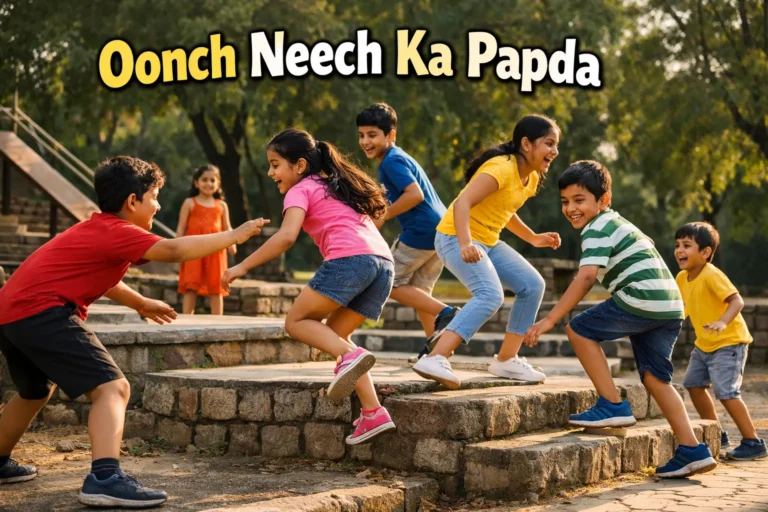
There was a time when kids did not need mobile games, battery backup, or Wi-Fi to have fun. All they needed was an open space, a few friends, and one loud shout that made everyone run in seconds. That is exactly the charm of Oonch Neech ka Papda.
If you have heard this name and wondered what it means, or if you want to teach this game to children today, this guide is for you. In simple words, Oonch Neech ka Papda is a traditional Indian outdoor game where one player becomes the catcher, called the denner, and others try to stay safe by moving between high and low surfaces.
It sounds easy. It is not. Once the denner starts chasing, the whole game becomes a mix of speed, timing, fun, and a little bit of dramatic overconfidence.
What Is Oonch Neech ka Papda?
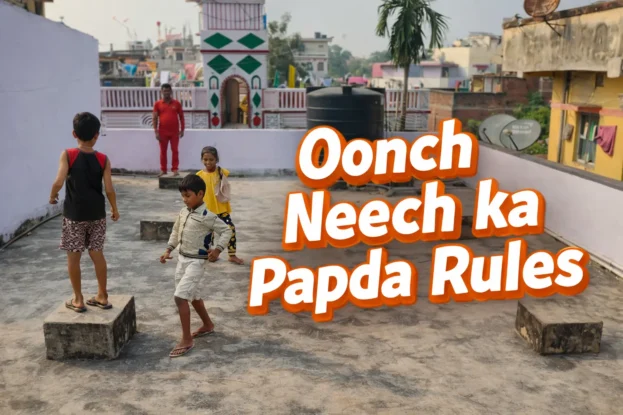
Oonch Neech ka Papda is a traditional North Indian children’s street game and a fun variation of tag. It is usually played in a place where both raised and lower surfaces are available. That could be a playground with steps, a park bench area, a lane with pavements, or any open spot where children can quickly move from one level to another.
The words are simple too:
- Oonch means high or elevated
- Neech means low or ground level
That is the whole heart of the game. One level is danger. The other level is safety.
Oonch Neech ka Papda Rules at a Glance
Here is a simple table for anyone searching for Oonch Neech ka Papda rules quickly.
| Rule | Simple Meaning |
|---|---|
| Minimum players | 4 or more |
| Main catcher | Called the denner |
| Best place to play | Uneven outdoor area with high and low surfaces |
| Safe place | The surface opposite to what the denner chooses |
| Main aim | Avoid getting tagged by the denner |
| If caught | Caught player becomes the next denner |
| Game style | Outdoor running and chasing game |
How to Play Oonch Neech ka Papda
If you are searching how to play Oonch Neech ka Papda, here is the step-by-step version in the easiest way possible.
1. Gather the players
You need at least 4 players to start, though more players make the game more exciting. With more children, there is more chaos, more shouting, and honestly, more fun.
2. Choose the denner
One child is selected as the denner, which means the catcher. This can be done by mutual agreement, a counting rhyme, or the usual classic method where everyone suddenly decides one unlucky child is “it.”
3. Stand together and say the chant
All players gather and shout:
“Oonch Neech ka Papda — Oonch maangi ki Neech?”
This means the players are asking the denner to choose either the upper level or the lower level.
4. Denner chooses Oonch or Neech
The denner picks one surface:
- If the denner chooses Neech, the ground becomes the denner’s zone
- If the denner chooses Oonch, the elevated area becomes the denner’s zone
The other players must quickly move to the opposite surface to stay safe.
5. Safe zone rule
This is one of the most important Oonch Neech ka Papda rules.
Players are safe only when they stand on the opposite surface from the one chosen by the denner. So if the denner picks ground level, the raised surface is safe. If the denner picks the raised surface, the ground is safe.
6. Denner restriction
The denner cannot move onto the opposite safe surface. That restriction is what makes the game smart, not just fast. It forces the denner to wait, chase carefully, and catch players when they step into danger.
7. Taunting is part of the game
Yes, this game has attitude.
Players often tease the denner by stepping briefly into the denner’s zone and saying something like:
“Hum tumhari Neech pe!”
That means, “We are in your zone, catch us!” It is playful, bold, and often followed by immediate regret and very fast running.
8. Keep moving
Players are not supposed to stay on one spot for too long. They need to move, shift, dodge, and keep the game active. That movement is what gives the game its energy.
9. Getting caught
If a player is tagged while standing on the denner’s chosen surface, that player becomes the new denner.
Then a fresh round starts, and the game continues.
Trending Article: Rosebud AI Review
What Is a Denner in Oonch Neech?
Many people search for Oonch Neech ka Papda denner rules, so here is the clear answer.
The denner is the catcher. This player chooses either Oonch or Neech and tries to tag the others on that chosen surface. The denner does not have full freedom to run everywhere. That is the twist. The denner is limited to one surface, which makes timing more important than speed alone.
In simple words, the denner is not just chasing. The denner is waiting for mistakes.
Oonch Neech ka Papda Number of Players, Age Group, and Ground
Here is another quick table for readers who want the basics.
| Detail | Answer |
|---|---|
| Number of players | 4 or more |
| Best age group | 3 to 8 years |
| Type of space needed | Uneven outdoor ground |
| Good places to play | Park, playground, street with steps, raised pavement area |
This is why Oonch Neech ka Papda for kids works so well. The rules are simple, but the movement keeps children fully involved.
Why Children Love This Oonch Neech ka Papda Outdoor Game
There is something very real about this game. No equipment. No setup headache. No one needs to buy anything. Just children, space, shouting, running, and one friend who is taking the denner role way too seriously.
This game helps children build:
- Alertness
- Physical agility
- Reflexes
- Team interaction
- Confidence
- Basic strategy
Children learn when to move, when to wait, and when not to act too smart in front of the denner. That last lesson usually arrives quickly.
Oonch Neech ka Papda Different Names in India
One of the most interesting things about this game is how it appears across regions in different forms.
| Region | Local Name |
|---|---|
| North India | Oonch Neech ka Papda |
| West Bengal | Kumir Daanga |
| Andhra Pradesh | Nela Banda |
| Maharashtra | Dagad ka Maati |
| Punjab, Pakistan | Ounch Neech |
So if someone searches for Kumir Daanga game West Bengal rules, Nela Banda game Andhra Pradesh rules, or Dagad ka Maati Maharashtra game rules, they are looking at games that follow a very similar idea.
That is what makes traditional games so beautiful. The name changes. The childhood feeling does not.
Oonch Neech Rules in Hindi Meaning
A lot of readers also look for Oonch Neech rules in Hindi or Oonch Neech ka Papda meaning in English.
Here is the simple translation:
- Oonch = high place
- Neech = low place
- Papda = part of the old chant and game phrase
The core idea stays the same: one player controls either the high or low zone, and others stay safe on the opposite side.
FAQ: Oonch Neech ka Papda Rules
1. What is Oonch Neech ka Papda?
It is a traditional Indian outdoor tag game played on uneven surfaces with high and low levels.
2. How do you play Oonch Neech ka Papda?
One player becomes the denner, chooses Oonch or Neech, and tries to tag others on that chosen surface.
3. What happens when a player is caught?
The caught player becomes the next denner.
4. How many players are needed?
At least 4 players are needed.
5. What age group is this game suitable for?
It is best suited for children aged 3 to 8 years.
6. What surface is needed?
An outdoor place with both elevated and ground-level areas.
7. Is Oonch Neech ka Papda a traditional game?
Yes, it is one of the classic 90s Indian street games rules kids still remember fondly.
8. Is the game still relevant today?
Yes. In fact, it fits perfectly into conversations around traditional outdoor games for kids India rules because it is active, social, and screen-free.
Conclusion
If you were searching for Oonch Neech ka Papda rules, the good news is this game is wonderfully simple. You need a few players, an uneven outdoor space, and one denner ready to chase. That is it.
But behind those easy rules, the game gives children a lot more than fun. It teaches movement, timing, confidence, and social play in the most natural way possible. No app update needed. No charging cable required. Just childhood doing what childhood does best.
And honestly, that may be the best part of all.