



Imagine volleyball. Now remove your hands. Add a rattan ball, a badminton-style net, and athletes who can bicycle-kick the ball over their own heads with the kind of casual elegance that would make a gymnast feel insecure. That’s Sepak Takraw in one sentence — and somehow, that sentence still doesn’t do it justice.
If you’ve never heard of it, you’re not alone. Most Indians haven’t. But here’s the thing: this sport has been played across Southeast Asia for over 500 years, it’s a fixture at the Asian Games, and it is — without exaggeration — one of the most physically spectacular things a human being can do with their body and a ball. And slowly, quietly, it is making its way into India.
So let’s talk about it. What is Sepak Takraw, how does it work, where can you play it in India, and why should you even care? All of that — right here.
What Exactly Is Sepak Takraw?
The name itself is a mashup. Sepak is Malay for “kick.” Takraw is Thai for the woven rattan ball used to play the game. Put them together, and you get the sport’s entire philosophy in two words: kick the ball.
But of course, it’s so much more than that.
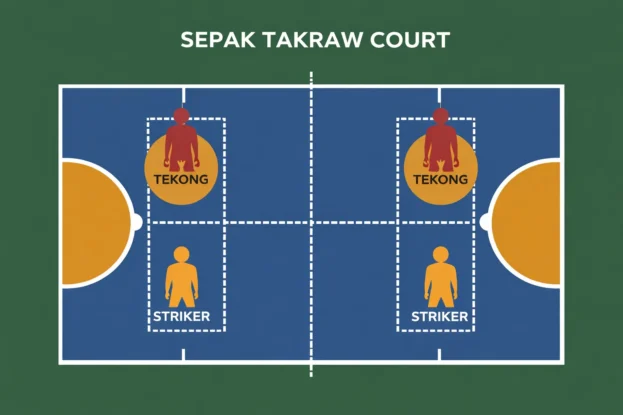
Sepak Takraw is a net sport played between two teams of three players each. The court is roughly the size of a doubles badminton court. There’s a net in the middle — about 1.52 metres high on the men’s side. The goal is to send the ball over the net and into the opponent’s court without it touching the ground. You have three touches to do it.
Here’s the catch: you cannot use your hands or arms. Feet, knees, chest, and head — that’s your entire toolkit.
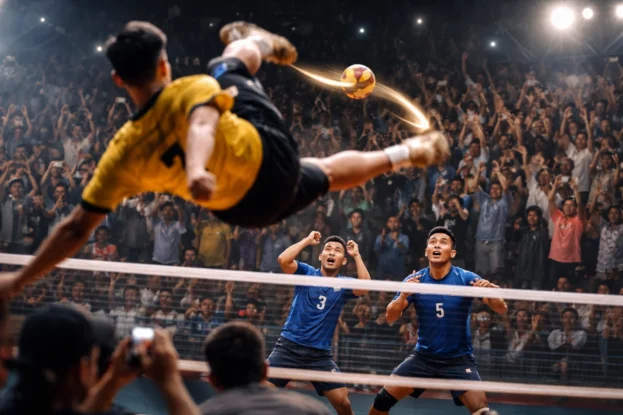
What this produces is something that looks less like a sport and more like a martial arts film. Players launch themselves into the air and deliver bicycle kicks, scissor kicks, and roll spikes — overhead kicks where a player literally somersaults in mid-air to smash the ball downward over the net at angles that should be physically impossible. It is extraordinary to watch. It is even more extraordinary to do.
A Brief History: 500 Years of Kicking
Sepak Takraw’s roots trace back to 15th-century Southeast Asia, particularly in the Malay Archipelago and the kingdoms of present-day Thailand and Malaysia. In its earliest form, it wasn’t even a competitive sport — players stood in a circle and kept the rattan ball in the air using only their feet, knees, and heads. The goal was pure skill, not winning.
By the 19th century, the net was introduced and formal rules began to take shape. Thailand and Malaysia both claim significant historical ownership of the sport, and both are right — it evolved across borders simultaneously in the way that folk sports often do.
The modern version was standardized in the 1960s, and the International Sepak Takraw Federation (ISTAF) was founded in 1988. Since then, the sport has been a staple of the Asian Games, the Southeast Asian Games, and various continental championships.
India’s relationship with the sport is younger but growing. The Sepak Takraw Federation of India (STFI) was established and has been working to develop the sport at grassroots and competitive levels — particularly in the northeastern states, where proximity to Southeast Asia has created a natural cultural connection to the game.
How the Game Actually Works
Let’s break down the rules, because once you understand them, watching a match becomes ten times more exciting.
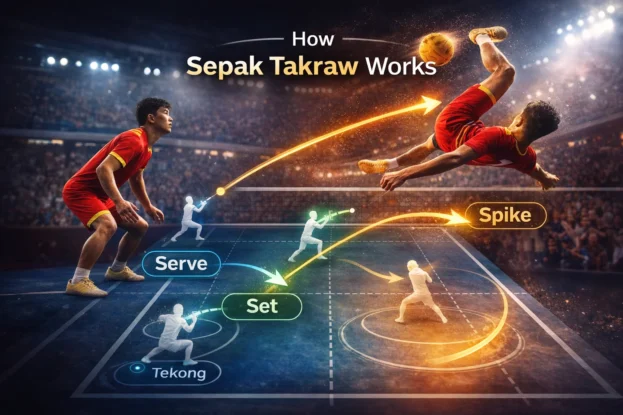
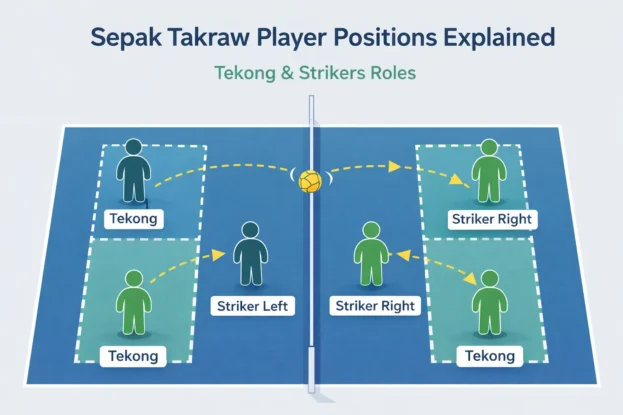
The teams: Each team (called a regu) has three players — a tekong (server) who stands at the back, and two strikers at the front on either side of the net.
Starting play: The tekong serves by flicking the ball over the net with their foot. They must keep one foot inside the service circle while serving. The ball must cross the net on the serve — if it doesn’t, it’s a fault.
Rallying: Each team gets a maximum of three touches to send the ball back over the net. Any body part except hands and arms is fair game. This is where the acrobatics happen — players will leap, twist, and contort themselves to keep rallies going and create attacking angles.
Scoring: Sepak Takraw uses a rally-point system, similar to modern volleyball. Every rally results in a point, regardless of who served. Matches are typically played as best of three sets, with each set going to 21 points (sometimes 15 in shorter formats).
Winning a point: You win a point when the ball lands in your opponent’s court, when they fail to return it within three touches, or when they commit a fault (touching with hands, stepping out of bounds, etc.).
The formats: There are three main competitive formats — Regu (3v3, the standard format), Double (2v2), and Quadrant (a team of four players defending against serves one at a time). Each format has its own tactical logic and visual style.
The Skills You Need to Play
Here’s where it gets both exciting and a little humbling. Sepak Takraw demands an unusual combination of skills that you won’t find in any other single sport.
Flexibility is non-negotiable. The roll spike alone — the signature overhead kick — requires players to arch their back, swing their dominant leg up over their head, and make clean contact at the peak of a jump. Without serious hamstring and hip flexibility, you won’t get anywhere near it.
Balance and coordination matter enormously. Unlike football, where your kicking foot does most of the work, Sepak Takraw requires you to control the ball with the inside of the foot, the heel, the knee, the chest, and the head — often in rapid sequence. Each surface behaves differently and requires its own muscle memory.
Jumping ability is what separates good players from great ones. The higher you can jump, the more options you have for attack. Many elite players can spike from well above net height, creating downward angles that are nearly impossible to defend.
Reading the game is an underrated skill. With only three touches available, every touch needs a purpose. Is this the set? Is this the spike? Where is the opponent positioned? Fast tactical thinking is as important as physical ability.
Basic progression for a beginner:
- Start with the inside kick — hitting the ball with the inside of your foot, like a basic football pass. This is your foundation.
- Practice keeping the ball up solo, alternating feet. This builds touch and control.
- Learn the knee touch — useful for low balls and quick redirects.
- Work on the header — it follows the same principle as football heading but demands more precision.
- Graduate to the outside kick and heel kick as your control improves.
- Only then attempt the roll spike — ideally with a coach or experienced player guiding you.
Sepak Takraw in India: Where Things Stand
India is not a Sepak Takraw powerhouse — not yet. But the sport is growing in pockets, and those pockets are genuinely exciting.
The northeastern states — Manipur, Assam, Mizoram, Meghalaya — have the most developed Sepak Takraw culture in the country. The proximity to Myanmar, Thailand, and other Southeast Asian nations means the sport arrived here earlier and took root more naturally. Manipur in particular has produced some of India’s best competitive players.
Beyond the Northeast, states like West Bengal, Tamil Nadu, and Karnataka have emerging federations and school-level programs. The Khelo India initiative has also listed Sepak Takraw among the sports it aims to develop, which means institutional funding and infrastructure are slowly beginning to catch up.
At the international level, India has competed in the Asian Games and South Asian Games in Sepak Takraw. The results have been modest so far, but the trajectory is upward.
Also Read: IPL 2026 Schedule Announced: Full Match List, Format, Teams, Venues Revealed
Why This Sport Deserves More Attention in India
Here’s my honest opinion: Sepak Takraw is criminally underrated in India, and the reasons it should be more popular here are stacking up.
It rewards Indian athletic strengths. Cricket, kabaddi, and wrestling have given India generations of athletes with explosive leg power, sharp reflexes, and high pain tolerance. These are exactly the physical attributes that Sepak Takraw demands.
It’s spectacular. In an era where sports content is consumed as much on Instagram and YouTube as on television, Sepak Takraw is made for the screen. A single roll spike clip goes viral every time. The sport is inherently watchable.
It’s accessible to start. All you need is a takraw ball and an open space. The rattan ball is inexpensive. The basic skills can be picked up in a park. You don’t need a gym, expensive equipment, or a formal facility to begin exploring the sport.
It’s growing globally. ISTAF has been pushing hard for Olympic inclusion, and while it isn’t there yet, the sport’s profile is rising worldwide. Getting in now means India could build genuine international competitiveness before the window gets more competitive.
Quick Reference: Sepak Takraw at a Glance
| Aspect | Detail |
|---|---|
| Origin | Southeast Asia (Thailand, Malaysia), ~15th century |
| Governing Body | International Sepak Takraw Federation (ISTAF) |
| Team Size | 3 players per side (Regu format) |
| Court Size | 13.4m x 6.1m (similar to badminton doubles) |
| Net Height | 1.52m (men), 1.42m (women) |
| Ball | Woven rattan or synthetic, 12–13 holes |
| Scoring | Rally point, first to 21 wins a set |
| Forbidden | Using hands or arms at any point |
| India’s Body | Sepak Takraw Federation of India (STFI) |
| Best States in India | Manipur, Assam, West Bengal, Tamil Nadu |
Frequently Asked Questions
What is Sepak Takraw and where is it from?
Sepak Takraw is a net sport originating in Southeast Asia, with roots in 15th-century Malaysia and Thailand. Players use their feet, knees, chest, and head — never their hands — to volley a rattan ball over a net. It combines elements of volleyball, football, and gymnastics into something entirely its own.
Is Sepak Takraw played in India?
Yes, though at a developing level. The sport is most active in India’s northeastern states, particularly Manipur and Assam. A national federation exists, and India has competed in international tournaments, including the Asian Games. Khelo India has also begun supporting its development at the grassroots level.
How is Sepak Takraw different from volleyball?
The core concept — get the ball over the net and into the opponent’s court — is similar. But in Sepak Takraw, hands and arms are completely prohibited. You play with your feet, knees, chest, and head only. This single rule changes everything about how the game looks, feels, and is played.
Can beginners learn Sepak Takraw?
Yes, with patience. The basic kicks — inside foot, knee touch, header — are learnable by anyone with reasonable fitness. The advanced techniques, like the roll spike, require serious flexibility and training time. Most coaches recommend starting with basic ball control drills and building up gradually over several months.
What equipment do you need to play Sepak Takraw?
At the most basic level, just a takraw ball — which is affordable and widely available online in India. For formal play, you need a court (badminton-sized) and a net at the correct height. Proper footwear with good ankle support is recommended once you begin jumping and spiking.
Is Sepak Takraw an Olympic sport?
Not yet. The International Sepak Takraw Federation (ISTAF) has been pursuing Olympic recognition, but the sport is currently included in the Asian Games, Southeast Asian Games, and South Asian Games. It has a strong continental presence, and international advocacy for Olympic inclusion is ongoing.
Which country is best at Sepak Takraw?
Thailand and Malaysia are the traditional powerhouses, with South Korea and Myanmar consistently competitive at the international level. At the Asian Games and ISTAF World Cup, these four nations dominate the podium across most events.
Also Read: 20 Best Pickleball Paddles in India: Top Picks for Every Skill Level
The Bottom Line
Sepak Takraw is not a sport. It’s a spectacle that happens to have rules.
It demands flexibility you have to earn, coordination that takes months to build, and the courage to throw your body into the air and trust that your foot will find the ball on the way down. It is difficult. It is beautiful. And in India, it is waiting for the athletes, the funding, and the attention it deserves.
If you’re a sports fan who hasn’t seen a Sepak Takraw match yet — search for a roll spike video right now. Seriously, stop reading and do it. I’ll wait.
And if you’re in Manipur, Assam, or any city with an active program? Go find a court. Talk to a coach. Start with the basics. Because this is one of those rare sports where watching it is incredible, but playing it — even badly, even just keeping the ball in the air for a few seconds with your knee — feels like you’ve unlocked something.
That’s worth chasing.