


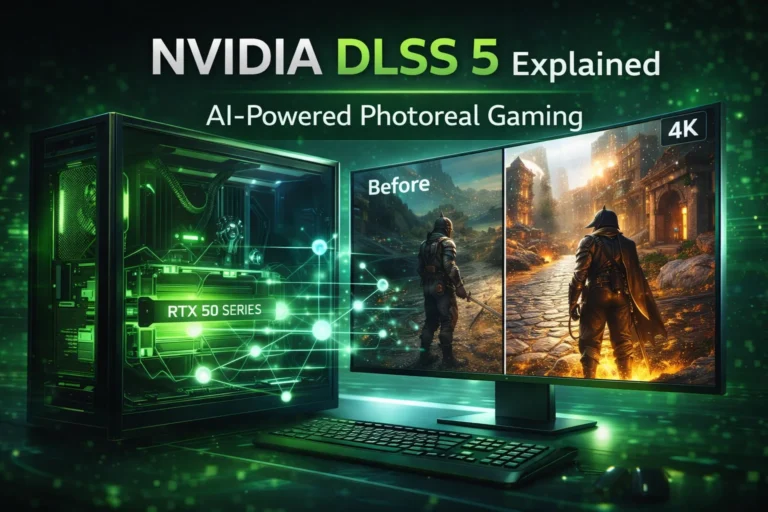
NVIDIA DLSS 5 is the latest version of the company’s AI-powered graphics technology, announced at GTC 2026. It represents a major leap in neural rendering, aiming to deliver photorealistic visuals in real-time gaming.
Unlike previous versions, DLSS 5 uses generative AI to enhance image quality, lighting, and materials. This approach moves beyond traditional rendering and brings graphics closer to real-world visuals.
NVIDIA DLSS 5 Announcement and Release Date
NVIDIA officially revealed DLSS 5 during its GTC 2026 event held on March 15-16, 2026. The company confirmed that the technology will roll out in fall 2026.
The rollout will begin through updates via the NVIDIA app, making it accessible to supported GPUs. Early adoption will focus on next-generation RTX graphics cards.
NVIDIA DLSS 5 Key Features
DLSS 5 introduces a new generation of AI-powered rendering technologies. It uses structured data and generative AI to create highly detailed and realistic visuals.
The technology aims to bridge the gap between real-time rendering and Hollywood-level visual effects. This makes it one of the most advanced graphics solutions introduced by NVIDIA.
| Feature | Details |
|---|---|
| Core Technology | Generative AI Neural Rendering |
| Visual Quality | Photorealistic lighting and textures |
| Performance | Real-time rendering at high resolutions |
| Use Case | Gaming, film, design, simulation |
| GPU Support | RTX 50 Series (initially) |
These features highlight NVIDIA’s shift toward AI-driven graphics processing rather than traditional rendering methods.
How DLSS 5 Works
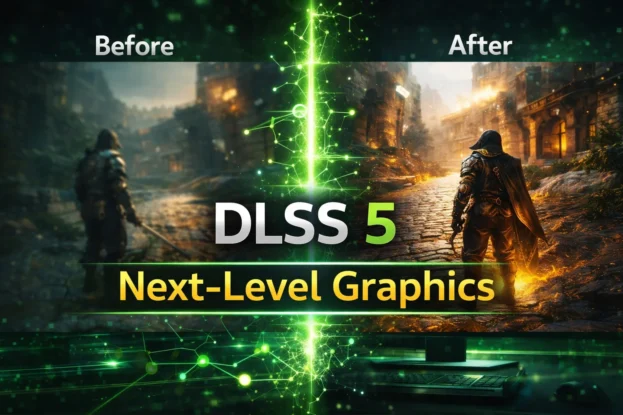
DLSS 5 works by using generative AI models trained on massive datasets of images and real-world visuals. It combines this with structured graphics data to enhance each frame dynamically.
Instead of simply upscaling images, DLSS 5 can generate realistic lighting, reflections, and textures. This results in visuals that look closer to real life than previous DLSS versions.
DLSS 5 vs Previous Versions
DLSS 5 builds on earlier versions like DLSS 4.5, which already introduced multi-frame generation. However, DLSS 5 takes a bigger step by integrating generative AI into the rendering pipeline.
This allows it to produce more accurate lighting and detail compared to traditional ray tracing alone. The upgrade represents a significant evolution in NVIDIA’s graphics technology.
| Version | Key Improvement |
|---|---|
| DLSS 3 | Frame Generation |
| DLSS 4.5 | Multi Frame Generation (up to 6X) |
| DLSS 5 | Generative AI Neural Rendering |
With each version, NVIDIA continues to push the boundaries of performance and visual quality.
Performance and Hardware Requirements
DLSS 5 is designed to run on the upcoming RTX 50 Series GPUs. Early demonstrations showed the technology running on high-end GPUs like the RTX 5090.
Some demos even used dual GPU setups to achieve maximum performance at 4K resolution. This indicates that DLSS 5 may require significant hardware power, especially at launch.
Supported Games and Compatibility
At launch, DLSS 5 will support select upcoming titles. One of the first confirmed games is AION 2, with more titles expected to be added later.
Initially, DLSS 5 will be exclusive to RTX 50 Series GPUs. There is no official confirmation yet regarding support for older RTX graphics cards.
| Category | Details |
|---|---|
| First Supported Game | AION 2 |
| GPU Support | RTX 50 Series |
| Platform | NVIDIA App Updates |
| Future Support | More games expected |
This limited compatibility suggests NVIDIA is focusing on next-generation hardware for this technology.
Also Read: Vivo T5x 5G Launch in India: Expected Price, Specifications, and Features
Real-World Applications Beyond Gaming
NVIDIA has highlighted that DLSS 5 is not limited to gaming. The technology can also be used in industries like filmmaking, architecture, and design.
By enabling real-time photorealistic rendering, DLSS 5 can reduce production time for visual effects. This makes it useful for professionals working in creative and technical fields.
Industry Reaction and Expectations
The announcement of DLSS 5 has generated strong reactions from the gaming and tech communities. Many developers were surprised by how quickly NVIDIA moved from DLSS 4.5 to DLSS 5.
Early demos showed impressive 4K visuals with near-photorealistic quality. However, some experts have noted that the technology may require powerful hardware to run smoothly.
What Makes DLSS 5 Different
The biggest difference with DLSS 5 is its use of generative AI for rendering. Instead of relying only on traditional graphics techniques, it creates new visual data in real time.
This allows for more realistic lighting, textures, and environmental effects. It represents a shift toward AI-driven graphics that could define the future of gaming visuals.
NVIDIA DLSS 5 Future Potential
DLSS 5 has the potential to transform how games and visual content are created. As hardware becomes more powerful, this technology could become more accessible to a wider audience.
Future updates may expand support to more GPUs and games. This could make DLSS 5 a key part of next-generation gaming and digital content creation.