


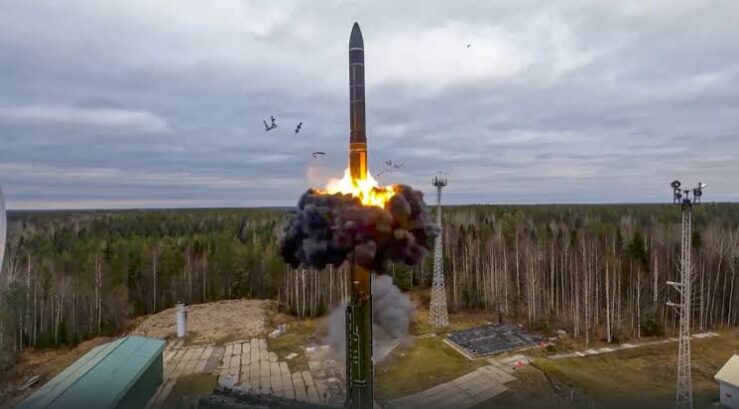
Recently, the United States seized a Russian oil tanker, following which tensions between the two countries have escalated. Russia possesses some of the world’s largest and most advanced missile systems, including intercontinental systems capable of striking U.S. territory within minutes. Let us take a closer look at which Russian missiles can reach the United States and the distance between the two countries.
Russian Missiles Capable of Reaching the United States
Russia’s strategic forces include land-based, sea-based, air-launched, and even underwater nuclear delivery systems. Many of these weapons are capable of striking any location within the United States.
RS-28 Sarmat
The RS-28 Sarmat is currently Russia’s most powerful intercontinental ballistic missile (ICBM). With a range of approximately 18,000 kilometres, it is designed to bypass conventional missile defence systems and can approach the United States via both the North Pole and even the South Pole routes. The missile can carry 10–15 nuclear warheads and travels at speeds of up to 25,500 kilometres per hour.
Also Read: US Seizes Russian Oil Tanker in Atlantic, Tensions with Moscow Escalate
Avangard
Avangard is not a traditional missile but a hypersonic glide vehicle mounted on top of an ICBM. Once launched, it can manoeuvre at speeds ranging from Mach 20 to Mach 27, making interception extremely difficult.
RS-24 Yars
The RS-24 Yars is a modern, mobile ICBM with a range of approximately 10,500 to 11,000 kilometres. It can be launched from road-mobile platforms or silos and has been specifically designed to penetrate U.S. missile defence systems.
Topol-M
Topol-M remains a major component of Russia’s nuclear arsenal. With a range of up to 11,000 kilometres, it is fully capable of reaching the U.S. mainland.
Burevestnik
Burevestnik is one of Russia’s most controversial weapons. It is believed to be powered by a nuclear reactor, giving it a theoretically unlimited range, estimated between 10,000 and 20,000 kilometres. Because it can fly at very low altitudes, it is difficult for conventional radar systems to detect.
Poseidon
Poseidon is not a missile but a nuclear-powered underwater drone. It is believed to have an unlimited range and is designed to detonate near coastlines. Such an explosion could potentially generate a radioactive tsunami.
Distance Between Russia and the United States
The shortest distance between Russia and the United States is just 3.8 to 4 kilometres, located in the Bering Strait between the Diomede Islands—one belonging to Russia and the other to the United States. The distance between the Russian mainland and Alaska is approximately 85 kilometres. Meanwhile, the aerial distance between Moscow and Washington, D.C. is roughly 7,800 to 8,900 kilometres.