


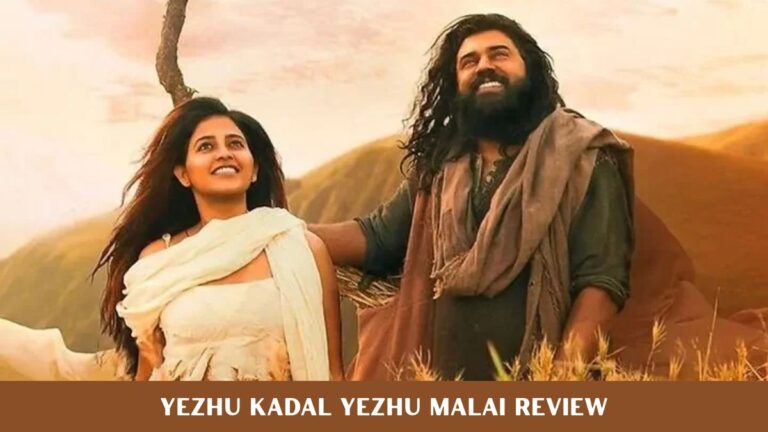
Yezhu Kadal Yezhu Malai Review: ★★☆☆☆ (2/5)
Yezhu Kadal Yezhu Malai has a genuinely interesting philosophical core about compassion and humanity, but poorly executed AI visuals and exhausting, repetitive dialogue turn the viewing experience into a real test of patience.
Rating: ★★☆☆☆ (2/5)
Language: Tamil
Genre: Fantasy Drama
Director: Ram
Cast: Nivin Pauly, Anjali, Soori
There is a popular meme circulating lately featuring actor Karunas’s dialogue from Polladhavan, Seri da, ippo enna, which roughly translates to okay, what now. It is a short, almost dismissive line, but one that perfectly fits any moment when you find yourself sitting through an inconsequential story, desperately searching for something to say that just shuts the whole thing down.
If there is one film this year that makes you want to say that from start to finish, it is director Ram’s Yezhu Kadal Yezhu Malai.
The film opens with an aunt narrating a bedtime story to a child about an immortal man who has lived for over 8,000 years. Death never comes for him, and he spends his endless existence searching for a woman he has seen reincarnated across multiple eras throughout history.
During one such episode, he crosses paths with a Dubai-returned man, played by Soori, who is thrilled to finally meet his son again after eight years apart. What follows is a string of eccentric incidents that jump across different time periods, with Nivin Pauly’s immortal character attempting to teach Soori’s character an important lesson about compassion.
Director Ram has built a reputation for poignant, unconventional films that push audiences to reflect on human emotion while still entertaining them, often taking philosophical detours along the way.
Yezhu Kadal Yezhu Malai clearly wants to follow that same tradition, pairing an immortal being with a self-centered, empathy-lacking mortal man. The central idea genuinely sounds interesting on paper, but Ram’s execution here becomes a real test of patience, and the film starts losing its grip on the audience within the very first few minutes.
None of the characters, lead or supporting, are given actual names throughout the film, an interesting creative choice in theory, but one that comes at the cost of sitting through over two hours of lengthy dialogue, delivered in a mix of colloquial Tamil and a heavily literary style reminiscent of Tholkappiyam. That dense, constant stream of dialogue drains much of the enjoyment out of the experience.
The film also leans heavily into fantasy and psychological territory, frequently cutting to birds, animals, and other creatures rendered through noticeably rough AI-generated visuals. These animals talk, deliver dialogue, and join Nivin Pauly’s character in spreading messages about humanity, and they show up on screen roughly every five minutes.
At times, even scenes featuring Nivin Pauly and Anjali appear to have been generated using AI, which feels less like creative experimentation and more like genuine shortcuts in filmmaking.
One particularly jarring moment shows the real Anjali swimming in a lake, only for another woman meant to resemble her to emerge from the water minutes later looking nothing like her at all, a clear sign that the filmmakers lost control of their AI tools just as thoroughly as they lost control of the screenplay.
The film’s central message, that human life and animal life deserve equal moral consideration, comes through clearly enough the first time. Unfortunately, it keeps repeating that same point again and again through endless encounters, by which point audiences are already worn out from Nivin Pauly’s extended speeches covering the Iron Age, ancient Egypt, and Mesopotamia.
The one genuinely interesting stretch of the film arrives through a reveal involving Anjali’s character, hinting at a far more compelling story rooted in history and philosophy buried somewhere underneath all the AI clutter. Unfortunately, by the time the film actually gets there, most viewers will already be thoroughly exhausted by visuals that often look worse than basic YouTube rhyme videos.
Nivin Pauly clearly puts in real effort bringing his quirky, immortal character to life, and Soori and Anjali do their parts competently too, but the screenplay drags on so long that two hours genuinely feel like four. Cinematographer NK Ekambaram does deliver some genuinely striking visuals of the Western Ghats and Dhanushkodi, at least offering something visually worthwhile to hold onto.
If you want something warmer and more emotionally satisfying this week, our review of Baththa, a gangster story that finds real heart in an unlikely friendship, is well worth checking out instead.