


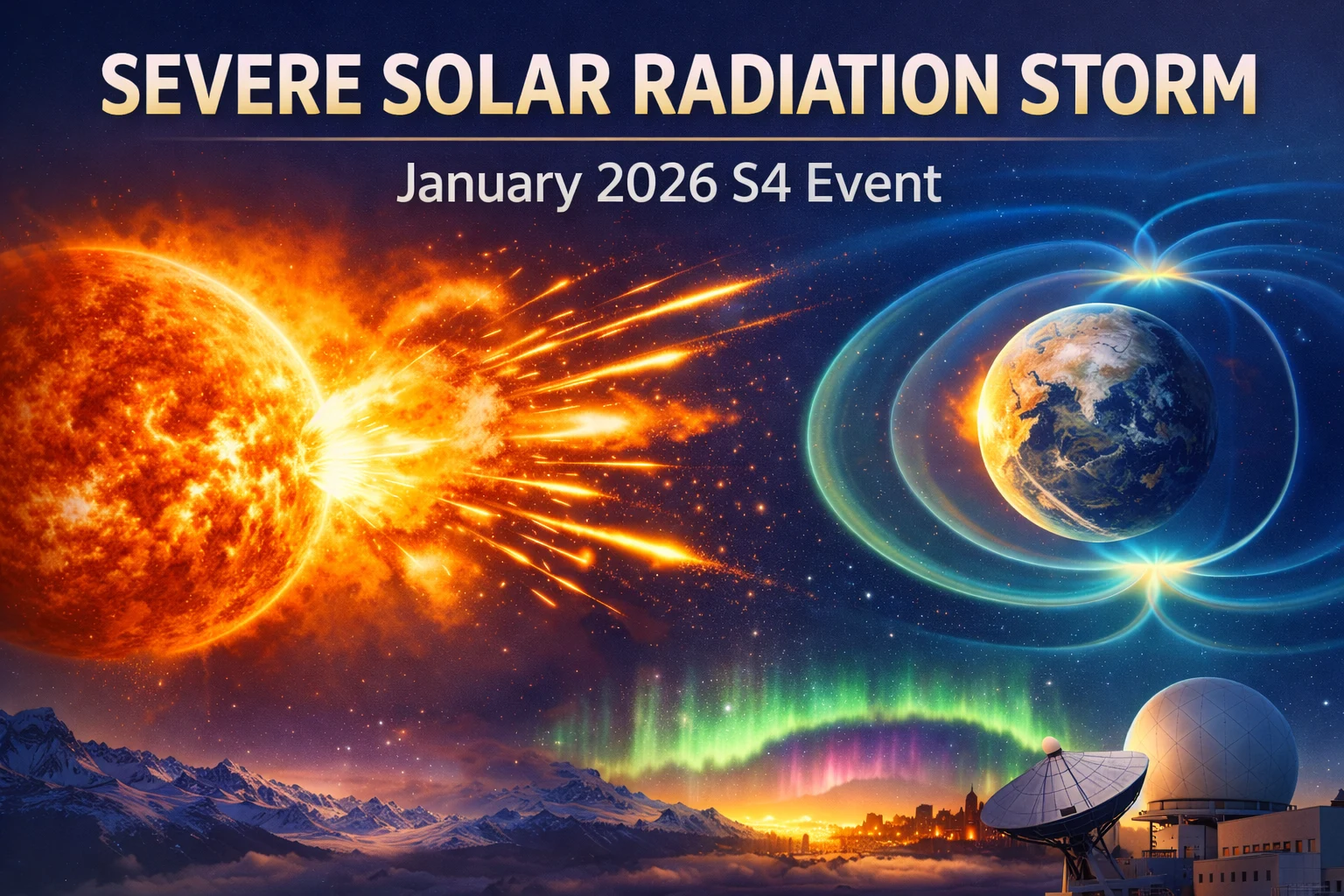
In January 2026, the world witnessed one of the most powerful solar radiation storms in over two decades. Triggered by intense activity on the Sun, this rare S4-level severe storm peaked on January 19, 2026, prompting alerts for satellites, airlines, and space agencies across the globe. While such events sound alarming, their real-world impact on people on the ground is limited. Still, they offer a fascinating look into how closely Earth is connected to our star.
What Is a Solar Radiation Storm?
A solar radiation storm happens when the Sun releases a burst of high-energy particles, mainly protons, into space. These particles are often produced during solar flares or coronal mass ejections (CMEs)—huge explosions of energy from the Sun’s surface.
Unlike normal sunlight, these particles travel at near-light speed and can reach Earth in minutes to hours. When they arrive, they interact with Earth’s magnetic shield, called the magnetosphere.Solar radiation storms are rated on a scale from S1 (minor) to S5 (extreme). The January 2026 event reached S4 (severe)—a level not seen this strongly in more than 20 years, according to the NOAA Space Weather Prediction Center.

What Made the January 2026 Storm So Unusual?
The January storm stood out for three main reasons:
- Its strength – An S4 storm is rare and powerful.
- Its duration – Radiation levels stayed elevated for several days.
- Its timing – It occurred during a period of heightened solar activity as the Sun moves toward the peak of its solar cycle.
Experts confirmed that the storm was driven by powerful solar eruptions that sent a wave of energetic protons directly toward Earth. These particles slammed into Earth’s magnetic field, creating effects both in space and near the polar regions.
Also Read: India’s Longest Border Is Not with Pakistan or China – Here’s the Truth
Why Were Satellites Put on Alert?
Satellites orbiting Earth are among the most vulnerable during solar radiation storms.
High-energy particles can:
- Damage sensitive electronics
- Cause temporary glitches or data errors
- Increase drag on satellites in low Earth orbit, slightly altering their paths
Because of this risk, satellite operators were warned in advance. Some spacecraft were placed into safe mode, a protective state that reduces exposure and prevents permanent damage.
This kind of early warning is routine and shows how prepared modern space systems are for space weather events.
Why Polar Flights Were Affected
Commercial aircraft flying near the North and South Poles also faced higher risks during the storm.
At high altitudes and polar routes:
- Earth’s magnetic protection is weaker
- Radiation exposure for pilots and crew can increase
- Radio communication, especially high-frequency (HF) radio, may become unreliable
To reduce these risks, aviation authorities advised airlines to reroute or adjust flight paths, especially on long-haul polar flights. These changes are precautionary and temporary, aimed at keeping radiation exposure well within safe limits.
Are People on the Ground in Danger?
For most people, the answer is no.
Earth’s atmosphere and magnetic field provide strong protection at ground level. Solar radiation storms do not cause direct harm to people, buildings, mobile phones, or power lines on the surface.
You do not need special equipment, shielding, or precautions during such an event if you are on the ground.
A Bright Side: Stunning Auroras
One of the most visible and beautiful effects of the storm was the appearance of auroras far beyond their usual polar locations.
As energetic particles collided with gases in Earth’s upper atmosphere, they produced vibrant displays of green, red, and purple lights. During this storm, auroras were reported in regions that rarely see them, delighting skywatchers and photographers worldwide.
Latest Status as of January 22, 2026
According to official monitoring updates:
- Radiation levels remain elevated but stable
- No new S4 peaks have been detected since January 19
- Related geomagnetic activity (G4 level) has weakened
- Continuous monitoring is ongoing
Space weather experts emphasize that conditions can change quickly, but there is no immediate threat from the current levels.
Why Monitoring Space Weather Matters
Events like this highlight why space weather forecasting is essential in today’s technology-driven world.
Modern society relies heavily on:
- GPS and satellite navigation
- Communication satellites
- Aviation systems
- Scientific and defense infrastructure
Organizations such as NOAA, NASA, ESA, and international space agencies constantly monitor the Sun to provide early warnings. These alerts allow industries to take preventive action, reducing risk and avoiding costly damage.
Final Thoughts: Should You Be Worried?
The January 2026 S4 solar radiation storm was scientifically significant, not socially dangerous.
For most people:
- Daily life continues as normal
- There is no health risk on the ground
- The event is more about awareness than alarm
If anything, such storms remind us how dynamic the Sun is—and how well-prepared scientists and engineers are to protect modern systems from space weather.
As solar activity continues to rise in the coming years, similar events may occur. Thanks to ongoing monitoring and global cooperation, the world is better equipped than ever to handle them safely.