


So the Ramayana teaser is finally out, and honestly, it’s a lot to take in.
Released on April 2, 2026 — fittingly on Hanuman Jayanti — the teaser for Nitesh Tiwari’s Ramayana: Part 1 “Rama” has been making rounds everywhere. And for good reason. It’s big, it’s emotional, and every few seconds there’s something that just hits differently.
But here’s the thing — if you watched it once and moved on, you probably missed a lot.

After closely analyzing the teaser, there are several details hiding in plain sight. Some are symbolic, some are story hints, and some are just really smart filmmaking choices. So before we get into it, do yourself a favour — go rewatch the teaser. Then come back here, and these details will make a lot more sense.
Ready? Now, let’s take a closer look at the biggest hidden details from the Ramayana teaser.
1. The Teaser Opens With the Cosmic Trinity
The teaser doesn’t start with Rama. It starts with glimpses of Brahma, Vishnu, and Shiva.
That’s a deliberate choice. It’s telling you upfront that this isn’t just a story about a prince going into exile and fighting a demon king. This is a story about cosmic order — about why the universe needed Rama to exist.
It sets the tone immediately. This is a divine story, not just a human one.
2. The Crown vs Exile Contrast
One moment, Rama is in full royal attire, surrounded by joy and celebration, on the edge of becoming king. The very next shot, he’s walking out of Ayodhya in simple clothes.
No dialogue. No explanation. Just the cut.
That one edit says more about sacrifice and duty than a whole scene of dialogue could. It’s quietly one of the most emotional moments in the teaser.
3. The Swayamvar Is There — You Just Have to Look
There’s a shot where flowers are falling and Rama walks through a grand hall. In the background, you can spot a massive bow.
That’s the Swayamvar. The moment where Rama lifts and breaks Shiva’s divine bow to win Sita’s hand in marriage.
The film doesn’t stop to explain it. It just puts it there. And that kind of confidence in the audience is refreshing.
4. The Glowing Line Around the Hut — Blink and You’ll Miss It
There’s a very quick shot of a glowing line drawn around a small hut, and Sita stepping close to it.
That’s the Lakshman Rekha.
Most people won’t catch it the first time. But it’s foreshadowing the most pivotal moment in the story — the moment that changes everything. It’s a blink-and-miss detail, but once you see it, it sticks.
5. The Golden Deer and Jatayu Show Up Early
The teaser briefly shows the golden deer and Jatayu fighting Ravana — two events that happen well into the story.
Why show them in the teaser this early? It could mean the film doesn’t tell the story in a straight line. Some of these moments might appear as flashbacks or be woven into the narrative in a non-traditional way.
It also builds intrigue. You know what’s coming, but you don’t know how the film will get there.
6. That Close-Up of Rama’s Hand Means More Than You Think
There are a few close-up shots of Rama’s hands — gripping the bow firmly and touching what looks like a ring.
The ring is a quiet but meaningful symbol. It represents his bond with Sita and his role as a protector. The way he holds the bow shows steadiness and purpose.
These aren’t random shots. They’re character moments told entirely through visuals.
7. Ravana’s Pushpak Vimana Looks Unlike Anything We’ve Seen
We get a brief look at Ravana’s legendary flying chariot, the Pushpak Vimana, and it’s striking.
The design mixes old mythological imagery with something that almost feels futuristic. It doesn’t look like a period piece prop — it looks like a machine from another world entirely.
That one shot tells you a lot about the kind of world-building this film has gone into.
8. The Colors Are Doing a Lot of the Storytelling
Ayodhya and the scenes around Rama and Sita are bathed in warm gold and soft blue tones. Peaceful. Divine. Familiar.
The moment Ravana or Lanka appears — red, green, dark shadows.
This contrast isn’t accidental. The film is using color to tell you who to trust and what to feel, without saying a single word.
The background score follows the same pattern, shifting tone as the visuals change.
9. The Title Card Is Shaped Like Something You’ll Recognize
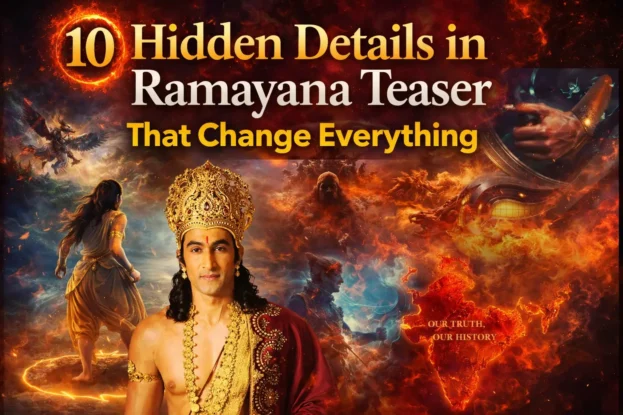
Look closely at the Ramayana title card. The shape of the text and the visual framing appears to mirror the outline of the Indian subcontinent.
And then there’s the line underneath: “Our Truth, Our History.”
That phrase changes how you see the whole film. It’s not presenting Ramayana as myth or legend — it’s presenting it as memory. As something that belongs to a civilization, not just a religion.
A small detail with a very large statement behind it.
10. Some Shots Look Like They Came Out of an Animated Epic
Several shots in the teaser have a quality to them that doesn’t quite look like regular live-action film. The lighting, the framing, the way characters move — it has a painterly, almost illustrated feel to it.
This is the VFX work by DNEG, and it’s doing something interesting. Rather than just making the world look realistic, it’s making it look mythic. The visuals feel heightened on purpose.
It gives the film its own visual identity — something that sits between a live-action film and an animated epic.
Why These Details Matter
Here’s the thing about a great teaser — it rewards you for paying attention.
The Ramayana teaser isn’t just showing you scale and spectacle. Every frame is doing something. Colors, compositions, symbols, and cuts — it all adds up to something that feels carefully thought through.
With AR Rahman and Hans Zimmer handling the music together, the performances already looking intense, and the VFX clearly at a global level, the expectations for Diwali 2026 are through the roof.
And if a two-minute teaser can pack in this much — the actual film is going to be something else entirely.