



Indian cinema has seen big-budget films before. But Rakaa — the upcoming Atlee directorial starring Allu Arjun — is operating at a scale that even by the standards of today’s blockbuster culture feels genuinely different.
With a reported budget somewhere between ₹800 crore and ₹1000 crore, a cast that includes some of the biggest names in the industry, and VFX ambitions that are being compared to international franchise filmmaking — this one has been generating conversation long before a single frame has been shown to the public.
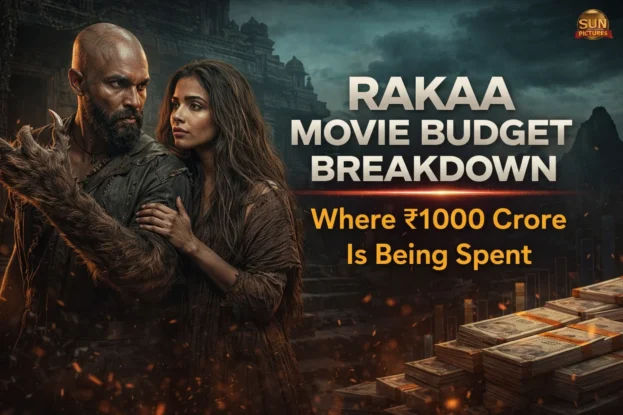
Here’s a full breakdown of where the money is going and what the cast is reportedly earning.

The Overall Budget — Where the Numbers Stand
Backed by Sun Pictures, Rakaa is being developed as a pan-India action epic. The budget has reportedly grown during production — a pattern that happens when VFX-heavy films push further into ambitious territory as the project takes shape.
| Category | Estimated Cost |
|---|---|
| Total Budget | ₹800–1000 crore |
| VFX and CGI | ~₹250 crore |
| Production and Sets | ~₹300 crore |
| Cast Salaries | ~₹300–310 crore |
The split is revealing. Nearly a third of the budget is going to cast salaries, and another quarter is sitting with VFX alone. That combination tells you exactly what kind of film Atlee and the producers are trying to make — a spectacle-driven, star-led experience built for massive screens and multiple markets simultaneously.
Allu Arjun — ₹175 Crore and a Profit Share on Top
The number that made people stop scrolling: Allu Arjun is reportedly charging ₹175 crore upfront for Rakaa. And that’s before the profit-sharing arrangement kicks in.
His backend deal reportedly includes a 15% profit share, which — if the film performs the way its backers are clearly expecting — could push his total earnings from this single project beyond ₹300 crore.
To put that in perspective: his upfront fee alone is higher than the total production budget of most Indian films. This is what his market value looks like after the extraordinary success of Pushpa, a film that turned him from a beloved Telugu cinema star into a genuinely pan-India phenomenon.
His role in Rakaa is reportedly complex — involving multiple characters, including a cop and what’s been described as a unique hybrid persona. Exactly what that means in the context of the story isn’t fully clear yet, but it’s clearly a creative setup designed to give him significant screen presence across different tones and registers.
Atlee — ₹100 Crore to Direct
Atlee’s reported fee of ₹100 crore for directing Rakaa is itself a headline-worthy number. It represents a significant jump from his previous projects and reflects both the scale of what’s being attempted and the commercial confidence that comes with his track record.
He’s the director behind Jawan, which became one of the highest-grossing Hindi films ever made. Before that, his Tamil films consistently delivered large-scale commercial entertainment. The producers of Rakaa are clearly paying for someone who has demonstrated the ability to handle enormous budgets and still deliver films that connect with mass audiences.
His directorial fee eating up a significant chunk of the overall budget also tells you something about how the film is being positioned — Atlee’s name is as much a part of the commercial proposition as the cast itself.
Deepika Padukone and Rashmika Mandanna — And the Pay Gap
Deepika Padukone is reportedly being paid between ₹20 and ₹25 crore for Rakaa. Rashmika Mandanna, who plays the antagonist — a new direction for her career — is estimated to be earning somewhere around ₹5 to ₹7 crore.
| Actor / Director | Role | Estimated Fee |
|---|---|---|
| Allu Arjun | Lead — multiple characters | ₹175 crore + 15% profit share |
| Atlee | Director | ₹100 crore |
| Deepika Padukone | Lead actress | ₹20–25 crore |
| Rashmika Mandanna | Antagonist | ₹5–7 crore |
The pay gap between Allu Arjun and his female co-stars has become one of the more discussed aspects of Rakaa’s financial story. Deepika’s fee is around one-seventh of Allu Arjun’s, and Rashmika’s is lower still — despite both being major stars in their own right with enormous fan bases.
This isn’t unique to Rakaa. The disparity between male and female lead salaries in big-budget Indian films has been a recurring conversation for years. Rakaa just makes the numbers visible in a way that’s hard to ignore. Whether that conversation leads anywhere beyond the comment sections remains to be seen, but the figures are what they are.
Also Read: Dacoit: A Love Story Movie Budget & Cast Salary: All Details Here
The VFX Investment — ₹250 Crore to Compete Globally
Spending ₹250 crore on VFX for a single Indian film is a significant amount. For context, that figure alone exceeds the total budget of the vast majority of Indian films produced each year.
The production team is reportedly working with international VFX studios to achieve a level of visual output that can sit comfortably alongside global action franchise filmmaking — not just look impressive by Indian cinema standards, but by international ones.
Alongside that, the production design budget of approximately ₹300 crore is covering large-scale physical sets, extensive action choreography, and multiple shooting locations. The first look released on April 7 — on Allu Arjun’s birthday — gave a brief glimpse of the visual tone being aimed for, and the reaction online suggested the early imagery is landing the way the team hoped.
What the First Look Told Us
The April 7 release of the first look created the kind of social media response that gives a production team confidence they’re on the right track. The imagery hinted at a multi-layered story, visually dense sequences, and a scale that felt genuinely different from what Indian cinema has typically offered at the budget range below this.
The production team is still working on the film, and they anticipate releasing more material in the coming months as the release date approaches. The scale of the film’s production suggests that the promotional campaign will be as ambitious as the film itself.
Is the Budget Justified?
That depends entirely on how you look at it.
From a pure business perspective — Allu Arjun post-Pushpa, Atlee post-Jawan, a budget designed to produce something that can genuinely compete for international attention — there’s a commercial logic to the scale of investment here. Sun Pictures is not a production house that makes reckless bets. They understand the market, and they’re clearly betting that a film of this ambition has a ceiling high enough to justify the floor.
From a broader industry perspective, the salary numbers — particularly the gap between what the lead actor earns and what his female co-stars take home — are worth reflecting on. The conversation about pay equity in Indian film keeps having the same shape because the underlying structures keep producing the same outcomes.
But as a film to watch? Everything about Rakaa so far suggests it’s being built as an experience — the kind that rewards a large screen, a good sound system, and an audience ready to be taken somewhere. Whether it delivers on that promise is something only the finished film can answer.
Note: All salary and budget figures are based on industry reports and estimates. Official figures have not been confirmed by the production.