


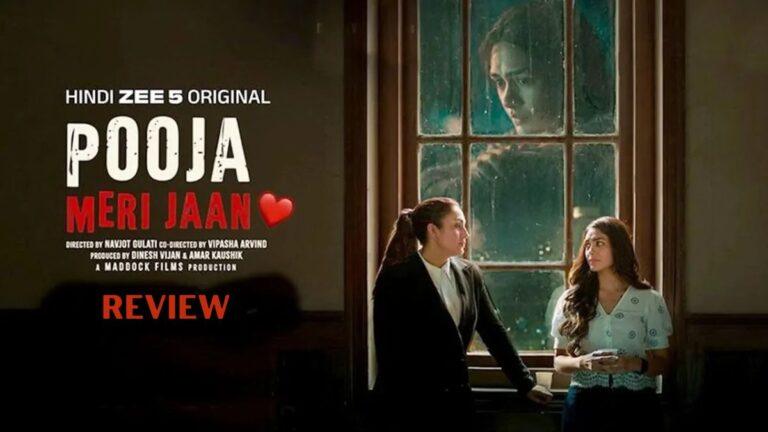
Pooja Meri Jaan Review: ★★★☆☆ (3/5)
Pooja Meri Jaan tackles an important conversation about rejection, consent, and social judgment with genuine sensitivity, anchored by a strong performance from Mrunal Thakur, but its courtroom drama lacks the sharp tension the premise promises.
Rating: ★★★☆☆ (3/5)
Platform: ZEE5
Genre: Courtroom Drama
Director: Navjot Gulati
Cast: Mrunal Thakur, Huma Qureshi, Vijay Raaz, Vikram Singh Chauhan
A few years ago, the film Pink made audiences sit up with its powerful reminder that no means no, delivered in Amitabh Bachchan’s resonant voice. And yet, Bollywood continues returning to stories about men who simply refuse to accept rejection. Pooja Meri Jaan picks up that same uncomfortable thread, this time asking where heartbreak ends and personal responsibility actually begins.
The film opens with Aniket, played by Vikram Singh Chauhan, literally playing Romeo in a theatre production, setting up an interesting contrast right from the start, since unlike Shakespeare’s tragic hero, the love here exists mostly in one person’s head. Aniket and Pooja, played by Mrunal Thakur, have been theatre friends for five years, playing on-stage lovers while Aniket has genuinely fallen for her offstage.
Even after Pooja makes it clear she only sees him as a friend, Aniket clings to filmi logic straight out of Bollywood romance, eventually proposing marriage. When she rejects him, he takes his own life, leaving behind a voice note that blames her for his death. What follows taps into a disturbingly familiar pattern we often see play out in real life.
Pooja is branded the villain almost instantly, with social media reducing her to a hashtag and a judgment before anyone actually knows what happened between them. She is arrested and accused of abetting his suicide, and the film spends its runtime exploring the resulting courtroom battle, along with the public shaming that follows her at every turn.
Director Navjot Gulati, who co-wrote the film, approaches heavy themes like consent, male ego, and harmful social conditioning with real sensitivity, keeping the film from tipping into a lecture even when it occasionally gets heavy-handed. The choice to name the lead character Pooja feels deliberate too, an ordinary, everyday name that makes her feel less like a singular victim and more like a stand-in for any young woman who could suddenly find herself at the center of this kind of public scrutiny.
Huma Qureshi plays Sana, a common friend turned lawyer who steps in to defend Pooja, and her character is positioned as the story’s moral and legal compass. Unfortunately, Sana’s frequent sermonizing sometimes makes her feel more like the film’s mouthpiece than a fully realized person, and her abrupt transition from corporate lawyer to criminal defense attorney within a single hearing feels more convenient than convincing.
That courtroom weakness ends up being the film’s biggest missed opportunity. The legal proceedings rarely generate the tension or intellectual sharpness a story like this promises, often functioning more as a vehicle for delivering the film’s message rather than building genuine dramatic stakes through evidence and cross-examination. Aniket’s psychology, particularly how his obsession took root, also never gets explored deeply enough, despite being central to the entire conflict.
Mrunal Thakur remains the film’s strongest asset, playing Pooja with real restraint, capturing fear, confusion, and quiet anger without reducing her to a simple victim trope. She is especially effective in moments that let her be reactive rather than purely vulnerable.
Vijay Raaz is excellent as the opposing lawyer, bringing a pathetic, feudal-minded quality to his character without ever turning him into a caricature, particularly in a small but memorable scene where he struggles to understand what a heart emoji means. Sunita Rajwar also shines in a smaller role as a sharp, world-weary police officer, delivering one of the film’s best lines with perfect deadpan timing.
In the end, Pooja Meri Jaan is well-intentioned, if not particularly bold in its execution. The drama occasionally overplays its hand, but it makes one point clear: any real conversation about consent has to start with actually taking a no seriously. That message alone makes the film worth watching, even if the courtroom drama around it needed sharper teeth.
If you’re deciding what else to watch this week, our review of Drishyam The Conclusion and our review of Baththa are both worth checking out too.