


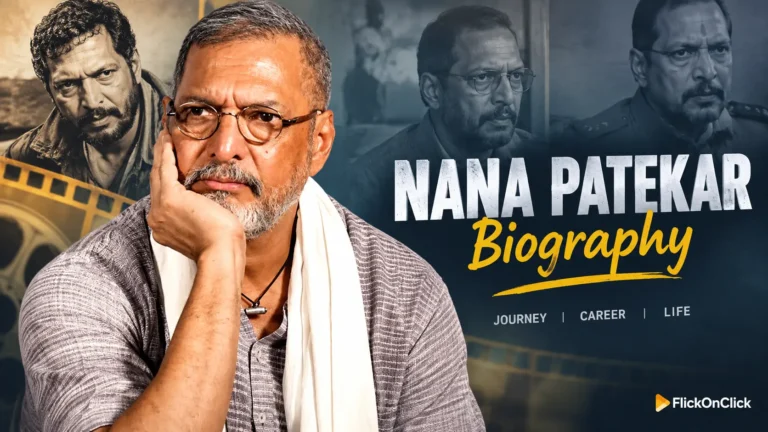
Veteran actor Nana Patekar passed away on 8 October 2026 at the age of 75. He was found unconscious at his home in Dona Paula, Goa, and was rushed to a hospital where doctors declared him dead. Reports say doctors tried CPR for 45 minutes, but he could not be revived.
A medico-legal case has been registered, and a post-mortem will be done. The Maharashtra government has announced that he will be given a state funeral.
For nearly five decades, Nana Patekar was the actor who could silence a room with one look. Here is the story of how a boy from a small coastal town became one of the most loved faces in Hindi and Marathi cinema.
Quick Facts
| Detail | Information |
|---|---|
| Birth name | Vishwanath Patekar |
| Born | 1 January 1951, Murud-Janjira, Raigad district, Maharashtra |
| Died | 8 October 2026, Dona Paula, Goa |
| Age | 75 |
| Occupation | Actor, writer, director, philanthropist |
| Education | Sir J. J. Institute of Applied Art, Mumbai |
| Years active | 1978 to 2026 |
| Spouse | Neelakanti Patekar (married 1978) |
| Child | Son, Malhar Patekar |
| Parents | Dinkar Patekar and Sanjanabai Patekar |
| Honours | Padma Shri (2013), three National Film Awards |
Early Life
Vishwanath Patekar was born on 1 January 1951 in Murud-Janjira, a coastal town in Maharashtra. His father ran a small textile painting business, but it did not last. Money became tight at home.
So young Nana went to work. As a teenager in Mumbai, he painted film posters and even zebra crossings on roads to help his family get by. It was hard, humble work, and he never hid it later in life.
He studied commercial art at the Sir J. J. Institute of Applied Art and worked in advertising for a while. At the same time, he was learning something else. He joined Marathi experimental theatre, and that is where his acting took shape. The stage taught him timing, silence, and the power of a sharp line, all of which he carried into films.
The Film Career Begins
Nana Patekar made his film debut in Gaman in 1978. It was a modest start. People began to notice him with Ankush in 1986, where his raw energy stood out. He also played a violent husband in Salaam Bombay! in 1988, a small role that stayed in the minds of those who saw it.
The real turning point came with Parinda in 1989. Directed by Vidhu Vinod Chopra, the film gave him the role of Anna, a cold and frightening gangster. Audiences could not look away. The performance won him the National Film Award for Best Supporting Actor.
From Villain to Star
After Parinda, Nana Patekar was no longer just a strong supporting name. He was now someone filmmakers wanted at the centre of the story.
In 1991, he directed and acted in Prahaar. To prepare, he trained with the army’s Maratha Light Infantry. That experience mattered more than a film role. He later received an honorary rank in the Territorial Army.
Tirangaa in 1993 and Krantiveer in 1994 made him a leading man. Krantiveer earned him the National Film Award for Best Actor. In 1996, Agni Sakshi brought him his third National Award.
His list of well-known films from these years and after is long. It includes Angaar, Khamoshi, Yeshwant, Ab Tak Chhappan in 2004, Apaharan, the comedy Welcome in 2007, and Raajneeti in 2010. What made him special was how easily he moved between a frightening villain, a tired cop, and a funny uncle. He did not fit into the usual hero or villain boxes.
His Work in Marathi Cinema
Even as a big Hindi film name, he never left Marathi cinema behind. He gave acclaimed performances in Dr. Prakash Baba Amte in 2014 and Natsamrat, which many people still call one of the finest Marathi films of recent times. In Natsamrat, he played an aging stage actor facing the cruelty of a changing world. Critics and fans praised it for its depth and restraint.
In 2016, he also lent his voice to Shere Khan in the Hindi version of The Jungle Book. His deep, rough voice was a perfect match for the tiger.
Related Read: Auqib Nabi Dar Biography
Service to the Country
Nana Patekar served in the Indian Territorial Army from 1990 to 2013 and retired with the rank of Honorary Lieutenant Colonel. He is also reported to have taken part in the Kargil War in 1999. For an actor who often played tough men on screen, this was a side of him that was very real.
The Naam Foundation
In 2015, Nana Patekar and actor Makarand Anaspure started the Naam Foundation. Its main goal was to support farmers in Maharashtra hit by drought. The foundation gives financial help to the widows of farmers who have died by suicide, and it funds water conservation work in the Marathwada and Vidarbha regions.
He did not make a show of it. He lived, in a farmhouse near Pune, and kept his focus on the work. For many people in rural Maharashtra, this was the part of his life that mattered most.
Also Read: Who Is the New CEO of Kotak Mahindra Bank? Anup Kumar Saha Biography
Controversy
In 2018, actress Tanushree Dutta accused him of harassing her on a film set in 2008. Nana Patekar denied the allegation. The Mumbai police closed the case in 2019, saying they found no evidence.
Awards and Honours
| Year | Honour | For |
|---|---|---|
| 1989 | National Film Award for Best Supporting Actor | Parinda |
| 1994 | National Film Award for Best Actor | Krantiveer |
| 1996 | National Film Award for Best Supporting Actor | Agni Sakshi |
| 2013 | Padma Shri | Contribution to the arts |
| Various | Filmfare Awards for Best Actor, Best Supporting Actor and Best Villain | Different films |
He is one of the few actors to have won Filmfare Awards in all three of these categories, which shows how wide his range was.
Family
Nana Patekar married Neelakanti Patekar in 1978. They have a son, Malhar Patekar. He was the son of Dinkar Patekar and Sanjanabai Patekar, and he often spoke about how his early struggles shaped the man he became.
Tributes and Legacy
News of his death has left the film world in shock. Marathi actor Siddharth Jadhav said he was in deep shock and that this was not the time for Nana Patekar to go, as he still had many things left to do. Actor and politician Ravi Kishan wrote that despite being a star, Nana Patekar always stayed far from the trappings of stardom. He remembered him as a man of simplicity and humility who never lost touch with his roots.
That is perhaps the best way to remember him. He was a fierce actor on screen and a simple, grounded man off it. From painting posters on Mumbai walls to having his own face on them, Nana Patekar lived a life few could have imagined for that boy from Murud-Janjira. His films, his dialogues and his work for farmers will stay with people for a very long time.