



So you’ve decided to dip your toes into the world of cryptocurrency. Maybe a friend mentioned Bitcoin at dinner. Maybe you saw a headline about Ethereum hitting a new high. Maybe you just downloaded an app and stared at the screen, wondering what on earth “staking” or “blockchain” actually means.
Don’t worry. We’ve all been there.
The truth is, crypto has a language of its own — and it can feel completely overwhelming when you’re starting. But once you understand the basics, everything starts to click. So let’s break it down, one concept at a time, in plain English. No jargon. No complexity. Just the stuff you actually need to know.

14 Crypto Concepts Every Newbie Should Know
Jumping into cryptocurrency for the first time can feel like walking into a conversation where everyone else already knows what’s going on, and you’re just nodding along, pretending to follow. The words sound technical, the concepts seem complex, and it’s hard to know where to even begin.
But here’s the thing — the basics aren’t actually that complicated once someone explains them properly. So let’s do that. Here are 14 concepts that will genuinely help you understand what crypto is, how it works, and what people are actually talking about when they use all that confusing terminology.

1. Cryptography — The Foundation of It All
Before we talk about crypto coins, let’s talk about the word “crypto” itself. It comes from the Greek word meaning “secret” or “hidden.” Cryptography is the practice of encrypting information so only the sender and the receiver can read it.
Think of it like a secret code between two friends. Nobody else can decode the message. This same principle is what keeps your digital transactions safe and private. Without cryptography, cryptocurrency simply wouldn’t exist.
2. Cryptocurrency — What It Actually Is
A cryptocurrency is a digital currency — money that exists entirely online, not as a physical coin or note in your pocket. Bitcoin was the first one, created back in 2009. After that, hundreds of other coins followed. These are called altcoins — alternative cryptocurrencies.
Some popular altcoins include Ethereum, Litecoin, and Solana. Each one was built with a slightly different purpose or improvement in mind. Today, companies like PayPal and Microsoft even accept Bitcoin as payment. The space has come a long way from being a niche internet experiment.
3. Wallet — Your Digital Bank Account
If you’re going to hold cryptocurrency, you need somewhere to keep it. That’s where a wallet comes in. Think of it as your personal bank account, except nobody else controls it but you.
There are two main types:
- Hardware wallet — A physical USB device that stores your crypto offline. Because it’s not connected to the internet, it’s much harder to hack. The downside? It costs money and you need to keep it somewhere safe.
- Software wallet — An app or program on your phone or computer. More convenient, but slightly more vulnerable since it’s connected to the internet.
For beginners, a software wallet is a fine starting point. Just keep your passwords safe.
Must Read: Top 7 Crypto Wallets to Buy Your First Bitcoin
4. Exchanges and Brokers — Where You Buy and Sell
Ready to actually buy some crypto? You’ll do it through either an exchange or a broker.
An exchange is like a marketplace where buyers and sellers trade directly with each other. You can buy, sell, and even store coins here. The risk is that if the exchange gets hacked, your coins could be at risk.
A broker is simpler. You buy directly from the platform and the coins go straight to your personal wallet. Brokers tend to be more beginner-friendly — they focus on making the whole process as smooth and easy as possible.
5. Trading — Buying and Selling for Profit
Trading is exactly what it sounds like — buying and selling crypto to make money. Since cryptocurrency prices change constantly, traders try to buy low and sell high. Simple in theory. A little harder in practice.
Here’s an important distinction: investing means buying and holding for the long term, hoping the value grows over months or years. Trading is much more active, making frequent moves to capture short-term price swings. Both are valid approaches, but they require different levels of time, attention, and risk tolerance.
6. Mining and Staking — How Transactions Get Approved
Every time someone sends crypto to someone else, that transaction needs to be verified. This is where mining and staking come in.
Mining involves powerful computers solving complex mathematical problems to confirm transactions. It uses a lot of energy. Bitcoin runs on mining.
Staking is a greener alternative. Instead of using computer power, you “stake” — or lock up — some of your coins as collateral to help verify transactions. In return, you earn rewards. Ethereum moved to staking a few years ago.
Both methods replace the need for a bank or any central authority. Instead of one company controlling everything, thousands of participants share the responsibility.
7. Decentralization — No One Is in Charge (and That’s the Point)
One of the most important ideas in crypto is decentralization. It means no single person, company, or government controls the network.
Compare it to banking. Right now, if you want to send money to someone, you need a bank to approve and process that transaction. You are dependent on a third party. With a decentralized network like Bitcoin, transactions happen directly between two people — peer-to-peer — with no middleman involved.
This also makes the network incredibly resilient. If one computer in the network fails or gets hacked, the rest of the network keeps going without missing a beat.
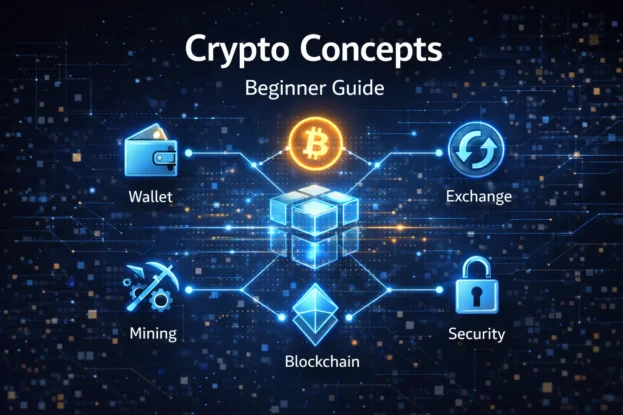
8. Blockchain — The Technology Behind It All
You cannot talk about crypto without talking about blockchain. It is the underlying technology that makes everything work.
Here’s the simplest way to think about it: imagine a notebook where every transaction ever made is written down permanently, in order, and nobody can erase or change any of it. Now imagine thousands of copies of that notebook existing simultaneously, all perfectly in sync.
That’s a blockchain. Each “block” contains transaction data. Each block connects to the one before it. The chain grows continuously. Nothing can be altered, deleted, or faked. It is one of the most tamper-proof record-keeping systems ever created.
9. Bitcoin — The One That Started It All
Bitcoin is the original. The first cryptocurrency ever created, launched in 2009 by an anonymous person or group using the name Satoshi Nakamoto — whose real identity remains unknown to this day.
What makes Bitcoin special? A few things. There will only ever be 21 million Bitcoins in existence. That limit is written into the code and can never be changed. This makes it scarce — similar to gold. It can’t be printed by a government, it’s not controlled by any single authority, and its value is driven purely by supply and demand.
That’s why people often call Bitcoin “digital gold.”
10. Private Key and Public Key — Your Crypto Identity
Think of your public key as your bank account number. You can share it with anyone who wants to send you crypto. It’s safe to share.
Your private key, on the other hand, is like your PIN — except losing it means losing access to your funds permanently. There is no “forgot my password” option in crypto. No customer service hotline. No recovery process.
Keep your private key safe. Write it down. Store it somewhere secure. This is non-negotiable.
11. Consensus Mechanisms — How the Network Agrees
For a blockchain to work, all the computers in the network need to agree on which transactions are valid. The method they use to reach that agreement is called a consensus mechanism.
The two main ones are:
- Proof of Work (PoW) — Used by Bitcoin. Computers compete to solve complex puzzles to validate transactions. It works, but uses enormous amounts of energy.
- Proof of Stake (PoS) — Used by Ethereum. Instead of energy, validators put up their own coins as security. If they act dishonestly, they lose their stake. More energy-efficient and increasingly common.
12. CEX vs DEX — Two Ways to Trade
When you want to buy or trade crypto, you’ll come across two types of platforms.
A CEX (Centralised Exchange) — like Coinbase or Binance — is managed by a company. They handle your account, verify your identity, and provide customer support. User-friendly and great for beginners.
A DEX (Decentralised Exchange) — like Uniswap — has no company behind it. You trade directly from your own wallet using smart contracts. More control, but also more responsibility. Better suited for experienced users.
13. Market Cap — How to Measure a Coin’s Size
Market capitalisation — or market cap — tells you the total value of a cryptocurrency. The formula is simple:
Market Cap = Price × Circulating Supply
Bitcoin’s market cap is in the trillions. Most altcoins are in the millions or billions. Why does this matter? Because a coin with a low price but a massive supply isn’t necessarily “cheap” — the market cap tells you the full picture. It’s one of the best ways to compare the actual size of different projects without being misled by price alone.
14. HODL, FOMO, and FUD — The Crypto Dictionary
Every community has its slang, and crypto is no exception. Here are three terms you’ll see constantly:
HODL — Originally a typo of “hold,” this has become the crypto motto for holding your coins through market ups and downs instead of panic-selling. When prices drop, HODLers stay calm and hold on.
FOMO — Fear Of Missing Out. When a coin is shooting up in price and everyone is talking about it, FOMO kicks in and pushes people to buy impulsively — often right before the price drops. Be careful with this one.
FUD — Fear, Uncertainty, and Doubt. Negative news or rumours that cause people to sell in panic. Sometimes it’s legitimate concern. Sometimes it’s deliberate misinformation designed to push prices down.
Also Read: Ocean Protocol and AI: Why the World’s Data Problem Is Crypto’s Biggest Opportunity
One Last Thing Before You Go
You don’t need to memorise all of this before you make your first move. You just need to understand enough to make decisions you’re comfortable with rather than ones driven by hype or panic.
Start small. Use a reputable exchange. Protect your keys. And keep learning — the people who actually do well in this space over the long run aren’t the ones who got lucky. They’re the ones who took the time to understand what they were doing.
You’ve made a start. Keep going.