


Let’s be real — picking a mobile plan is annoying. There are too many options, the fine print is confusing, and half the time you end up paying for things you don’t even use.
So here’s a straightforward breakdown of what Airtel is currently offering under ₹500, what you actually get, and how to figure out which plan makes sense for you.
First, Why Are People Still Going With Airtel?
In a market where Jio and Vi are constantly trying to undercut everyone on price, Airtel has held its ground — and for good reason.

The network quality is genuinely better in most places. Call drops are less frequent, internet speeds are more consistent, and it performs well even in semi-urban areas where other networks start struggling. People who’ve switched away and come back usually say the same thing: the price difference wasn’t worth the drop in quality.
There’s also the bundled stuff. Airtel doesn’t just give you data and calls — depending on the plan, you might get OTT access, cloud storage, music streaming, and other perks through the Airtel Thanks app. When you add all that up, the value gets more competitive.
Airtel Prepaid Plans Under ₹500
Prepaid is still what most people go with. No bills, no commitment, recharge when you want. Here’s what Airtel currently has in this range:
| Plan | Validity | Daily Data | What Else You Get |
|---|---|---|---|
| ₹299 | 28 days | 1.5GB/day | Unlimited calls, 100 SMS/day |
| ₹359 | 28 days | 2GB/day | Airtel Thanks benefits |
| ₹479 | 56 days | 1.5GB/day | OTT access, unlimited calls |
| ₹499 | 28 days | 3GB/day | Premium data, faster speeds |
Which one should you pick?
The ₹299 plan is the sweet spot for light users — someone who’s mostly on Wi-Fi at home or work and just needs mobile data for commuting or occasional browsing. 1.5GB a day is more than enough for that.
The ₹359 plan bumps you to 2 GB daily and throws in Airtel Thanks for the benefits, which can include OTT subscriptions. If you watch content on your phone regularly, this one starts making more sense.
The ₹479 plan is interesting because of the 56-day validity. If you travel, go through low-usage phases, or just hate recharging every month, the longer validity alone is worth considering. You get the same 1.5GB daily, but don’t have to touch it for nearly two months.
The ₹499 plan is for heavy users. 3GB a day with premium data and faster speeds — if you’re streaming, video calling, or working from your phone, this is where you want to be.
Airtel Postpaid Plans Under ₹500
Postpaid has been growing quietly, especially among working professionals and families. One bill a month, no recharge reminders, and usually better data value. Here’s what’s available:
| Plan | Monthly Data | Connections | What Else You Get |
|---|---|---|---|
| ₹399 | 40GB | 1 | Unlimited calls, SMS |
| ₹499 | 75GB | 1 | OTT benefits, family add-on options |
The ₹399 plan gives you 40GB for the month — which sounds like a lot until you realize how quickly video streaming eats through it. For moderate users, it’s perfectly fine. For heavy streamers or people who work remotely, the ₹499 plan with 75GB is the smarter call.
Both plans come with unlimited calls and the option to add family members at a discounted rate, which is where postpaid starts making real financial sense for households.
Prepaid or Postpaid — How Do You Decide?
Here’s the honest breakdown:
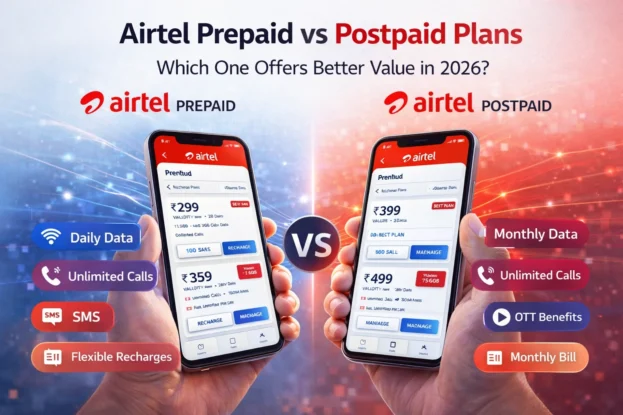
Go prepaid if you want full control over what you spend, you don’t use huge amounts of data, or your usage changes a lot from month to month. There’s no commitment, and you can switch plans whenever you want.
Go postpaid if you hate the hassle of recharging, you use a lot of data consistently, or you want data rollover, which lets you carry forward whatever you didn’t use that month. Postpaid also tends to have better customer service priority, which matters if you ever run into network issues.
For most students, the prepaid option at ₹299 or ₹359 is sufficient. A postpaid plan at ₹399 or ₹499 is typically worthwhile for professionals who depend on their phone for work. For families, the ₹499 postpaid plan with add-on connections saves money compared to each member on separate plans.
The Extras That Actually Matter
Airtel has been quietly building out its ecosystem beyond just calls and data, and in 2026, those extras are worth paying attention to.
Airtel Thanks rewards vary by plan but can include free or discounted OTT subscriptions — think Amazon Prime, Disney+ Hotstar, and others. If you’re already paying for those separately, a plan that bundles them in essentially costs less than it looks on paper.
Several plans also include Wynk Music and Airtel Xstream. Not everyone uses them, but if you’re into music or streaming, they’re there without any extra charge.
Also Read: Raghav Chadha Questions 28-Day Mobile Recharge System and Incoming Call Restrictions in Rajya Sabha
A Quick Guide by User Type
| User Type | Best Plan | Why |
|---|---|---|
| Students | Prepaid ₹299 or ₹359 | Budget-friendly, enough data for daily use |
| Working professionals | Postpaid ₹399 or ₹499 | Reliable, high data, no recharge hassle |
| Families | Postpaid ₹499 | Add-on connections make it cost-effective |
| Heavy data users | Prepaid ₹499 or Postpaid ₹499 | Maximum data for daily heavy usage |
One Thing Worth Keeping in Mind
Airtel isn’t the cheapest option out there — it never has been. If your only priority is getting the most data for the least money, Jio will probably win that comparison.
But if network reliability matters to you, if you’ve had frustrating experiences with call drops or slow speeds elsewhere, or if the bundled OTT and extras actually fit into your life, Airtel holds up well at this price range.
The ₹299 prepaid and ₹399 postpaid plans are probably the best entry points if you’re trying Airtel for the first time or switching from a different operator. Start there, see how the network performs in your area, and go up from there if you need more.
What’s Coming Next
Airtel has been adding more OTT tie-ups and is expected to bring more flexible plan structures as data consumption keeps climbing. There’s also been talk of more personalized plan options down the line — where you can mix and match data, validity, and extras based on your specific usage.
For now, though, the plans under ₹500 cover most people’s needs without forcing you to overpay. Just match the plan to how you actually use your phone, and you’ll be sorted.