


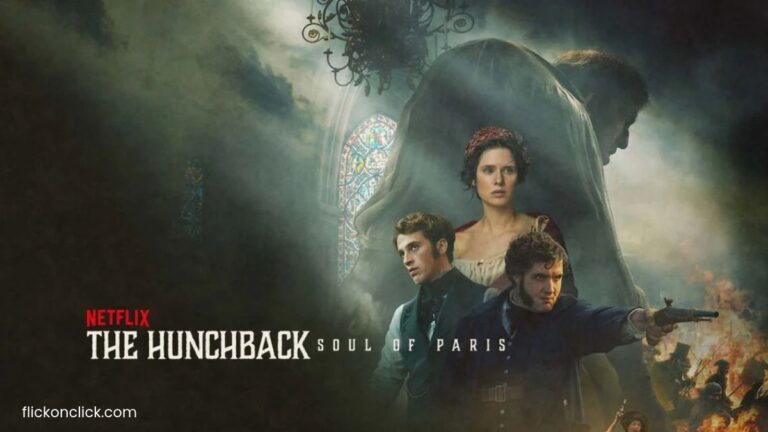
The Hunchback, Soul of Paris Review: ★★☆☆☆ (2/5)
The Hunchback, Soul of Paris looks grand, with strong costumes and a fine cast, but it swaps the emotional core of the classic story for a thinner, busier plot. Several ideas are interesting, yet few of them are explored in depth.
Rating: ★★☆☆☆ (2/5)
Platform: Netflix
Genre: Historical Drama
Director: Jean-François Richet
Writers: Éric Besnard and Edgar Marie
Cast: Vincent Cassel, Daphné Patakia, Karim Leklou, Benjamin Voisin
Runtime: 1 hour 46 minutes
Language: French
Everyone knows the story of the hunchback of Notre-Dame, whether from Victor Hugo’s novel or the Disney film. So when a new version arrives, the big question is simple: what does it add? Netflix’s French film, known as Quasimodo, l’âme de Paris, tries to answer that by changing the story quite a bit. Sadly, those changes make it feel smaller, not bigger.
The film is set in Paris in 1830, at a time when cholera is spreading, and poor people are treated as if their lives don’t matter. A young doctor, played by Benjamin Voisin, is desperate to find a cure. His intentions may be good, but his methods are dark, because he experiments on people he considers expendable.
Vincent Cassel plays Quasimodo, a stonemason often mistaken for a mindless monster. The doctor believes his body might hold the key to a cure, so the police start hunting him. Meanwhile, Quasimodo has fallen for Agnès, a free-spirited dancer played by Daphné Patakia, and he tries to protect her from men who treat her as something they are owed.
The idea is partly inspired by reports that a real hunchbacked stone worker may have lived near the cathedral in Hugo’s time and might have inspired the book. That is a neat starting point. The film wants to imagine who that man might have been.
The trouble is what the film leaves out. In the original story, a religious figure named Frollo is a major force. He takes Quasimodo in and hurts him, and he also lusts after the woman Quasimodo cares about.
That conflict gave the story its fire. By pushing that part aside and focusing on a doctor and a police chief, the film loses much of its emotional punch. One critic said the story no longer feels like Quasimodo’s own, and it is easy to see why.
With so many subplots, Quasimodo himself gets pushed to the edge of his own film. Cassel is almost unrecognizable under impressive makeup work, but the script gives him little to do.
The film has a few interesting thoughts. The doctor’s belief that human lives can be sacrificed for medical progress hints at a darker, gothic tone. But the film never really explores it. Voisin plays the part with the right level of smugness, yet the idea stays on the surface. Karim Leklou, a fine actor, plays the police chief, but his character feels blank and never comes alive.
Agnès also isn’t fully developed, which is a shame, since the love story is usually the heart of any Quasimodo tale. A long scene inside Notre-Dame is well made, but it still doesn’t deliver the emotion the story needs. Some dialogue also tells you how people feel instead of letting you feel it.
The sets and costumes are impressive, and the film has a large scale. Still, the Paris on screen feels a bit clean and stiff, even when we see arrests and rats in the streets. One critic felt the computer made views of the city looked like a video game, and the final scenes of unrest don’t have much emotional power.
The film also can’t decide what it wants to be. It tries to be an adventure, a monster story, and a romance, and none of them gets enough room. At nearly two hours, it also feels a little long for this version of the tale.
The Hunchback, Soul of Paris has a few provocative ideas and a cast worth watching, but it forgets what made the old story so moving. It isn’t offensive, just listless. If you love the original, you may be better off revisiting that instead.
If you want something with more bite this weekend, our Octopus review asks if a ZEE5 thriller about a missing wife is worth watching. For a true story, check our You Can See Everything review, which asks how far we can trust Elizabeth Holmes. And for something lighter, our Focker-in-Law review covers Ariana Grande’s fresh energy in a familiar comedy.