


You Can See Everything Review: ★★★★☆ (4/5)
You Can See Everything is an unsettling, smartly shot documentary that mixes real access with reenactments. It does not hand you easy answers, but it keeps you hooked for nearly three hours.
Rating: ★★★★☆ (4/5)
Genre: Documentary
Language: English
Directors: Lance Oppenheim and Nathan Fielder
Featuring: Elizabeth Holmes, Billy Evans, Amanda Seyfried
Runtime: Nearly 3 hours
What happens when someone who spent years controlling her public image lets a camera into almost every corner of her private life? And what happens when the person behind that camera is Nathan Fielder, a filmmaker who loves to blur the line between reality and performance? That is the big question behind You Can See Everything. The film releases in theatres in India on 27 November.
The documentary is about Elizabeth Holmes, the Theranos founder who was convicted of defrauding investors. It is set around the 34 days before she reports to prison. We spend time with Holmes, her partner Billy Evans, and their family. But as the film soon shows, getting close does not mean getting the truth.
Holmes insists she has never lied. Even with a criminal conviction behind her, she seems unwilling to let go of her version of events. The filmmakers do not challenge every claim in the sharp way of a normal investigative documentary. Instead, they let conversations breathe, sometimes in an uncomfortable way, and they let people reveal themselves through small reactions.
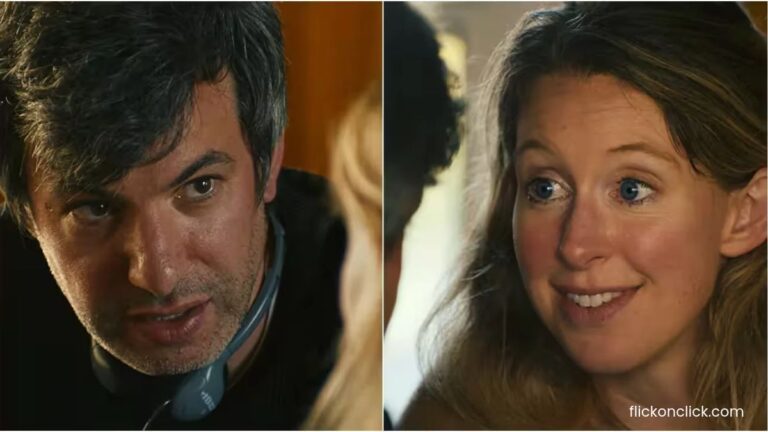
The camera work is the film’s secret weapon. For the first hour and twenty minutes, it feels like the camera wants to suffocate you. Tight close-ups fill the screen, so every twitch, every sniffle while crying, every nervous look, and every hopeful nod is caught in sharp detail. You are not simply watching people talk. You are watching them watch each other, react to each other, and maybe play with each other.
That closeness is on purpose. Oppenheim wants you to notice everything, and there is no comfortable distance to hide behind. It becomes an uneasy exercise in reading faces. You can never be sure whether you are seeing real pain, careful planning, or just someone trying to get through a hard conversation.
Then the style changes. When Amanda Seyfried enters the film, the frame opens up. She played Holmes in The Dropout, and here she takes part in reenactments of scenes the filmmakers could not capture themselves. The shots turn wider, with more room to breathe. It is a sharp contrast to the tight first half, and it makes the gap between real footage and recreation easy to see.
Seyfried’s presence is one of the film’s strangest and most interesting moments. She once played Holmes in a scripted series, and now she becomes part of a documentary about the same person. Fiction and non-fiction meet in an almost dreamlike way, and it adds another layer of performance to a story already full of them.
Even with all the access to Holmes’ home, her relationship, and her family, it is hard to tell how much is unfiltered and how much is a carefully built story for television. The film invites you in but never promises that being inside will give you the whole truth. In fact, the more you see, the more you doubt what you are seeing.
That doubt is both the film’s biggest strength and its most fascinating idea. It is less interested in giving a neat verdict on Holmes than in showing how performance, perception, and control work. Who is performing for the camera? Who is being pushed around? And is the filmmaker also playing a part in the very show he is recording?
Despite its long running time, the film never tests your patience. It is deeply unsettling, yet it is hard to look away.
If you want more to watch, our Octopus review covers a Tamil thriller with a clever courtroom twist. For a Telugu film to skip, check our Bhogi movie review, and for a lighter family comedy, read our Focker-in-Law review.
You Can See Everything promises that you can see it all. Whether you can believe it all is another matter, and that may be exactly the point.
You Can See Everything releases in theatres in India on 27 November.