


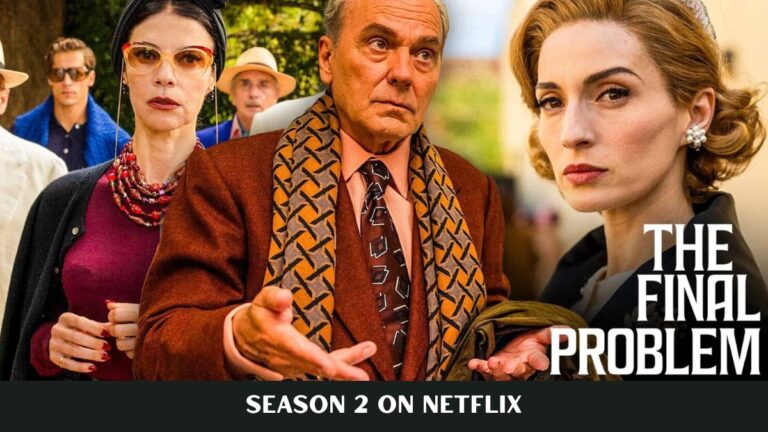
The Final Problem has quickly become one of Netflix’s more intriguing mystery drops this month, and now that its central case has been solved, viewers are naturally wondering whether there’s more story left to tell.
If you haven’t watched it yet, this review of The Final Problem breaks down exactly why this old-school whodunit, with its clever Sherlock Holmes twist, is worth your time before diving into spoiler territory here.
What The Final Problem Is About
Inspired by the world of Sherlock Holmes, the series, originally titled El problema final, follows a retired actor famous for playing the legendary detective on screen, who suddenly finds himself living out a real murder mystery.
Set on a small islet off the coast of Mallorca, the story traps thirteen inhabitants together with no way off the island after several people turn up dead. What follows is a genuinely classic whodunit, one that constantly echoes Arthur Conan Doyle’s A Scandal in Bohemia at nearly every turn.
The cast includes José Coronado, María Valverde, Martiño Rivas, Gonzalo de Castro, Pepón Nieto, Cristina Kovani, José Condessa, Daniel Holguín, Michael Stobbe and Maribel Verdú, with Félix Viscarret directing.
How the Mystery Resolves
After plenty of red herrings pointing viewers toward Francisco Foxá as the likely culprit, the truth turns out to be far more shocking. Adela, someone who’s spent much of the show as Basil’s close confidant and ally, is revealed to be the actual killer. It’s a genuinely stunning twist, especially considering one of her victims was her own close friend Elisa.
The reason behind her actions turns out to be even more layered than expected. Basil eventually uncovers that Adela and Elisa had swapped identities upon arriving on the island, each hoping to escape a life they couldn’t otherwise have.
The real Elisa, posing as Adela, had grown consumed with jealousy over the wealth and status the real Adela enjoyed so easily, while she herself had struggled for everything. Adela’s condescension toward her only deepened that resentment over time.
But the mystery runs deeper still. The entire scheme was actually built around revenge against Sr. Klemmer, a man who had committed serious atrocities against Elisa’s husband during the Holocaust and never faced consequences for it.
Elisa had orchestrated this entire trip and identity swap specifically to eliminate Klemmer and walk away clean, though she ultimately got tangled in her own web of deception by the end.
Basil’s own connection to the case adds another layer entirely. Years earlier, he had taken advantage of a young Elisa, who once dreamed of becoming an actress, before abandoning her.
That history leaves him wracked with guilt once the truth comes out, and rather than turning her in through a conventional arrest, he chooses to stay quiet about her crimes, effectively letting her walk away and start over.
So, Is There a Season 2?
As of now, Netflix has not announced a second season for The Final Problem, and the series has been presented explicitly as a limited series with a complete, self-contained mystery. Basil identifies Elisa and fully understands her motives for revenge, even without delivering a traditional arrest, which gives the story a genuine sense of closure rather than an unresolved cliffhanger.
That said, another case is possible in concept, since the ending doesn’t strictly require a confirmed renewal to feel complete. The story deliberately closes its central question while still leaving some emotional threads, particularly around Basil’s guilt and his choice to protect Elisa, open to interpretation.
For now, without an official announcement from Netflix, any Season 2 speculation should be treated as just that, speculation. If a follow-up does happen, it would likely need to build an entirely new mystery around Basil rather than continuing directly from this case, given how definitively this particular mystery has been solved.
If closed-ended mysteries with real emotional stakes are what you’re drawn to, Habeas Corpus’s own uncertain Season 2 status is also worth a read, since it explores a similarly open-ended question about where its story goes next.