


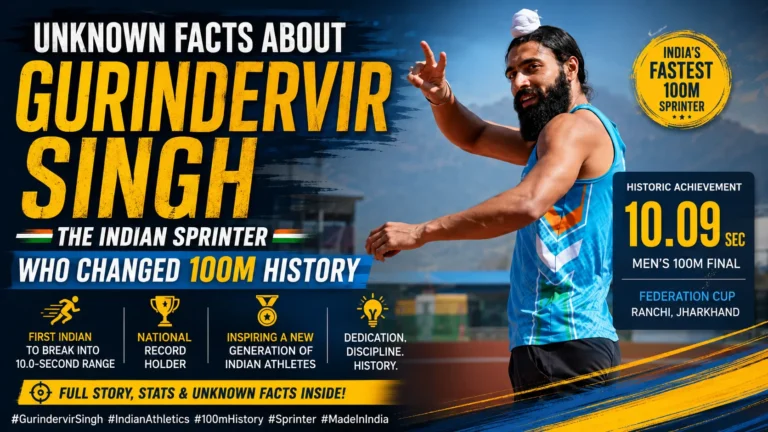
By now, most Indian sports fans know the headline. Gurindervir Singh ran 10.09 seconds at the 2026 Federation Cup in Ranchi and became the first Indian athlete in history to officially break the 10.10-second barrier in the men’s 100 metres. It was a historic moment, widely covered, genuinely celebrated.
But the person behind that sprint — the 25-year-old from a small village in Punjab who fought through health problems, early doubts, and a fiercely competitive domestic rival to get there — is far less understood than the record he just set. Here are the unknown facts about Gurindervir Singh.
Unknown Facts About Gurindervir Singh – India’s Fastest Sprinter

He Started Dreaming About Sprinting After Watching Usain Bolt in 2008
Gurindervir was about eight years old when he watched Usain Bolt tear through the 100 metres at the Beijing Olympics. That was it. Something shifted. The confidence, the speed, the way Bolt made the whole thing look almost easy — it pushed the young Punjabi boy toward sprinting at a time when most kids around him were playing cricket or kabaddi. The Bolt connection is genuinely at the root of everything that followed.
He Is From a Village in Jalandhar, and His Father Was a Police Constable
Born on December 24, 2000, in Patial village in Jalandhar district, Gurindervir grew up in circumstances that were comfortable enough but far removed from the kind of high-performance athletic infrastructure that produces world-class sprinters in most countries. His father was a Punjab Police constable before retiring. There were no elite academies, no professional tracks nearby, no team of coaches waiting to develop him. What he had was discipline, local facilities, and a refusal to accept the ceiling others imagined for him.
Some Early Coaches Told Him Indians Cannot Sprint Fast
This one is hard to read, but it is true. Early in his career, some coaches reportedly suggested he move toward longer distances like the 400m. The reasoning was straightforward and also quietly devastating — a belief that Indian athletes simply do not have the natural fast-twitch capacity to compete seriously in the 100 metres at an international level. Gurindervir heard those suggestions and decided to prove the opposite. His 10.09 seconds is, among other things, a very direct answer to everyone who said it could not be done.
He Battled Serious Health Problems During His Career
Before the records and the celebrations, there were years of struggle that few people know about. During his early competitive period, Gurindervir reportedly battled severe stomach ulcers linked in part to poor hostel conditions while training. That kind of health crisis does not just affect performance — it affects your ability to train consistently, to recover properly, and to believe the effort is worth it. He worked through it, rebuilt slowly, and came back stronger. That stubbornness matters more than most people realise.
He Is a Petty Officer in the Indian Navy
Many fans do not know that Gurindervir Singh serves in the Indian Navy as a petty officer. His life is not only about athletics — it runs alongside military service, with all the structure and discipline that entails. He has spoken about how the armed forces environment shaped his mental toughness and approach to routine. Balancing a military career with the demands of professional sprinting at an elite level is not something many athletes manage. He has.
He Broke the National Record Twice in 48 Hours
The Federation Cup story is extraordinary even beyond the final result. On Friday, Gurindervir ran 10.17 seconds in the semifinal and briefly became India’s fastest man. Within the hour, rival Animesh Kujur ran 10.15 seconds in the very next heat and reclaimed the record. The following day, Gurindervir came back in the final with 10.09 seconds — breaking the record by a margin that made the whole two-day exchange feel like something out of a sports film. Two national records in two days, in front of the same crowd, against the same rival.
His Post-Race Celebration Went Viral for a Very Good Reason
After crossing the line in Ranchi, Gurindervir held up a handwritten note that read: “Task is not finished yet. Wait, I am still standing.” The image spread quickly on social media — not just because of the context, but because of what the message said about his mindset. He was not celebrating an endpoint. He was serving notice that this was the beginning. For a 25-year-old who just became the fastest Indian in history, that attitude is genuinely exciting.
He Also Holds India’s Indoor 60m National Record
The 100m achievement gets all the attention, but Gurindervir also holds India’s national record in the 60 metres at 6.60 seconds. That indoor record is a signal of his explosive starting ability — the phase of a sprint where the race is often won or lost before it properly begins. His start has become one of his most talked-about technical strengths.
Also Read: Gurindervir Singh Creates 100m History With 10.09 Sprint at Federation Cup 2026
He Is Part of India’s Fastest Ever 4×100m Relay Team
Beyond his individual performances, Gurindervir is part of the Indian relay team that holds the national record in the 4×100 metres at 38.69 seconds. That team effort matters because it suggests Indian sprinting is not just a one-man story anymore. There is depth, there is competition, and there are more athletes who are genuinely fast enough to contribute at an international level.
The Reliance Foundation Changed the Trajectory of His Career
After joining the Reliance Foundation athletics programme and working under coach James Hillier, Gurindervir gained access to proper sports science support, physiotherapy, recovery protocols, and structured high-performance coaching. The improvement in his times from that point was not coincidental. Access to the right support system can unlock what raw talent alone cannot — and that is exactly what happened here.
His 10.09 Seconds is the Second Fastest in Asia This Season
To understand how significant this number is in a global context — Gurindervir’s 10.09 is the second-fastest sprint by an Asian athlete this season. Only 19-year-old Japanese sprinter Fukuto Komuro’s 10.08 sits above it. That places Gurindervir in genuine continental competition, not just domestic record territory.
At 25, with the Commonwealth Games and Asian Games ahead, the ceiling on his career is genuinely unclear. And if that handwritten note in Ranchi is any guide, he would tell you the ceiling is the wrong thing to be looking at.