


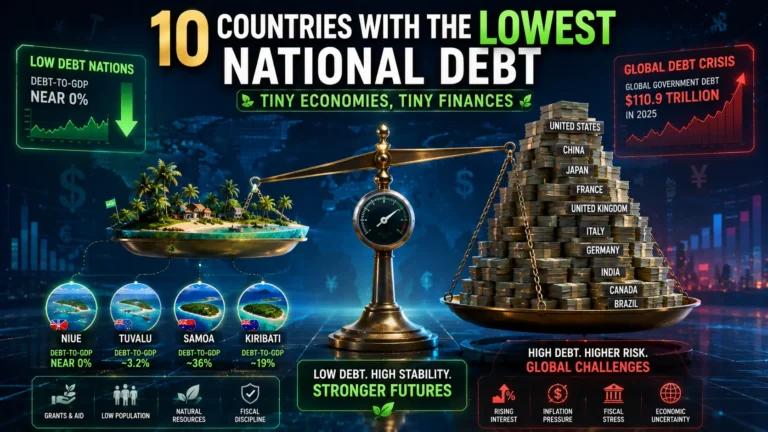
Every government borrows. It’s almost a rule of running a country. But while the headlines focus on the United States, Japan, and China racking up trillions, a small group of nations sits on the opposite end of the chart — owing so little that their entire national debt could be cleared by a single billionaire writing a check. Global government debt crossed $110.9 trillion in 2025. The countries on this list contribute almost none of it.
There are two ways to look at low national debt. The first is the raw dollar figure — how many millions or billions does a country actually owe? The second is the debt-to-GDP ratio — how small is that debt compared to the size of the economy? Both numbers matter, and they don’t always tell the same story. A nation can owe very little in dollars but still feel squeezed because its economy is tiny too. This article looks at both angles.
The Top 10 Countries with the Lowest National Debt (2026)
Here’s a clear look at who owes the least, combining total debt and debt-to-GDP for the full picture:
| Rank | Country | Total Debt (approx.) | Debt-to-GDP | Key Driver |
|---|---|---|---|---|
| 1 | Niue | ~$4 million | Near 0% | Free association with New Zealand, grant-funded |
| 2 | Nauru | ~$35 million | ~13% | Phosphate revenue, Australian support |
| 3 | Tuvalu | ~$60 million | ~3.2% | Trust fund income, climate aid |
| 4 | Palau | ~$80 million | ~80% | U.S. Compact funding, tourism |
| 5 | Marshall Islands | ~$90 million | ~21% | U.S. Compact agreement, fisheries |
| 6 | Kiribati | ~$150 million | ~19% | Fishing licenses, foreign grants |
| 7 | Micronesia (FSM) | ~$180 million | ~14% | Tourism, remittances, and tight budgets |
| 8 | São Tomé and Príncipe | ~$300 million | ~55% | Cocoa exports, donor aid |
| 9 | Tonga | ~$400 million | ~42% | Remittances, tourism |
| 10 | Samoa | ~$450 million | ~36% | Tourism, remittances, tight budgets |

A Closer Look at Each Country
1. Niue — Niue is, by almost every measure, the country with the smallest national debt on Earth — barely a few million dollars. With a population of under 2,000 people and a free association agreement with New Zealand, Niue runs on grants rather than loans. It’s often listed alongside Liechtenstein as one of the only nations considered effectively debt-free. The catch? Its economy is so small that even a minor shock would feel enormous.
2. Nauru — Nauru’s national debt sits around $35 million. The country once grew rich from phosphate mining, then nearly went bankrupt when reserves ran out. Today it relies heavily on Australian aid and revenue from hosting a regional processing center. Debt-to-GDP has fallen sharply over the last decade through careful budget restraint.
3. Tuvalu — Tuvalu’s story is unlike most others on this list. Its debt-to-GDP ratio of just over 3% makes it one of the lowest in the world, second only to Liechtenstein in some IMF rankings. The country earns money from a sovereign trust fund, fishing licenses, and an unlikely source — leasing its “.tv” internet domain. Yet rising sea levels threaten the country’s very existence.
4. Palau — Palau owes roughly $80 million in absolute terms, but its debt-to-GDP ratio is higher than its neighbors because tourism — its main industry — collapsed during the pandemic and has been slow to recover. The U.S. Compact of Free Association keeps grant money flowing in, softening the blow.
5. Marshall Islands — With about $90 million in debt and a debt-to-GDP ratio near 21%, the Marshall Islands stays solvent thanks to its Compact agreement with the United States, fishing license income, and a sovereign trust fund being built up for the day U.S. payments taper off.
6. Kiribati — Kiribati’s debt sits near $150 million. Most of its income comes from selling fishing rights in its enormous ocean territory, plus support from international donors. Despite its modest debt, climate vulnerability remains the country’s biggest financial threat.
7. Micronesia (FSM) — The Federated States of Micronesia owes around $180 million. Like the Marshalls and Palau, it benefits from a Compact with the U.S. and has been quietly building up a trust fund for long-term stability. Debt remains low because lenders treat the country cautiously, and grants do most of the heavy lifting.
8. São Tomé and Príncipe — The only African country on the list, this twin-island nation off West Africa owes about $300 million. Most of its budget comes from cocoa exports and international aid. Its debt-to-GDP ratio is higher than its dollar figure suggests, reflecting just how small the economy really is.
9. Tonga — Tonga’s national debt is close to $400 million, much of it owed to China for post-disaster reconstruction loans. Remittances from Tongans living in New Zealand, Australia, and the U.S. are a lifeline that keeps the economy ticking and the debt manageable.
10. Samoa — Samoa rounds out the list at around $450 million. The country has worked hard to keep its budget tight and its borrowing modest, with the IMF regularly praising its fiscal management. Tourism and remittances do most of the economic work, and the government has avoided big-ticket loans that other small nations have stumbled into.
Why Do These Countries Owe So Little?
There’s rarely a single reason. Low debt usually comes from a mix of:
Small populations, small budgets — A country of 2,000 or 20,000 people simply doesn’t need to build national highway systems, fund massive militaries, or run sprawling welfare programs. Less spending means less borrowing.
Grants instead of loans — Many of these nations receive direct financial support from larger partners. The U.S. Compacts of Free Association keep Palau, Micronesia, and the Marshall Islands afloat. Australia and New Zealand do the same for several Pacific neighbors. When grants cover the bills, debt doesn’t pile up.
Remittances from abroad — Tonga, Samoa, and Kiribati all depend heavily on money sent home by citizens working overseas. This income flows directly into households, reducing the need for government borrowing to support living standards.
Limited access to credit — Lenders see tiny, climate-exposed island economies as risky bets. That naturally caps how much these countries can borrow, even if their governments wanted to.
Also Read: 10 Countries with the Highest National Debt in 2026
Is Low Debt Always a Good Sign?
Low debt is not automatically a sign of strength. What matters is the context around it.
Liechtenstein and Brunei have ultra-low debt-to-GDP ratios — under 3% — because they’re genuinely wealthy and disciplined. That’s structural strength. But Niue or Tuvalu have low debt partly because no one will lend to them at scale, and their economies are too small to absorb major borrowing in the first place. That’s not strength — it’s fragility wearing a friendly face.
The danger zone for these small nations isn’t debt itself. It’s climate shocks, tourism collapse, and reliance on a handful of donors. One bad cyclone or one expired aid agreement can flip a low-debt country into a debt crisis almost overnight.
What It Means for the Rest of Us
These 10 nations may not move global markets, but their experience offers something the giants on the high-debt list often miss — proof that living within your means is possible, even when life is hard.
The IMF has warned that global public debt is on track to approach 100% of world GDP by 2030. Most of the world is borrowing more, not less. The countries on this list show another path, even if that path is partly forced on them by geography and size.
Their debt is small. Their lessons are not.