


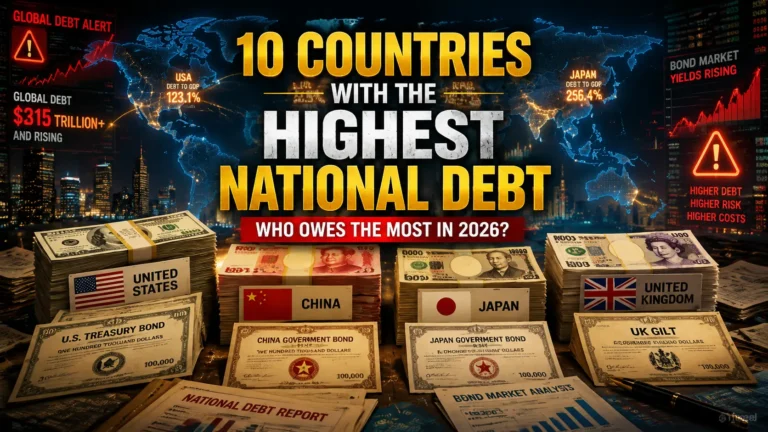
Every government borrows money at some point. Roads need building. Hospitals need funding. Crises need managing. But when a government borrows more than it can comfortably pay back, year after year, the debt piles up into something much harder to ignore.
Global government debt reached $110.9 trillion in 2025. That’s not a typo. And a handful of countries are responsible for the bulk of it.
There are two ways to look at national debt. The first is the raw dollar amount — how many trillions does a country actually owe? The second is the debt-to-GDP ratio — how big is that debt compared to the size of the economy? Both numbers matter, but for very different reasons. A $10 trillion debt is far less scary if you’re the world’s third-largest economy than if you’re a small island nation. This article covers both lenses.
The Top 10 Countries with the Highest National Debt (2026)
Here’s a clear look at who owes the most, combining total debt and debt-to-GDP for the full picture:
| Rank | Country | Total Debt (approx.) | Debt-to-GDP | Key Driver |
|---|---|---|---|---|
| 1 | United States | ~$36–37 trillion | ~123% | Pandemic spending, tax cuts, entitlements |
| 2 | China | ~$15–18 trillion | ~84–97% | Local govt debt, rapid infrastructure build-up |
| 3 | Japan | ~$10–11 trillion | ~230% | Decades of stimulus, aging population |
| 4 | United Kingdom | ~$3.5–4 trillion | ~101% | Post-Brexit shocks, pandemic borrowing |
| 5 | France | ~$3.2–3.9 trillion | ~116% | Pensions, welfare, structural deficits |
| 6 | Italy | ~$2.8–3.2 trillion | ~137% | Slow growth, social spending, low reform |
| 7 | India | ~$2.5–3 trillion | ~80–83% | Infrastructure, subsidies, welfare |
| 8 | Germany | ~$2.5–2.8 trillion | ~64% | Post-COVID recovery, defense spending |
| 9 | Canada | ~$1.5–2 trillion | ~107–112% | Housing pressures, provincial debt |
| 10 | Brazil | ~$1.4–1.6 trillion | ~75% | Fiscal swings, commodity dependence |
A Closer Look at Each Country
1. United States — In terms of raw dollars, the United States has the highest debt in the world — more than twice that of any other country. The sharp increase this century is linked to frequent tax cuts, rising entitlement spending, and policy responses to the Global Financial Crisis and the Covid-19 pandemic. The good news? The dollar’s status as the global reserve currency keeps borrowing costs low and ensures strong market demand for U.S. Treasury bills.
2. China — China’s national debt is currently about $15 trillion. Because of China’s massive economy, the country’s debt is only about 84% of its GDP. China’s current debt level is a significant increase from 2014. Local government debt and state-owned enterprises are big parts of the picture that don’t always show up in headline numbers.
3. Japan — Japan’s story is unlike anyone else’s. Japan had the highest public debt level in relation to its GDP in 2025, at almost 230 percent. The Japanese government is currently spending around half of its total tax revenue on servicing its massive debt. Yet Japan hasn’t collapsed. Why? Because almost all of its debt is held by Japanese banks, insurers, and citizens — meaning the risk stays inside the country.
4. United Kingdom — Brexit-related costs, a painful cost-of-living crisis, and the pandemic pushed UK debt past 100% of GDP for the first time in decades. It’s a developed economy with a manageable but clearly rising burden.
5. France — France remains in the top 10 because persistent fiscal gaps have kept debt elevated outside crisis years. The issue is not imminent distress but reduced room for maneuver as aging, defense, and interest costs compete for budget space.
6. Italy — Italy has been on Europe’s watch list for years. With debt above 135% of GDP and slow economic growth, it’s frequently monitored by the European Central Bank. Any shock to Italy’s borrowing costs sends tremors through the entire eurozone.
7. India — India’s debt, while large in dollar terms, is mostly domestically held and tied to productive spending on infrastructure and welfare. With one of the fastest-growing major economies in the world, India’s debt-to-GDP ratio is relatively contained for now.
8. Germany — Ironically, Germany is the “responsible” one on this list. Its debt-to-GDP is around 64% — far lower than most peers. It got here through decades of fiscal discipline, though recent defense and energy investments are pushing numbers higher.
9. Canada — Canada’s debt looks manageable on paper, but Canada stands out with the highest household debt-to-income ratio in the G7, and provincial-level borrowing adds a layer of pressure that federal numbers alone don’t capture.
10. Brazil — Brazil’s debt has grown steadily, driven by pension obligations, social programs, and commodity-market volatility. Political instability around fiscal policy has made investors nervous, which pushes borrowing costs up further.
Why Do Governments Keep Borrowing?
There’s rarely a single villain. Debt builds up through a mix of:
Demographic pressure — Older populations need more healthcare and pensions. Japan, Italy, and France are classic examples. Fewer working-age people means less tax income, but the bills keep growing.
Crises and wars — Governments borrow heavily during emergencies. COVID-19 alone added trillions to debt across almost every country in the top 10. Wars and conflicts do the same in less stable nations.
Stimulus and growth policy — Sometimes debt is deliberate. Governments borrow to build roads, schools, or industries, hoping future economic growth will more than cover the cost. It works — until it doesn’t.
Structural deficits — Some governments simply spend more than they collect in taxes every single year, with no easy political fix in sight.
Also Read: Lahore Is Bringing Back Its Pre-Partition Names
When Is High Debt Actually Dangerous?
High debt is not automatically a crisis. What matters is the context around the debt.
Japan owes 230% of its GDP and still functions normally, because its debt is in yen, owned by its own people, and at very low interest rates. Germany carries far less debt but would be in trouble if its economy stopped growing.
The danger zone is when debt is in a foreign currency, held by overseas lenders, at rising interest rates, in a slow-growth economy. That’s when debt stops being a policy tool and starts being a trap.
What It Means for the Rest of Us
These 10 countries don’t owe their money in a vacuum. When the U.S. raises borrowing, global interest rates move. When Japan shifts its bond policy, markets shake worldwide. When Italy’s debt looks wobbly, European investors get nervous.
The IMF has warned that global public debt is on track to approach 100% of world GDP by 2030. The countries on this list are driving that trend — and how they manage it will shape inflation, currency values, investment flows, and economic growth for everyone else.
It’s their debt. But in a connected world, it’s also our problem.