


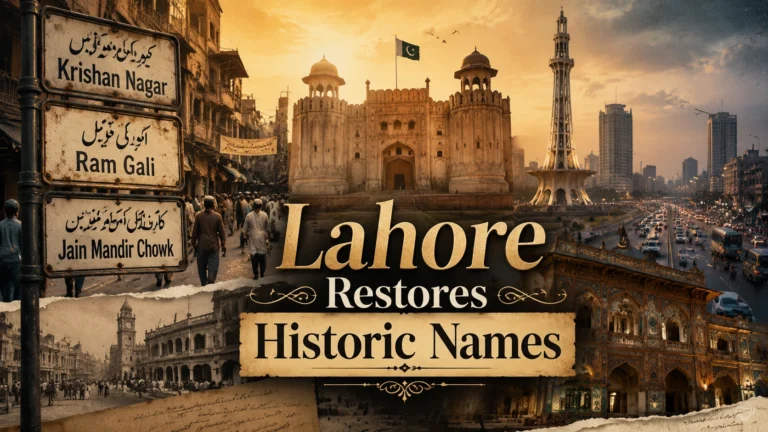
When news broke that Lahore was officially restoring several of its pre-Partition street and neighborhood names — Krishan Nagar, Ram Gali, Sant Nagar, Jain Mandir Chowk, Lakshmi Chowk among them — the reaction across social media wasn’t the muted acknowledgment that usually follows municipal administrative decisions.
People cried. They shared old photographs. They posted their grandparents’ stories. They searched for historical maps they’d never seen of streets their families had described to them across generations. In India and Pakistan, both, and among diaspora communities scattered across the world, something about this news landed with unusual weight.
That reaction tells you something important about what street names actually are and what they can carry — not just geographic information, but history, identity, grief, and the specific kind of longing that comes from loving a place you’ve never been able to fully claim.
What Lahore Was Before 1947
To understand why these names matter, you have to understand what Lahore was.
Before Partition, Lahore was one of the subcontinent’s great cities — a place where Hindu, Sikh, and Muslim communities had lived together, argued, traded, prayed, and created a culture for generations. The city’s identity was genuinely composite. Different neighborhoods had different characters shaped by the communities that lived in them. The architecture mixed Mughal grandeur with Sikh-era structures and colonial buildings. The food, poetry, music, and intellectual culture of Lahore emerged from that mix.
Krishan Nagar — what became Islampura after Partition — was a well-established Hindu-majority residential area with schools, markets, and community institutions. Ram Gali was known for the Hindu families and businesses that gave it its daily life. Sant Nagar and Jain Mandir Chowk similarly took their identity from the Sikh and Jain communities that had shaped them over decades and centuries.
In August 1947, that world ended in one of history’s most catastrophic upheavals. An estimated 14 million people crossed the new borders in both directions in a matter of months. Lahore became part of Pakistan; its Hindu and Sikh population largely fled or was expelled. The communities that had named those streets, built those buildings, and filled those neighborhoods were gone — and over the following decades, many of the names that carried their presence were changed.
The Names That Survived in Memory
Here’s what’s striking about this story: many of those old names never fully disappeared. They survived in the oral histories of families who left, in old letters, in the specific way elderly Lahori residents continued referring to places long after the official names had changed.
Ask anyone from a family displaced from Lahore in 1947. They know the old names. Their parents told them. Their grandparents described the streets as if they’d never left. The geography of a place you were forced to abandon gets preserved in family memory with a specificity that official maps rarely match.
For those families — now spread across India, Pakistan, the UK, Canada, and elsewhere — the restoration of names like Krishan Nagar and Ram Gali isn’t an administrative update. It’s official acknowledgment that their history in that city was real, that it happened, that it deserves to be legible in the present.
What Has Actually Been Restored
The restoration covers several areas across Lahore, with varying levels of formality in how the changes have been implemented — some through official municipal records, some through signage updates, some through heritage registry documentation.
| Restored Name | Previous Name | Significance |
|---|---|---|
| Krishan Nagar | Islampura | Prominent pre-Partition Hindu residential locality |
| Ram Gali | Various modernized references | Historic Hindu residential lane from before 1947 |
| Sant Nagar | Modernized references | Area associated with Sikh and Hindu communities |
| Jain Mandir Chowk | Babri Chowk | Named for the historic Jain temple once located here |
| Dhobi Ghat | New Muslim Town-linked references | Traditional working-class area with old Lahore identity |
| Lakshmi Chowk | Various | Iconic cultural and food district with Hindu historical roots |
| Shah Alami historical naming | Heritage registry references | Famous pre-Partition commercial market area |
| Kucha and Gali heritage names | Unnamed colonial-era sectors | Traditional Mughal-era neighborhood identity |
The scope isn’t uniform — some restorations are more complete than others, and the process of bringing official usage in line with heritage names is ongoing. But the direction of travel is clear, and the intent to preserve Lahore’s pre-partition identity in public record and signage represents a meaningful shift.
What Prompted This
The restoration appears to be part of a broader heritage preservation effort in Pakistan rather than a single top-down political decision. Historians, conservation groups, and urban heritage advocates have been arguing for years that Lahore’s identity is inseparable from its pre-Partition history — that acknowledging the Hindu, Sikh, and Jain communities that shaped the city for centuries doesn’t threaten its present identity but enriches it.
That argument has gained traction at the official level. The logic is sound: Lahore is already celebrated internationally for its Mughal heritage, its Sikh history concentrated around places like the Lahore Fort and the Samadhi of Ranjit Singh, and its colonial-era architecture. Extending that heritage consciousness to neighborhood and street names that carry community history is consistent with the city’s established approach to its own past.
Urban historians make a specific point worth noting: restoring historical names doesn’t erase what came after them. Lahore in 2026 is a Muslim-majority Pakistani city with its own living culture and identity. Acknowledging that it was also, before 1947, home to communities who named its streets and built its neighborhoods doesn’t create a contradiction. History is layered, and cities that acknowledge all of their layers tend to be more interesting and more honest than those that present only one narrative.
The Response Across the Subcontinent
The reaction on social media has been striking in its emotional register. Accounts based in India have been sharing photographs of pre-Partition Lahore with captions noting which neighborhood their families came from. Pakistani accounts have been responding with current photographs of the same streets and neighborhoods. The exchange has a quality that much of India-Pakistan online interaction doesn’t — genuine warmth rather than point-scoring.
Older members of displaced families have been sharing specific memories that the restored names triggered. A grandmother remembers the sweetshop near Krishan Nagar. A grandfather describing the Jain temple at the chowk that now bears its historical name again. The specificity of these memories — their granular detail across seven decades of distance — speaks to how deeply Partition geography is embedded in family consciousness across the subcontinent.
For younger generations on both sides of the border, the development has created fresh curiosity about a Lahore many of them knew only as a name in family stories. Historical map searches reportedly increased significantly after the announcement. There is something about having the official geography updated to match the remembered geography that makes the history feel newly accessible.
What It Means for Heritage Tourism
The practical dimension is worth acknowledging alongside the emotional one. Lahore already attracts significant cultural tourism from Pakistan, from the diaspora, and from international visitors interested in the region’s layered history. The restoration of pre-Partition names makes the city’s Sikh, Hindu, and Jain heritage more navigable for visitors with connections to those communities.
Families who return to Lahore — as some do, to see the streets their grandparents described — will now find that the official names match the ones they were told. That alignment between remembered history and present reality is meaningful for heritage tourism in a way that’s difficult to fully quantify but easy to understand.
Heritage experts have consistently argued that cities with honestly preserved historical identity attract deeper visitor engagement than those where the history has been curated into a single narrative. Lahore’s decision to make its pre-Partition names visible again is consistent with treating the city’s full history as an asset rather than a complication.
The Bigger Conversation This Has Opened
The restoration of these names has become a catalyst for wider discussions about how Pakistan and India relate to their shared pre-Partition history — discussions that are usually politically difficult but that the specific, non-confrontational nature of this heritage initiative has made easier to have.
The conversation isn’t about 1947 itself, or about borders, or about the political decisions that shaped Partition. It’s about a city that existed before those decisions and the communities that made it. That more specific and less politically charged framing has allowed people on both sides of the border to engage with it in ways that broader discussions of partition often don’t permit.
Whether this particular initiative becomes a template for similar heritage efforts in Lahore or other Pakistani cities remains to be seen. Conservation groups are already discussing which other historical sites and naming conventions might receive similar treatment. The appetite for this kind of work appears to be real, and the public response to the first round of restorations will likely inform how far it goes.
What the Names Carry
Partition was, among many other things, a massive act of cultural erasure. Communities that had lived for generations in specific places were removed from those places — and then, over time, removed from the official record of those places as well. The names changed. The maps changed. The buildings remained, but the identity attached to them was overwritten.
What Lahore is doing — slowly, imperfectly, incompletely — is writing some of that back in. Not undoing the partition, which cannot be undone, and not pretending that the last seventy-seven years didn’t happen. But acknowledging that Krishan Nagar was Krishan Nagar before it was Islampura, that Ram Gali was Ram Gali, and that the Jain temple stood at that chowk and gave it its name for reasons worth remembering.
For the families whose history those names carry — families scattered across two countries and several continents — that acknowledgment means something. It says, “You were here.” This was yours. It is still, in some small and official way, connected to you.
That’s not a small thing. For a city and a history shaped by one of the most painful separations in modern human experience, it might be exactly the right kind of beginning.