


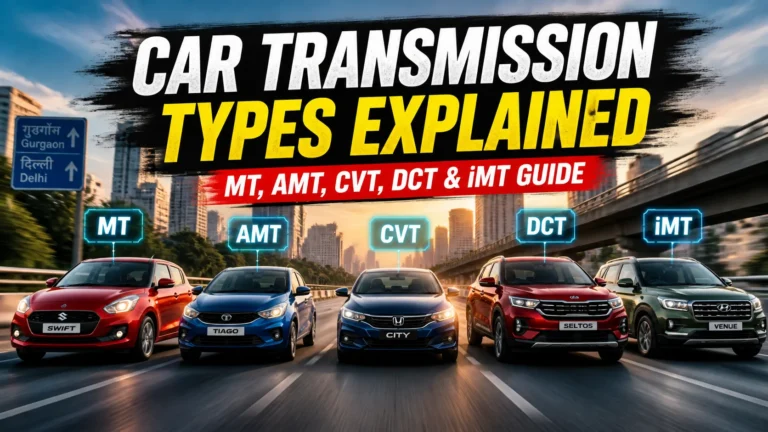
Walk into any car showroom in India and within five minutes someone will throw six confusing words at you — manual, automatic, AMT, CVT, DCT, iMT. Most salespeople assume you already know what these mean. Most buyers pretend they do. This article is for everyone who has ever nodded along and quietly Googled it later. Here is a plain, honest look at every car transmission type available today, what each one actually feels like behind the wheel, how much it will cost you, and which one makes the most sense for your life.
The transmission is the part of your car that decides how engine power reaches the wheels. Different transmission types do this job in very different ways, and that difference affects your daily drive more than most people realise. Before picking a car, it is worth spending ten minutes understanding this — it could save you a lot of frustration down the road.
Manual Transmission (MT) — The Old Faithful
The manual is the original. You control everything — clutch pedal, gear lever, timing. It gives you the most direct connection to the car, and drivers who enjoy driving genuinely love it. It is also the most fuel-efficient option and the cheapest to buy. The catch is obvious: Mumbai or Delhi traffic with a manual clutch can wear out your left leg and your patience at the same time. If you park on hills regularly, be ready for some tense moments early on. That said, for anyone who does not mind putting in a little effort, a manual is hard to beat on value.
iMT (Intelligent Manual Transmission) — Manual Without the Clutch Pedal
The iMT is a genuinely clever idea. You still shift gears yourself using a regular gear stick, but there is no clutch pedal. The car handles the clutch automatically using sensors whenever you move the gear lever. It feels like a manual in terms of control, but your left foot gets a well-deserved holiday in traffic. Mileage is close to a proper manual. Maintenance is simpler and cheaper than most automatics. Currently offered on select Hyundai and Kia models in India, it is probably the most underrated option available today — especially for city drivers who want control without the fatigue.
Torque Converter Automatic (TC) — Smooth, Reliable, No Surprises
This is what most people picture when they say ‘automatic’. No clutch, no gear stick — just drive. Torque converter automatics have been around for decades, and the reason they keep selling is simple: they work. Shifts are smooth, the driving experience is effortless, and modern six or eight speed versions are decently fuel-efficient too. They cost more than a manual up front, and the fluid needs regular changing, but long-term reliability on Indian roads is solid. If comfort is your top priority and you do a lot of city driving, this is a strong, sensible choice.
CVT (Continuously Variable Transmission) — The Mileage Champion
The CVT has no fixed gears at all. Instead, it uses a belt-and-pulley system that adjusts continuously, giving you seamless acceleration without any gear shift sensation. The result is excellent fuel efficiency, which is why many of India’s most mileage-friendly automatics use a CVT. The trade-off is a distinctive sound — the engine tends to hold at a steady RPM under acceleration, creating a ‘droning’ noise that some people find odd. The bigger concern is maintenance: CVT fluid changes are non-negotiable, and if ignored, repairs can run between one and two and a half lakh rupees. Treat it well and it will serve you. Neglect it and the bill arrives fast.
AMT (Automated Manual Transmission) — The Budget Automatic
The AMT takes a regular manual gearbox and adds a small computer to handle the clutch and shifts for you. The result is automatic convenience at a very low price premium — typically around fifty to sixty thousand rupees over the manual variant. It is mechanically simple, which keeps repair costs low. The downside is the driving feel. AMTs can feel jerky at low speeds, particularly in stop-and-go traffic, with a slight head-nod every time it changes gear. Most drivers adjust to it, but it is something you should experience in a test drive before committing. For budget buyers who want automatic without spending big, AMT makes practical sense.
DCT (Dual-Clutch Transmission) — The Sporty One
A DCT uses two separate clutches — one for odd gears, one for even — pre-selecting the next gear before you even ask for it. The result is lightning-fast gear changes and a sporty, responsive drive that petrolheads genuinely enjoy. On a highway or open road, a DCT feels brilliant. In slow city traffic, it can feel nervous and occasionally jerky as it hunts between gears. Repair costs are the highest of any automatic — DCT mechatronic unit repairs can easily touch one lakh rupees or more. It is best suited to drivers who do a lot of highway driving and want performance. For pure city use on a budget, there are better options.
Also Read: How Do Hybrid Cars Work? Everything Explained in Simple Terms
Quick Comparison: All Six Transmissions at a Glance
| Transmission | Driving Feel | Mileage | Cost vs MT | Maintenance | Best For |
| MT (Manual) | Hands-on, full control | Best | Cheapest | Low (clutch wears in traffic) | Budget buyers |
| iMT | Manual-like, no clutch pedal | Very Good | +₹15-25k | Low, close to MT | City drivers, mileage lovers |
| Torque Converter | Smooth, effortless glide | Good | +₹50k–1.5L | Reliable if serviced | Comfort seekers |
| CVT | Seamless but can drone | Excellent | +₹80k–1.3L | Costly if fluid neglected | Highway cruisers |
| AMT | Affordable auto, slightly jerky | Very Good | +₹50-60k | Simple but sensors age | Budget automatic buyers |
| DCT | Sporty, fast shifts | Good | Highest | Expensive to repair | Performance drivers |
So Which One Should You Pick?
For someone doing daily city driving in India — dealing with traffic, watching fuel costs, and not wanting a massive service bill — the iMT is probably the most well-rounded choice right now. You get manual-style control, no clutch fatigue, near-manual mileage, and low maintenance costs. If you want a proper automatic without worrying too much about long-term repairs, a torque converter is your safest bet. If budget is everything and you just want automatic convenience in a hatchback, the AMT does the job. The CVT rewards disciplined maintenance. The DCT is for those who enjoy the drive. And the honest manual is still the best deal for anyone who does not mind the clutch.
There is no single right answer here — it depends on your city, your daily commute, and how you actually drive. But now at least, when the salesperson starts talking transmissions, you will know exactly what questions to ask.