


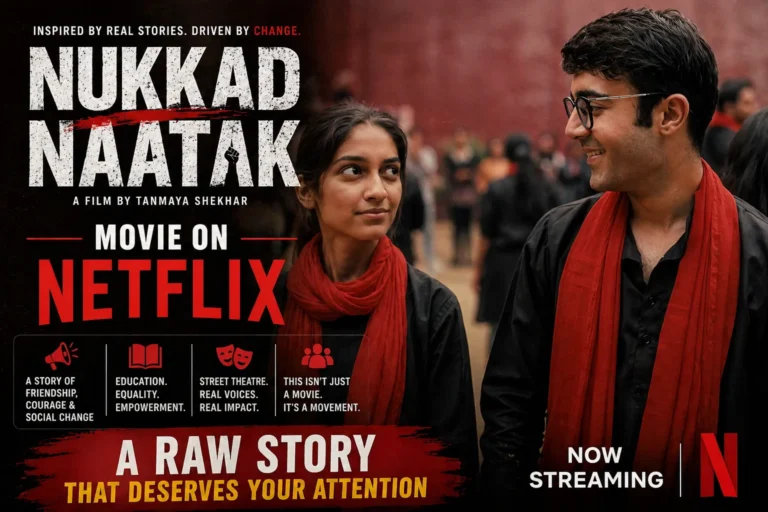
Nukkad Naatak has been on Netflix since April 24, 2026, and if the algorithm hasn’t pushed it your way yet, that’s the algorithm’s failure, not the film’s.
Directed by Tanmaya Shekhar and crowd-funded into existence by people who believed in it before anyone with money did, this is a social drama about two engineering students, a second chance they didn’t deserve, and the children from a nearby slum who end up changing their lives.
It’s set in Dhanbad, shot in real locations, performed by largely unknown actors, and it’s one of the more quietly affecting things available on the platform right now. Here are five reasons it’s worth your time.
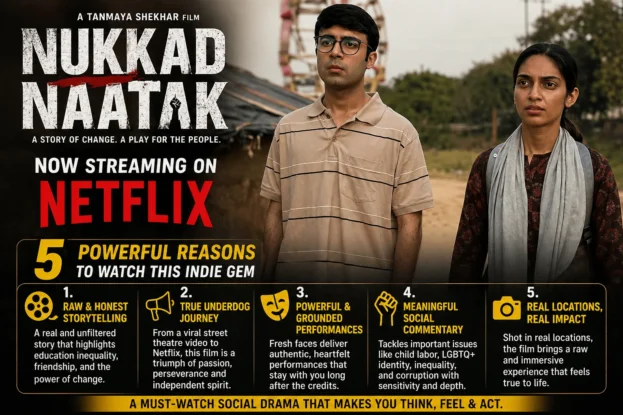
1. The Story Is Honest in a Way That Most Films Aren’t
The setup sounds simple: two college students on the verge of expulsion are given a choice — leave, or do something difficult and uncomfortable that might teach them something. They choose the uncomfortable option. They’re assigned to educate children from a slum nearby and help get them enrolled in school.
What makes Nukkad Naatak work is that it doesn’t treat this premise as a neat redemption arc where privileged people discover the poor have feelings too and everything is resolved by the third act. It’s messier than that. The students resist, resent, gradually understand, and change in ways that feel earned rather than scripted.
The film also doesn’t shy away from showing what the slum children’s lives actually look like — the child labour, the education gap, the way systems fail the same people repeatedly. It shows these things without being exploitative or miserabilist. It just shows them, and trusts the audience to sit with what that means.
2. The Film Itself Getting to Netflix Is Part of the Story
Nukkad Naatak was crowd-funded. Not picked up by a production house, not backed by studio money — made by people who passed a hat around and believed enough in what they were trying to say to fund it themselves.
That journey — from a crowd-funding campaign to a global streaming platform — is genuinely unusual, and it adds something to the experience of watching the film. You’re watching something that exists because the people who made it refused to let it not exist. That kind of stubborn belief in a story tends to show up in the work itself, and it does here.
It’s also an encouraging reminder that the gates aren’t entirely closed. A small film from Dhanbad with no famous cast can end up on Netflix if it’s good enough. That matters.
3. The Performances Feel Real Because They Are
The two lead actors — Molshri Singh and Shivang Rajpal — are not household names. And watching them, you’ll be grateful for that, because there’s no celebrity baggage interfering with who these characters are.
Their performances are natural in the way that’s actually harder to achieve than theatrical acting. No big moments, no obvious emotional signposting. Just two people playing characters who are trying to figure out who they are and not quite managing it — which is completely authentic to the age and the situation.
Danish Husain in a supporting role brings the kind of grounded gravitas that anchors the story when it needs weight. The ensemble as a whole never overacts, never tries to make you feel things you haven’t been prepared to feel. They let the situations do the work.
4. It Takes On Real Issues Without Turning Into a Lecture
Education inequality, child labour, LGBTQ+ identity — Nukkad Naatak deals with all of these, and it handles none of them as issues to be solved within a two-hour runtime. Instead, they’re woven into the fabric of who these characters are and what their world looks like.
The LGBTQ+ storyline in particular is handled with a care and matter-of-factness that avoids making it either a tragedy or a triumph. It’s just part of the story, part of someone’s life, treated with the same seriousness as everything else the film deals with.
Films that want to be socially conscious often end up being socially instructive — telling the audience what to think rather than showing them something to think about. Nukkad Naatak mostly avoids that trap. It raises questions and leaves them open, which is actually more respectful of the audience’s intelligence.
5. The Cinematography Does More Than It Needs To
Shot in real locations around Dhanbad — actual college buildings, actual slum streets — the film has a documentary quality to its visuals that serves the story perfectly. You don’t doubt for a second that these places are real because they are real.
The contrast between the world of the engineering college and the world of the slum isn’t created through visual metaphor or colour grading tricks. It’s just there, in the actual environments, doing its work quietly. That restraint is its own kind of skill.
There are no moments where the cinematography calls attention to itself. It just shows you where you are and trusts that being shown is enough.
Who Will Get the Most From This Film
If you tend to watch films for the story and the performances rather than the production value, Nukkad Naatak will work for you. If you enjoy cinema that takes social issues seriously without turning into a public service announcement, this is exactly that. Students, anyone who’s spent time working with communities different from their own, people who appreciate independent filmmaking on its own terms — this film will land with all of them.
It’s also a genuinely good film to watch when you want something that feels important without being exhausting. It’s not a heavy sit. It moves at a reasonable pace, it has warmth and even occasional humour amid its more serious material, and it ends in a place that feels earned.
Also Read: 7 Japanese Horror Movies on Netflix That Will Terrify You Instantly and Keep You Awake at Night
Who Should Watch Nukkad Naatak?
Nukkad Naatak isn’t trying to be the biggest film on Netflix. It’s trying to tell one specific story honestly and with care. That’s a humbler ambition than most films set for themselves, and the film meets it.
In a platform landscape full of content competing loudly for your attention, a quiet film that earns its emotional moments through patience and honesty is its own kind of valuable. It’s been on Netflix since April 24. Give it an evening.