


You’ve been seeing Bitcoin headlines everywhere — on your phone, in your WhatsApp family group, maybe even on your CA’s Instagram. And now you’re here, finally Googling: “Where do I even start?”
The answer? A crypto wallet. Think of it as your digital bank account — except you’re the bank, and no one can freeze your account at 2 AM because the server is down. The problem is, there are about a hundred wallets out there, each claiming to be the “best.” So which one actually works for someone in India, with INR, on a tight budget, and zero interest in reading a 40-page technical manual?
Buying your first Bitcoin can feel confusing, especially with changing regulations in India. A crypto wallet is your personal tool to store, send, and receive digital assets securely.
For beginners, the focus should be on 3 things: easy fiat deposits, strong security, and a simple interface. With India’s 30% crypto tax and FIU compliance rules, choosing the right wallet becomes very important. I’ve done the homework for you. Here are the top 7 crypto wallets to buy your first Bitcoin in India — ranked for safety, simplicity, and yes, UPI support.
Types of Crypto Wallets Explained
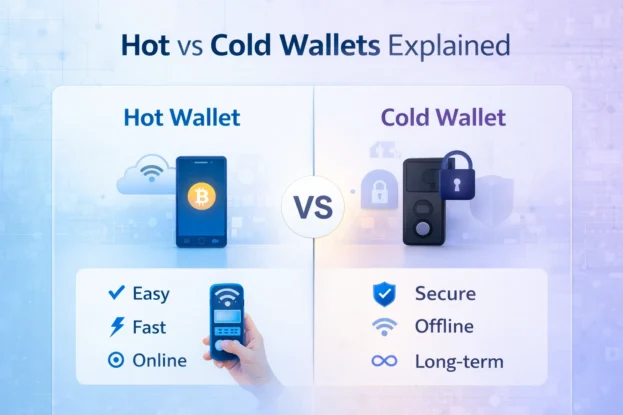
Before picking one, it helps to understand the two main wallet types. Each serves a different purpose depending on your experience and investment goals.
Hot Wallets
Hot wallets are connected to the internet and are usually mobile or desktop apps. They are easy to use and ideal for beginners making their first Bitcoin purchase.
Cold Wallets
Cold wallets are hardware devices that store crypto offline. They offer higher security and are better for long-term holders who want to protect larger investments.
Quick Comparison: All 7 Wallets at a Glance
| Wallet | Type | INR Support | Tax Help | Rating |
| CoinDCX | Hot/Custodial | ✅ UPI/NEFT | ✅ Auto TDS | ⭐⭐⭐⭐⭐ |
| Trust Wallet | Hot/Non-Custodial | ❌ No INR | ❌ Manual | ⭐⭐⭐⭐ |
| MetaMask | Hot/Non-Custodial | ❌ No INR | ❌ Manual | ⭐⭐⭐⭐ |
| Exodus | Hot/Non-Custodial | ❌ No INR | ❌ Manual | ⭐⭐⭐⭐ |
| Ledger Nano X | Cold/Hardware | ❌ No INR | ❌ Manual | ⭐⭐⭐⭐⭐ |
| Trezor Model T | Cold/Hardware | ❌ No INR | ❌ Manual | ⭐⭐⭐⭐⭐ |
| Zengo | Hot/Non-Custodial | ✅ UPI | ❌ Manual | ⭐⭐⭐⭐ |
Best Crypto Wallets to Buy Bitcoin Safely in India
1. CoinDCX — Best for Absolute Beginners in India
| CoinDCX | |
| Type | Custodial Hot Wallet + Exchange |
| Best For | Beginners who want INR on-ramp & auto tax compliance |
| INR Support | ✅ UPI, IMPS, NEFT/RTGS |
| Security | Multi-factor authentication, 95% cold storage |
| Our Rating | ⭐⭐⭐⭐⭐ (4.8/5) — Editor’s Pick for Beginners |
If you’re a first-timer in India, CoinDCX is probably your smoothest entry point. It’s basically the Zerodha of crypto — regulated, beginner-friendly, and built for the Indian market. You can deposit INR directly using UPI or NEFT and buy Bitcoin in minutes. The interface feels like a regular investment app, not some hacker’s terminal.
The India advantage: CoinDCX automatically deducts the 1% TDS on every transaction and generates tax reports. So you don’t have to do mental gymnastics come March 31st.
Also Read: Best Stocks to Buy This Month
The catch: It’s custodial — meaning CoinDCX holds your private keys. Think of it like keeping money in a bank. Convenient, yes. But if they get hacked (and it happened in July 2025 to the tune of ₹370 crore), your funds could be at risk. The takeaway? Buy here, but move your holdings to a self-custody wallet if you’re holding long-term.
- ✅ Direct INR deposit via UPI
- ✅ Auto TDS deduction — zero paperwork
- ✅ 500+ cryptocurrencies, including Bitcoin
- ✅ FIU-compliant and fully legal in India
- ❌ Custodial — you don’t control your private keys
2. Trust Wallet — Best Non-Custodial Wallet for DeFi Fans
| Trust Wallet | |
| Type | Non-Custodial Hot Wallet |
| Best For | DeFi users, NFT collectors, multi-chain holders |
| INR Support | ❌ No direct INR (use via exchange transfer) |
| Security | Non-custodial, self-custody of private keys |
| Our Rating | ⭐⭐⭐⭐ (4.5/5) |
Trust Wallet is the official wallet of Binance and has become one of the most downloaded crypto wallets in India — and for good reason. You control your private keys, there’s no KYC required, and it supports 70+ blockchains. That means Bitcoin, Ethereum, Solana, Polygon, and everything in between, all in one app.
The flow for Indian users is usually: buy Bitcoin on CoinDCX → transfer to Trust Wallet for safe self-custody. It’s a two-step process, but you’re now your own bank.
- ✅ Self-custody — you own your private keys
- ✅ 70+ blockchains, 10 million+ digital assets
- ✅ Built-in dApp browser for DeFi
- ✅ No KYC required to set up
- ❌ No direct INR/UPI support
- ❌ Tax reporting is entirely manual
3. MetaMask — Best for Ethereum & Web3 Explorers
| MetaMask | |
| Type | Non-Custodial Hot Wallet (Browser Extension + Mobile) |
| Best For | Web3 users, DeFi, NFT buyers on Ethereum |
| INR Support | ❌ No INR on-ramp natively |
| Security | Non-custodial; browser extension — vulnerable to phishing |
| Our Rating | ⭐⭐⭐⭐ (4.3/5) |
MetaMask is essentially the passport to Web3. Want to buy an NFT on OpenSea, use a DeFi protocol, or interact with any Ethereum-based app? MetaMask is your go-to. It’s a browser extension that plugs right into Chrome or Brave, and a mobile app for when you’re on the move.
Real talk on security: MetaMask wallets have been targeted frequently by hackers — mostly through phishing sites and malicious browser extensions. The wallet itself is secure; the weakest link is always the user. So if you use MetaMask, be obsessively careful about which sites you connect it to. Think of it like your credit card — great tool, terrible idea to use on every random website.
- ✅ Gateway to the entire Ethereum/Web3 ecosystem
- ✅ Easy to set up — works in 5 minutes
- ✅ Supports Ethereum, Polygon, Solana, and more
- ❌ Frequent phishing target — use with caution
- ❌ Best for small balances only
4. Exodus — Best for Desktop Users Who Want an All-in-One Experience
| Exodus | |
| Type | Non-Custodial Hot Wallet (Desktop + Mobile) |
| Best For | Desktop-first users, multi-chain holders, stakers |
| INR Support | ❌ No INR support (third-party fiat options exist) |
| Security | Non-custodial; pairs with Trezor for extra security |
| Our Rating | ⭐⭐⭐⭐ (4.4/5) |
If MetaMask is the pocket knife of crypto wallets, Exodus is the Swiss Army version. It supports 260+ coins across 50+ blockchains, lets you stake directly in-app, and has one of the most beautiful interfaces in the industry. Seriously, it looks like an app designed by someone who cares deeply about aesthetics — rare in the crypto world.
For Indian users, Exodus works best as a portfolio tracker and storage wallet — you’d buy Bitcoin on CoinDCX and transfer it here for safekeeping. It also pairs with Trezor hardware wallets for an added layer of cold security.
- ✅ Supports 260+ coins, including Bitcoin
- ✅ Built-in staking and swap features
- ✅ Pairs with Trezor for cold storage
- ✅ Stunning interface across mobile and desktop
- ❌ No INR/UPI support
- ❌ Not ideal as a buying platform for Indian users
5. Ledger Nano X — Best Hardware Wallet for Serious HODLers
| Ledger Nano X | |
| Type | Cold Hardware Wallet |
| Best For | Long-term Bitcoin holders with ₹50,000+ in crypto |
| INR Support | ❌ No INR (buy on exchange, transfer to Ledger) |
| Security | EAL5+ certified secure element, fully offline |
| Our Rating | ⭐⭐⭐⭐⭐ (4.9/5) — Best for Long-Term Security |
Here’s a phrase you’ll hear every serious crypto person say: “Not your keys, not your coins.” The Ledger Nano X is the hardware wallet that makes this real. It’s a physical device — looks like a USB drive — that keeps your private keys completely offline. Hackers can’t touch what isn’t on the internet.
The Ledger Nano X supports over 5,500 cryptocurrencies, including Bitcoin, and pairs with the Ledger Live app for managing your portfolio. It’s Bluetooth-enabled, so you can manage it from your phone without plugging it in every time. For anyone holding a serious amount of Bitcoin — say, more than ₹50,000 — this is non-negotiable.
- ✅ Completely offline — immune to online hacks
- ✅ Supports 5,500+ cryptos, including Bitcoin
- ✅ EAL5+ certified military-grade security chip
- ✅ Bluetooth-enabled for mobile use
- ❌ Costs ₹12,000–₹15,000 (investment in security)
- ❌ No INR on-ramp — must transfer from exchange
6. Trezor Model T — Best Open-Source Hardware Wallet
| Trezor Model T | |
| Type | Cold Hardware Wallet |
| Best For | Privacy-focused users, open-source advocates |
| INR Support | ❌ No INR (transfer from exchange) |
| Security | Open-source firmware, air-gapped capable, EAL5+ |
| Our Rating | ⭐⭐⭐⭐⭐ (4.8/5) |
Trezor and Ledger are the two godfathers of hardware wallets, and choosing between them is like choosing between iPhone and Android — both are excellent, and the ‘right’ one depends on your priorities.
Trezor’s edge: Its firmware is fully open-source. That means thousands of security researchers around the world can inspect the code for vulnerabilities. There are no secrets. For the privacy-obsessed, this transparency is a massive selling point.
The Model T has a colour touchscreen, supports 1,000+ assets including Bitcoin, and can be used with Trezor Suite — a clean desktop app for managing your portfolio. It’s a bit pricier than the basic Model One, but the touchscreen and broader coin support make it worth it.
- ✅ Fully open-source — maximum transparency
- ✅ Touchscreen interface — easier to navigate
- ✅ 1,000+ coins supported
- ✅ Pairs with third-party wallets like Exodus
- ❌ Higher price point than entry-level options
- ❌ No INR support — transfer from exchange
7. Zengo — Best Seedless Wallet with UPI Support
| Zengo | |
| Type | Non-Custodial Hot Wallet (MPC Technology) |
| Best For | Users who want security without seed phrases |
| INR Support | ✅ UPI supported for INR purchases |
| Security | MPC technology — no seed phrase vulnerability |
| Our Rating | ⭐⭐⭐⭐ (4.4/5) |
Zengo is the wallet for people who’ve heard horror stories about someone losing ₹20 lakh because they forgot to write down their seed phrase. It eliminates seed phrases using something called MPC — Multi-Party Computation — which splits your private key across multiple secure servers. No seed phrase = no seed phrase disaster.
What makes Zengo genuinely exciting for Indian users is its UPI support for INR purchases. You can buy Bitcoin directly inside the app using UPI — a rarity among non-custodial wallets. It’s also one of the few wallets experimenting with biometric recovery (3D facial scan), making it feel like something out of a spy thriller.
- ✅ No seed phrase — no single point of failure
- ✅ UPI support for direct INR crypto purchases
- ✅ 3D FaceLock biometric recovery
- ✅ Staking, NFT support, dApp access
- ❌ Mobile-only — no desktop app
- ❌ Premium features require a Zengo Pro subscription (₹1,700/month)
How to Choose the Right Wallet for You
Not sure which one to pick? Here’s a simple decision framework:
| Your Situation | Go With |
| Complete beginner, want INR support | CoinDCX |
| Beginner who also wants self-custody | CoinDCX to buy + Trust Wallet to store |
| Into DeFi and Ethereum apps | MetaMask |
| Want an all-in-one desktop experience | Exodus |
| Holding ₹50,000+ long-term | Ledger Nano X or Trezor Model T |
| Hate the idea of a seed phrase | Zengo |
| Want UPI + self-custody in one app | Zengo |
Is Crypto Legal in India? What You Need to Know
The short answer: Yes, absolutely. As of 2025, buying, holding, and trading cryptocurrency is completely legal in India. What’s not legal is using it to pay for your chai or auto rickshaw ride — it isn’t recognized as legal tender.
Here’s what the tax situation looks like for Indian crypto investors:
- 30% flat tax on all crypto profits — no deductions, no slab benefits
- 1% TDS is deducted on every sell/swap, even if you make a loss
- KYC is mandatory for all Indian exchanges
- Wallets are legal — hot and cold — no restrictions
Pro tip: Wallets like CoinDCX handle TDS automatically. If you’re using non-custodial wallets for DeFi, keep a manual record or use a crypto tax tool like KoinX or ClearTax Crypto.
5 Golden Rules for Keeping Your Bitcoin Safe in India
- Never share your seed phrase — not with family, not with ‘Binance support’, not with anyone. Ever.
- Buy on a regulated Indian exchange — CoinDCX, ZebPay for INR on-ramps. Avoid unverified P2P platforms.
- Move large amounts to cold storage — if you’re holding more than ₹50,000 in crypto, a Ledger or Trezor is worth every rupee.
- Use 2FA everywhere — Google Authenticator, not SMS OTP (SIM swaps are real).
- Double-check wallet addresses — always verify the first and last 4 characters before sending. Clipboard malware is a thing.
Also Read: Should You Invest in Crypto During War? Opportunities and Risks You Must Know
Frequently Asked Questions (FAQs)
Which is the safest crypto wallet in India?
For long-term holders, hardware wallets like Ledger Nano X or Trezor Model T are the safest — your keys stay offline. For daily use, Trust Wallet and Zengo offer strong non-custodial security without the hardware cost.
Can I buy Bitcoin directly with UPI in India?
Yes! CoinDCX and Zengo both support UPI for direct INR deposits. CoinDCX is the easier option for beginners, while Zengo offers a self-custodial experience alongside UPI support.
What is the difference between a hot wallet and cold wallet?
A hot wallet is connected to the internet (like CoinDCX, Trust Wallet, MetaMask) — great for convenience, but more vulnerable to hacks. A cold wallet (like Ledger or Trezor) is offline — maximum security for long-term storage. Use both: hot for everyday use, cold for serious holdings.
Do I need to pay tax on crypto in India?
Yes. All crypto profits are taxed at a flat 30%, and there’s a 1% TDS on every sale or swap. Indian exchanges like CoinDCX handle TDS automatically. For DeFi or foreign exchange transactions, you’ll need to track and report manually.
Is it safe to keep Bitcoin on an exchange in India?
Short term — fine. Long-term — risky. Exchanges like WazirX ($230M hack in 2024) and CoinDCX ($44M hack in 2025) have both been targeted. Keeping large amounts on an exchange is like leaving cash on the counter. Buy on an exchange, store in a wallet you control.
What is a seed phrase, and why does it matter?
A seed phrase is a set of 12–24 words that is the master key to your crypto wallet. Lose it, and your funds are gone forever. No bank can help you. No customer support can recover it. Write it on paper, store it somewhere safe, and never share it with anyone — ever.
Final Thoughts: The Right Wallet Changes Everything
Look, buying Bitcoin in India has never been easier. The infrastructure is here, the regulations are clearer than ever, and India is literally ranked #1 globally in crypto adoption. The only thing between you and your first Bitcoin is picking the right wallet.
Here’s my honest recommendation based on where most Indian beginners start:
- Step 1: Sign up on CoinDCX, do your KYC, deposit ₹1,000 via UPI, buy Bitcoin.
- Step 2: Download Trust Wallet or Zengo, transfer your Bitcoin there for self-custody.
- Step 3: Once you’ve accumulated meaningful holdings, get a Ledger Nano X. Seriously.
That’s it. Three steps. You’re no longer just reading about crypto — you’re in it.
Disclaimer: This blog is for educational purposes only and does not constitute financial advice. Crypto investments are subject to market risk. Please do your own research (DYOR) before investing.