


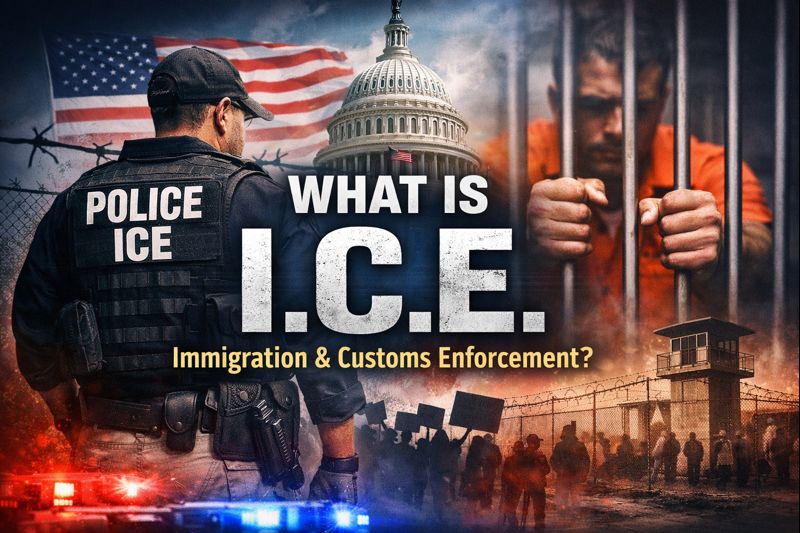
ICE is a term that often appears in global news, protests, and political debates. But what exactly is ICE, and why is it so controversial in recent years?
This article clearly explains what ICE is, what it does, how it started, how it works, and why it has become a major topic of debate in 2026.
Table of Contents
What Does ICE Stand For?
ICE stands for U.S. Immigration and Customs Enforcement.

It is a federal law enforcement agency of the United States that works under the Department of Homeland Security (DHS).
ICE is mainly responsible for:
- Enforcing immigration laws inside the U.S.
- Detaining and deporting undocumented immigrants
- Investigating crimes related to immigration, smuggling, and trafficking
When and Why Was ICE Created?
ICE was created in 2003, shortly after the 9/11 terrorist attacks, as part of the Homeland Security Act.
Before ICE existed:
- Immigration enforcement was handled by older agencies like INS (Immigration and Naturalization Service)
- Customs enforcement was handled separately
The U.S. government merged parts of these agencies to create ICE, with the goal of:
- Improving national security
- Strengthening border and immigration enforcement
- Investigating cross-border crimes
Main Departments Inside ICE
ICE operates through two major divisions, each with a different role.
1. Enforcement and Removal Operations (ERO)
This is the part of ICE most people are familiar with.
ERO handles:
- Arrests of undocumented immigrants
- Detention in ICE facilities
- Deportations from the U.S.
If someone hears about ICE raids or ICE arrests, it usually involves ERO.
2. Homeland Security Investigations (HSI)
HSI focuses on serious crimes, such as:
- Human trafficking
- Drug smuggling
- Child exploitation
- Financial crimes
- Document fraud
HSI often works with other law enforcement agencies, both inside and outside the U.S.
Why ICE Became More Powerful in 2026
ICE has gained extra attention and power in early 2026 due to policy changes under Donald Trump’s second presidential term.

Also Read: Cases Registered Against Donald Trump Before Presidency Rule
According to reports from BBC, NDTV, and The New York Times, the administration has made ICE central to its immigration strategy.
Key changes include:
- Massive budget expansion
ICE’s total funding is reported to exceed $100 billion through 2029. - More arrests
ICE aims to conduct up to 3,000 arrests per day, targeting undocumented immigrants across major U.S. cities. - Expanded detention capacity
ICE has purchased large warehouses and converted them into “mega detention centers.”
Some facilities are designed to hold 8,000+ detainees at once, pushing total detention beds beyond 100,000. - Increased surveillance
ICE now reportedly works with private firms for:- Social media monitoring
- Facial recognition technology
- Targeting court check-ins
Individuals attending immigration hearings or routine check-ins are being detained.
These measures are aimed at increasing deportations to over one million per year, according to media reports.
Why ICE Is So Controversial
ICE’s expanded role has triggered strong criticism from activists, legal experts, and human rights groups.
Major criticisms include:
- Deaths in custody
Reports indicate 30+ deaths in 2025 and several more in 2026, often linked to poor medical care in detention centers. - Use of masks and unmarked operations
ICE agents have been criticized for conducting arrests while masked, leading critics to describe the agency as operating like a “secret police force.” - Warrant concerns
Legal experts argue that ICE sometimes relies on administrative warrants, not court-approved judicial warrants, raising constitutional concerns. - Detention conditions
Some facilities have reported:- Overcrowding
- Disease outbreaks (including measles)
- Lack of medical staff
Protests Against ICE in 2026
Public anger has led to widespread demonstrations.
One major example is the Anti-ICE Strike held on January 30–31, 2026, where protesters called for:
- No work
- No school
- No shopping
The protest aimed to pressure the government to:
- Reduce ICE’s powers
- Improve detention conditions
- Abolish ICE entirely
Supporters’ View of ICE
Supporters argue that ICE is:
- Enforcing existing U.S. laws
- Protecting national security
- Delivering on election promises related to border control
They believe strong immigration enforcement is necessary to:
- Prevent illegal entry
- Reduce crime
- Maintain legal order
Is ICE the Same as Border Patrol?
No. ICE and Border Patrol are different agencies.
- Border Patrol works mainly at borders and ports of entry.
- ICE works inside the U.S., focusing on enforcement, detention, and deportation.
Both agencies operate under DHS but have separate responsibilities.
Final Thoughts about ICE
ICE is one of the most powerful and controversial law enforcement agencies in the United States today.
- It was created for security and immigration enforcement
- Its powers have expanded significantly in 2026
- Supporters see it as law enforcement doing its job
- Critics see it as a system that threatens civil rights and human dignity
Understanding ICE is important because its actions affect millions of lives, shape immigration policy, and continue to influence global discussions on human rights and law enforcement.
For the latest updates, always rely on verified sources like BBC, NDTV, The New York Times, and official government statements.